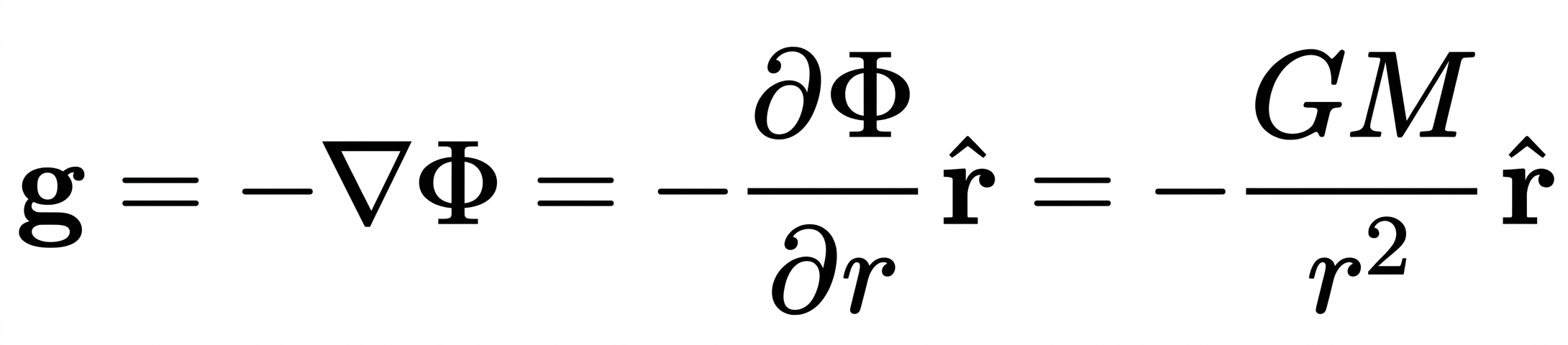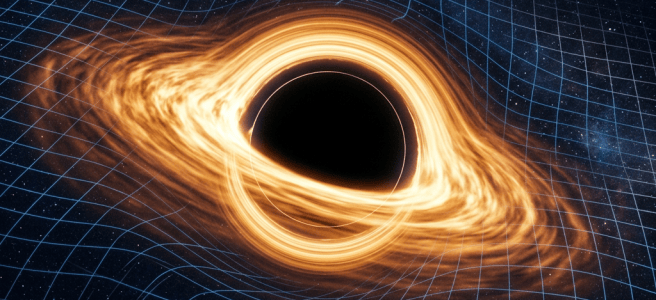
I find the Schwarzschild metric, written as

to be one of the most beautiful, profound and terrifying equations ever discovered. It tells us how time slows down and how space elongates for those in the presence of a gravitational field, while embedding within it the previous discoveries of how time slows down and space contracts for observers moving at high speeds. And, most terrifying of all, it predicts the existence of world-destroying black holes and other phenomena that are truly mind bending. My goal in this post is to derive the Schwarzschild metric from the Minkowski metric for flat space, which we already derived in the earlier post https://mathintuitions.com/2025/01/23/the-lorentz-factor-and-the-invariance-of-relativity/ and has the form of:

If we use spherical coordinates (for more on these coordinates visit https://mathintuitions.com/2023/08/09/its-all-relative-a-different-visualization-for-the-warping-of-space-time-in-general-relativity/) instead of the Cartesian coordinates, we get:

which is still the metric for flat space.
But what if a gravitational mass distorts space-time, where time and space may be different compared to the flat spacetime metric given above?
We will first propose the most general metric possible given 4 basis vectors (time and the 3 dimensional basis vectors):
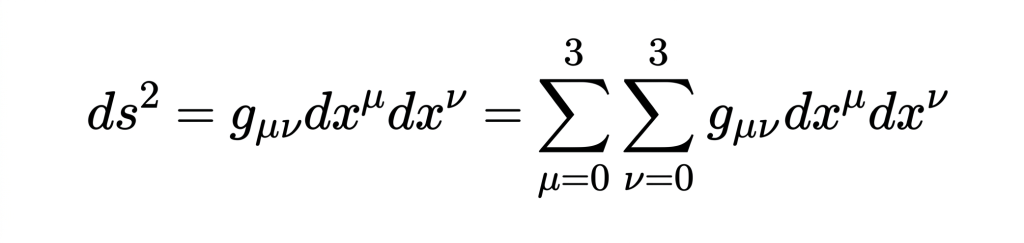
and expanding we would get:
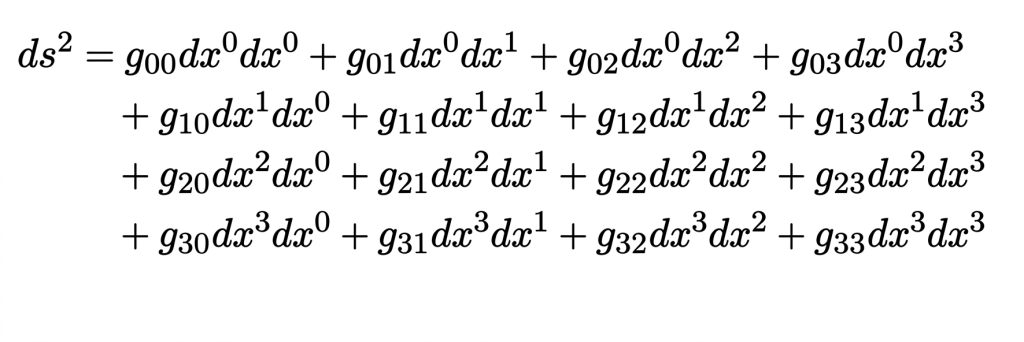
Using spherical coordinates for space, the above becomes:
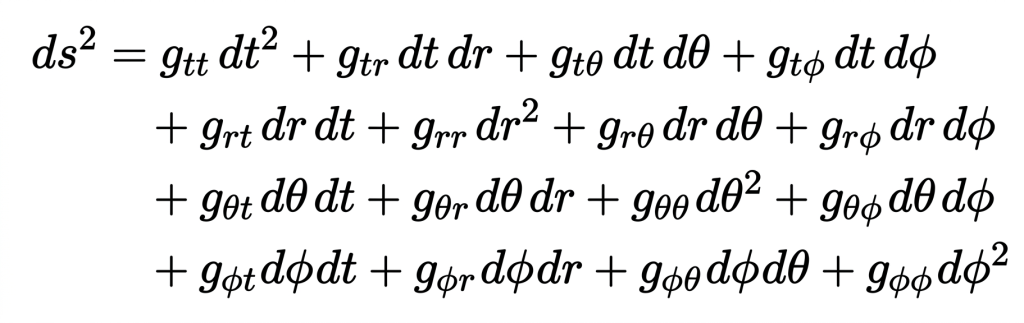
which in flat space gives only 4 nonzero metric terms of gtt, grr, gθθ, and gΦΦ
In building a different metric for a space-time in which a gravitational mass creates a different flow of time and space due to curvature, we start off with the admission that although we don’t know what this looks like exactly, we can still impose 2 major assumptions, each of which is addressed below (1- Spherical Symmetry, 2- Time Symmetry):
- Spherical Symmetry
What does spherical symmetry mean? It means that if you travel + or – by the same angle given a fixed r, the distance traveled will be the same. This is the arc length formula that says for fixed r, your distance traveled is r times absolute value of theta, giving you the same distance for plus and minus angles. It also means that whatever measurements we are taking, they will be equivalent no matter the angle we are taking them at; all that actually will matter is the radial distance from a gravitational mass.
This means that the metric term dgθΦ must be zero, because if we travel + or – by the same angle, the metric must result in the same distance. The following shows why the metric with respect to θ or Φ must be 0 when we have equations where dθ must equal -dθ or dΦ must equal -dΦ (we will only reflect one angle at a time in the equation below).

Essentially any terms in the metric involving dθ or dΦ (even gtθ or gtΦ) must vanish because if you give +dθ it’s the same result as going -dθ and the only way thats possible is for the metric to be 0 so any first order terms containing dθ and dΦ must have the metric go to zero.
Moreover, spherical symmetry means that none of the metric coefficients multiplying dt or dr themselves can depend on Φ or θ because, if they did, it would violate spherical symmetry by changing the value of ds² depending on your angle of measurement.
2. That the metric is symmetric with respect to time: any metric terms involving the time basis vector must be zero (traveling + or – t must give the same ds invariant, and no metric coefficient can contain a t term, which would mean ds would change depending on what time it is). Note that terms containing t combined with θ or Φ also go to 0 because of spherical symmetry as well:
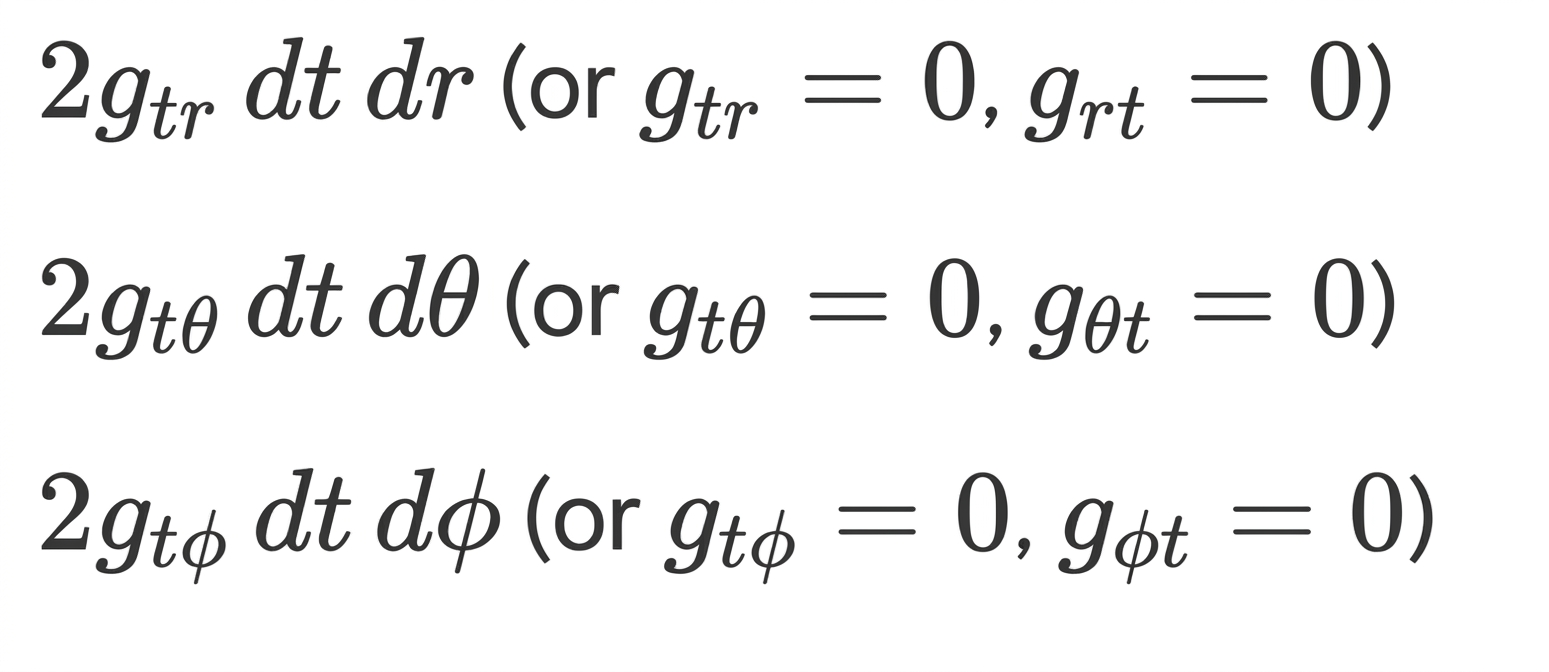
Therefore, our general metric has become:

since A and B can no longer depend on time or angles- they must be functions of r, and to preserve spherical symmetry we must have the last term as it is.
However, by “forcing” the last term to conform to spherical symmetry, we have defined r to be the areal radius. If we have a giant circus tent propped up with a central pole, and decide to walk in a circle around it at some constant elevation, we would measure the areal radius to be the flat projection of the radius of that circle in order to ensure spherical symmetry. However, the true distance from the origin (which is measured from the top of the tent pole to any point on the tent) is no longer equivalent to the areal radius r, due to the curvature of the tent surface itself:
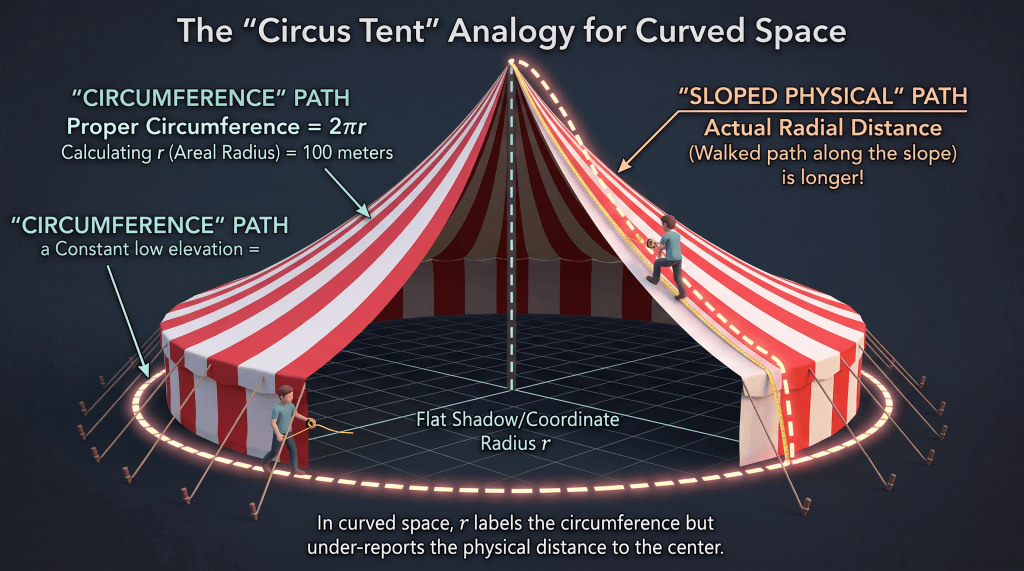
This means that anywhere that “r” or “dr” appear in the Schwarzschild metric, it is referring to the areal radius. Note that in the flat Minkowski metric, the areal radius of r and dr are equivalent to the actual physical distance (or “proper”) distance from the origin, since the Minkowski metric coefficient in front of dr is 1, which means for 1 unit of dr , ds (proper distance) is also one.
And now we can add another assumption: that A(r) and B(r) must go to 1 as r, the flat-space projection of the distance from a gravitational mass, goes to infinity, in order to recover the Minkowski metric for flat space.
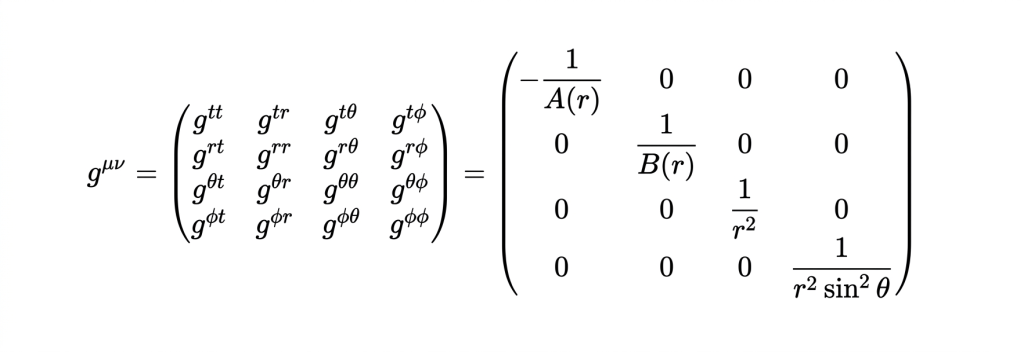
Now we can use the above metric coefficients to fill in the metric matrix
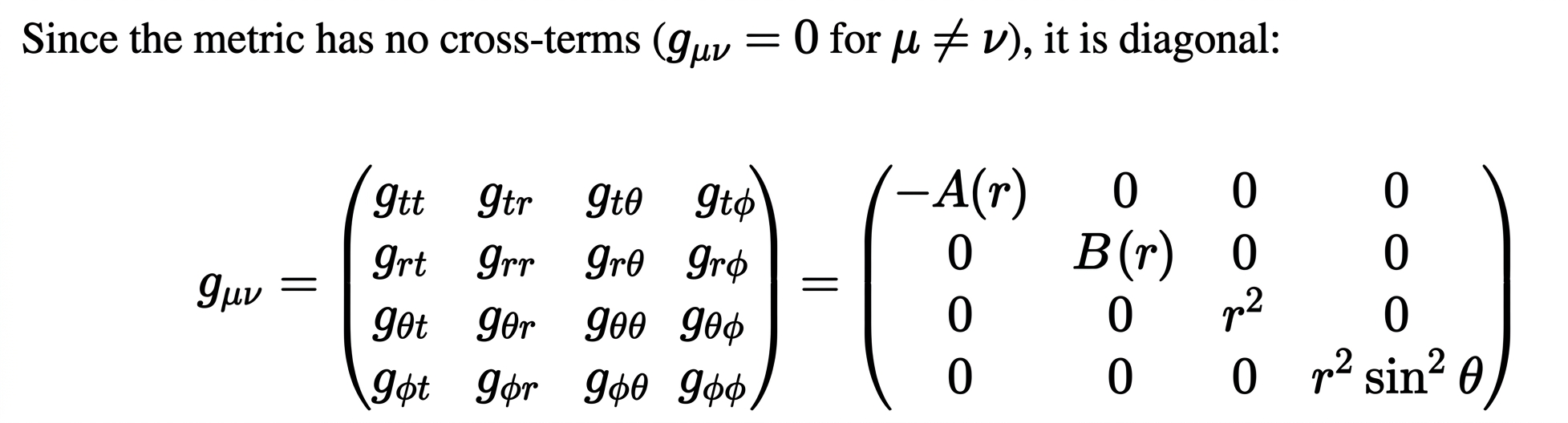
and its inverse (which when multiplied by the metric above produces the identity matrix of all 1’s in the diagonal):
So how do we go about solving for A(r) and B(r) at areal radii other than infinity?
Our plan will be to use the Ricci tensor which must be zero in empty space and is written in terms of the Christoffel symbols, and since we can solve the Christoffel symbols in terms of the metric coefficients, there may be a way to eventually solve for these metric coefficients inside the Ricci tensor (see the #appendix3 for why the Ricci tensor is 0 in empty space).
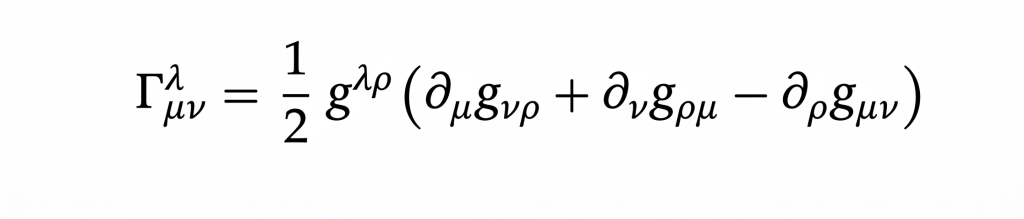
Let’s start by solving for the Christoffel symbols in terms of the metric, and then plug these into the Ricci tensor: (see the #appendix1 for the derivation of the Christoffel symbol in terms of the metric). Luckily, we will only need the easily calculable derivatives of the original metric and not of the inverse metric:
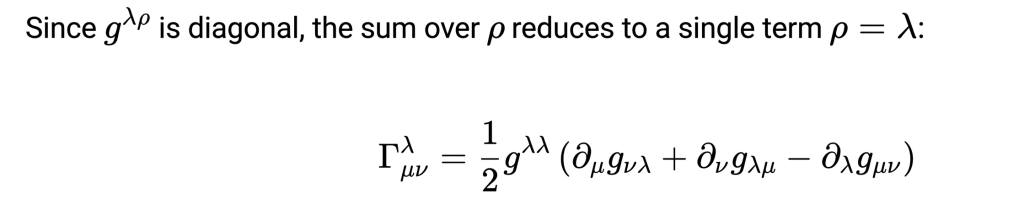
Now we solve for different values of lambda! Solving for each value is like a fun logic puzzle, and I will present the Christoffel symbol for each value followed by the logic needed to solve it, followed by the actual solutions.
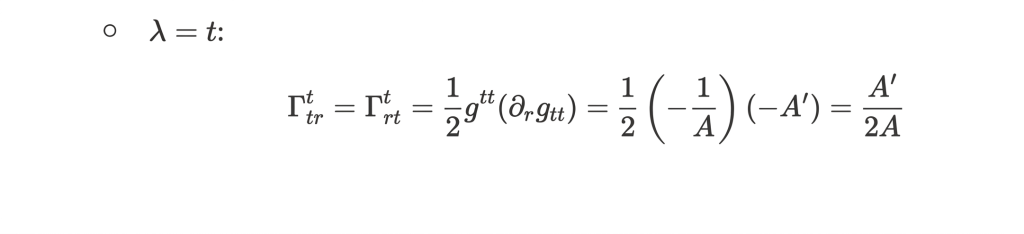
Let’s take the case where lambda is t:
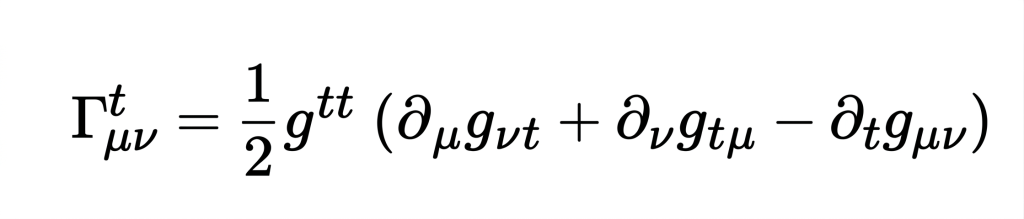
Here is the logic to solving:
1, The last term inside the metric drops out because of time symmetry.
2. Additionally, the only way for the first two terms inside the metric to be non zero is if v= t or u=t since only diagonal metric terms are non-zero.
3. Finally, the first two terms in the parentheses with partial derivatives in term of du and dv must be taken in terms of dr, since gtt does not change with respect to dt, dθ, an dr.
So imposing these conditions where if u is t then v must be r or if v is t then u must be r we get:
Now let’s find out when lambda is r:
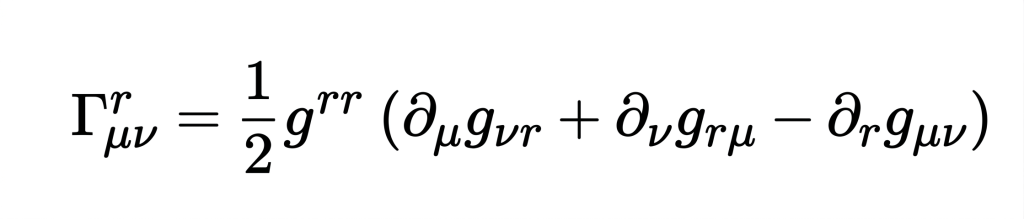
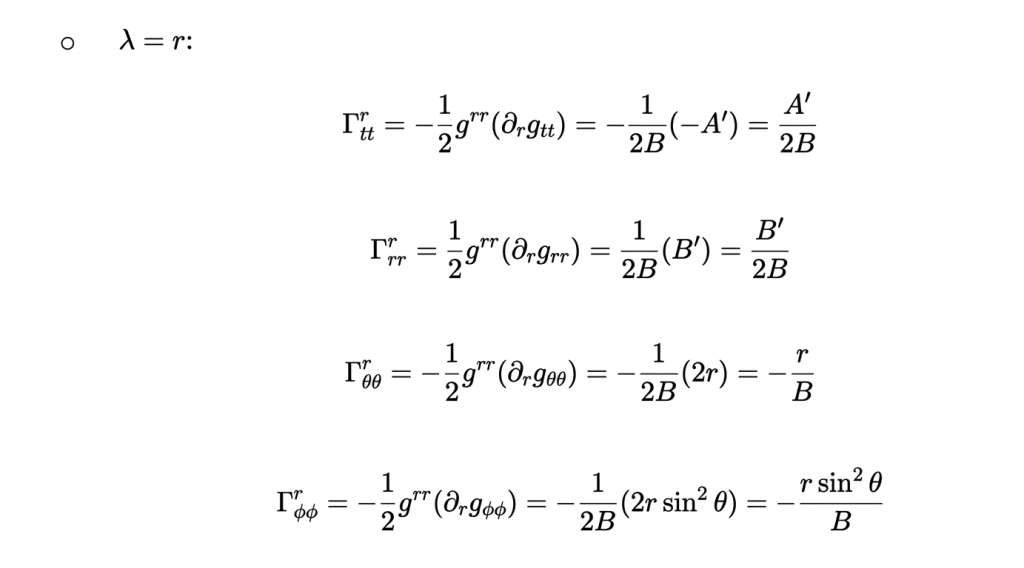
- The first two metric terms inside the parentheses can only be non-zero if v=r and u=r. The final metric term is non zero if u=v=t, u=v=r, u=v= θ, or u=v=∅
2. If u and v are both t, the first two terms inside the parentheses drop out b/c the metric is time symmetric and we are left with just the final term inside the parentheses.
3. If u and v are both r, you get three identical terms inside the parentheses so you are left with just one positive one.
4. If u and v are both θ, the first two terms inside the parentheses drop out, leaving only the third term.
5. If u and v are both ∅, the first two terms inside the drop out, leaving only the third term inside the parentheses.
Imposing these conditions we get:
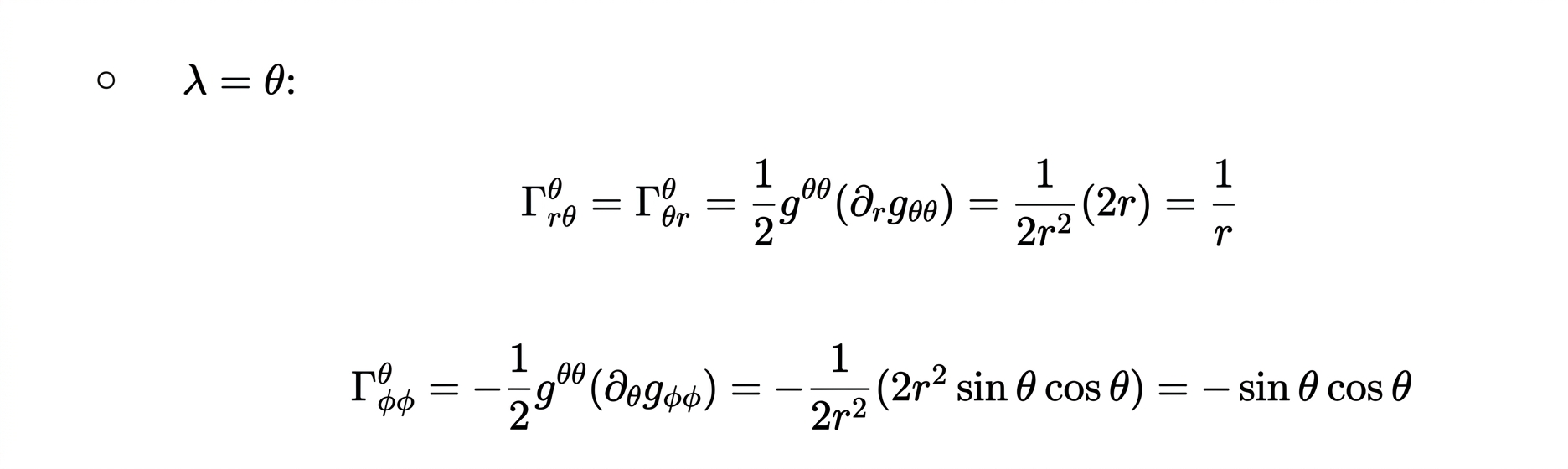
Now let’s solve for when lambda is θ:
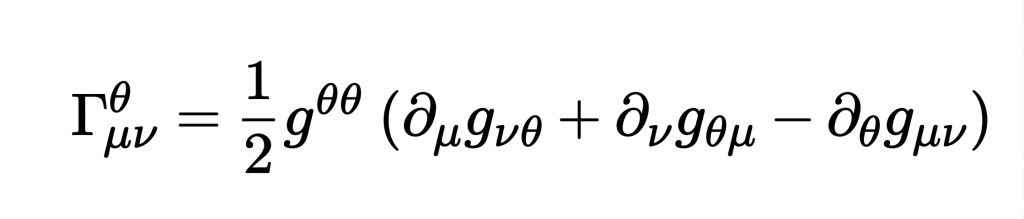
The last term in the parentheses can only be non-zero when u=v=∅ (note that these are only the components of the metric tensor whose derivative we are taking, while the covariant derivative of all the metric components must be 0- see #appendix1).
The only way for either of the first two terms to be non zero is if v=θ or u=θ so we have the following Christoffel symbols::
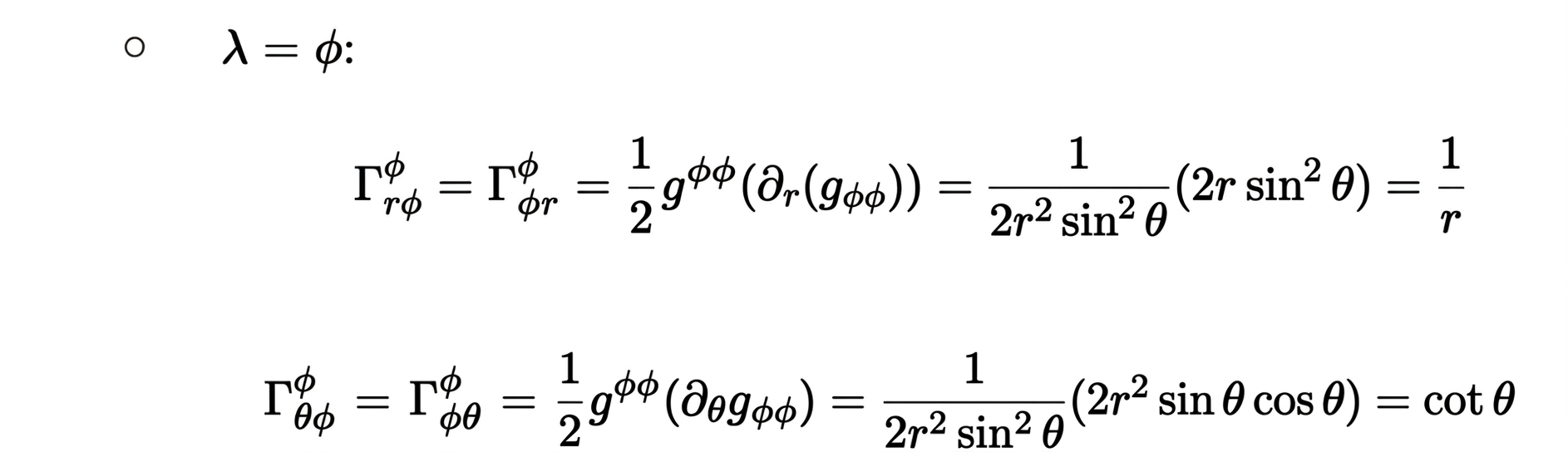
Now let’s take the final case where lambda is equal to ∅:
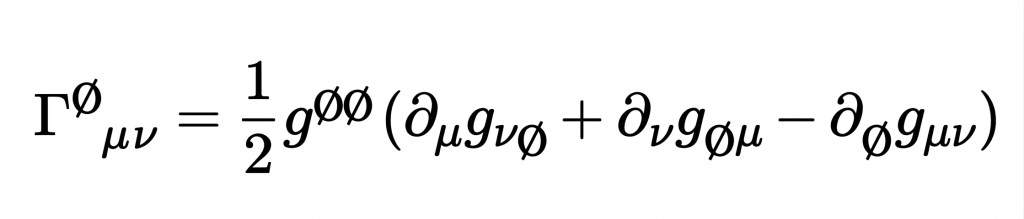
The third term in the parentheses is always 0 because of spherical symmetry (it can change with respect to θ, our latitudinal angle due to our spherical coordinates, but doesn’t change with respect to ∅, our longitudinal angle). For more on these spherical coordinates visit https://mathintuitions.com/2023/08/09/its-all-relative-a-different-visualization-for-the-warping-of-space-time-in-general-relativity/
The only way for the first two terms in the parentheses to be non zero is if v or u=∅ while u or v=r or
if v or u= ∅ while u or v=θ
The next step is to plug these values of the Christoffel symbols into the Ricci Tensor, which we know to equal 0 in empty space. The Ricci Tensor is defined by a contraction of the Riemann Tensor:
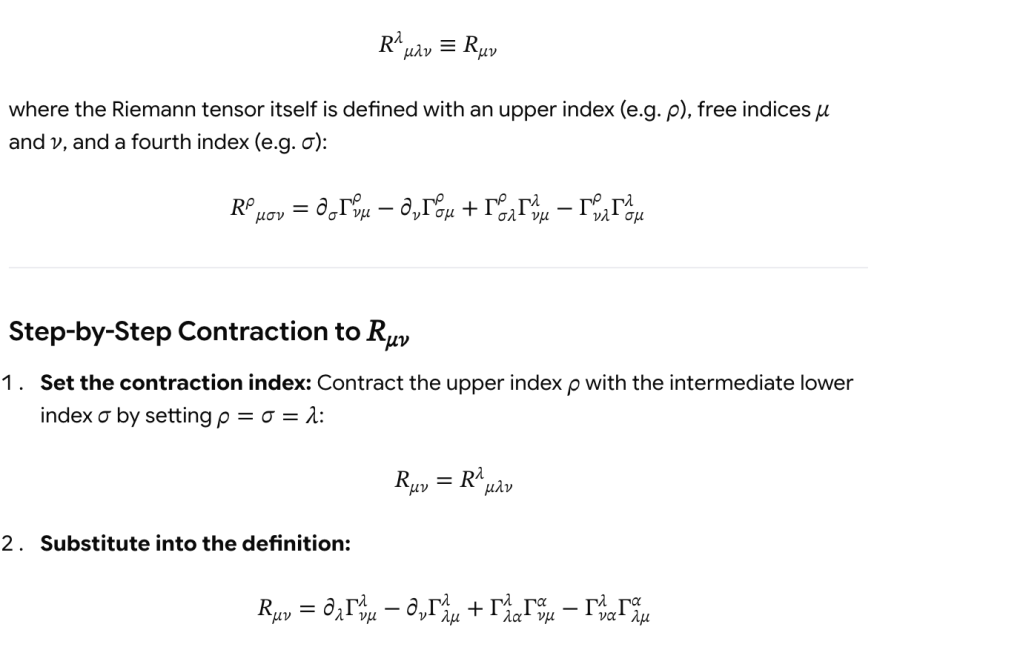
The next step is to plug the values of the Christoffel symbols into the Ricci Tensor. We actually only need to solve for Rtt and Rrr to help us narrow down the metric coefficients for the Schwarzschild metric:
Let’s deal with Rtt first, which equals:

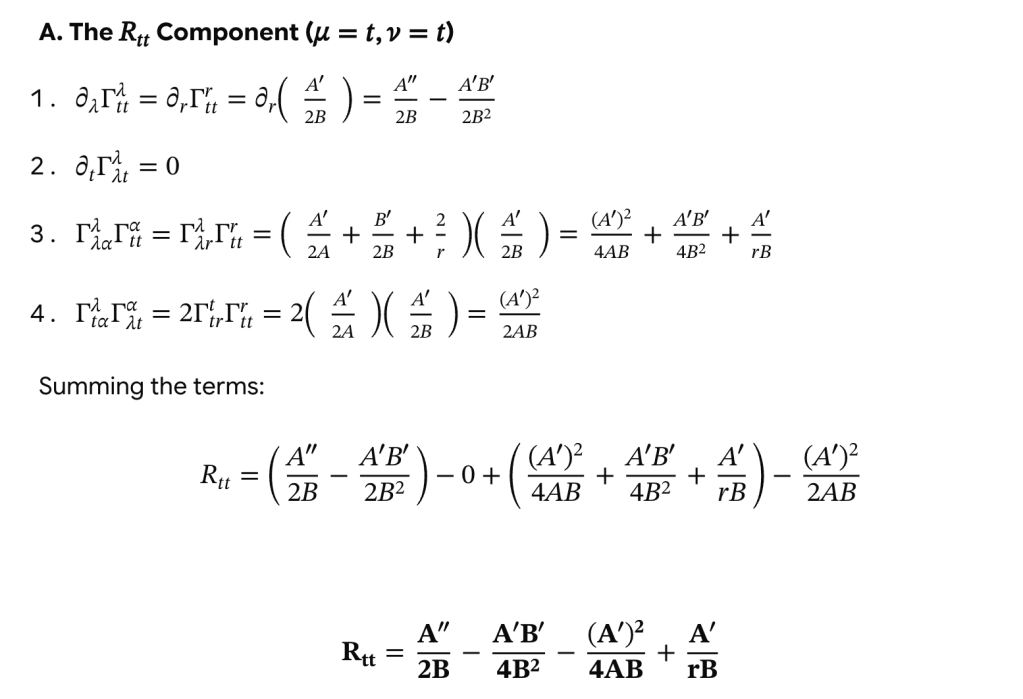
Now let’s solve for Rrr, which equals:

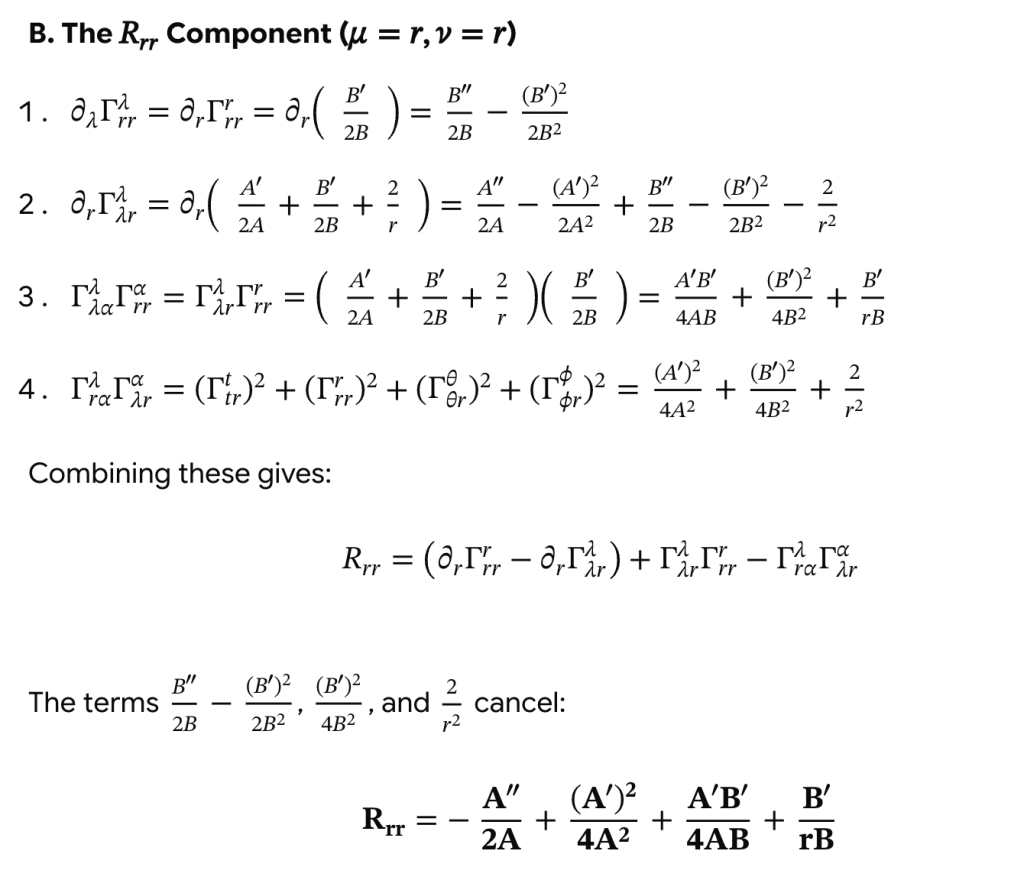
Now with the knowledge of what Rrr and Rtt equal in terms of the general Schwarzschild metric, we can begin to solve for the general coefficients. We know that both Rrr and Rtt equal zero, so we can construct the following argument: Note the clever placement of the A and B coefficients in the denominators in order to help cancel terms;
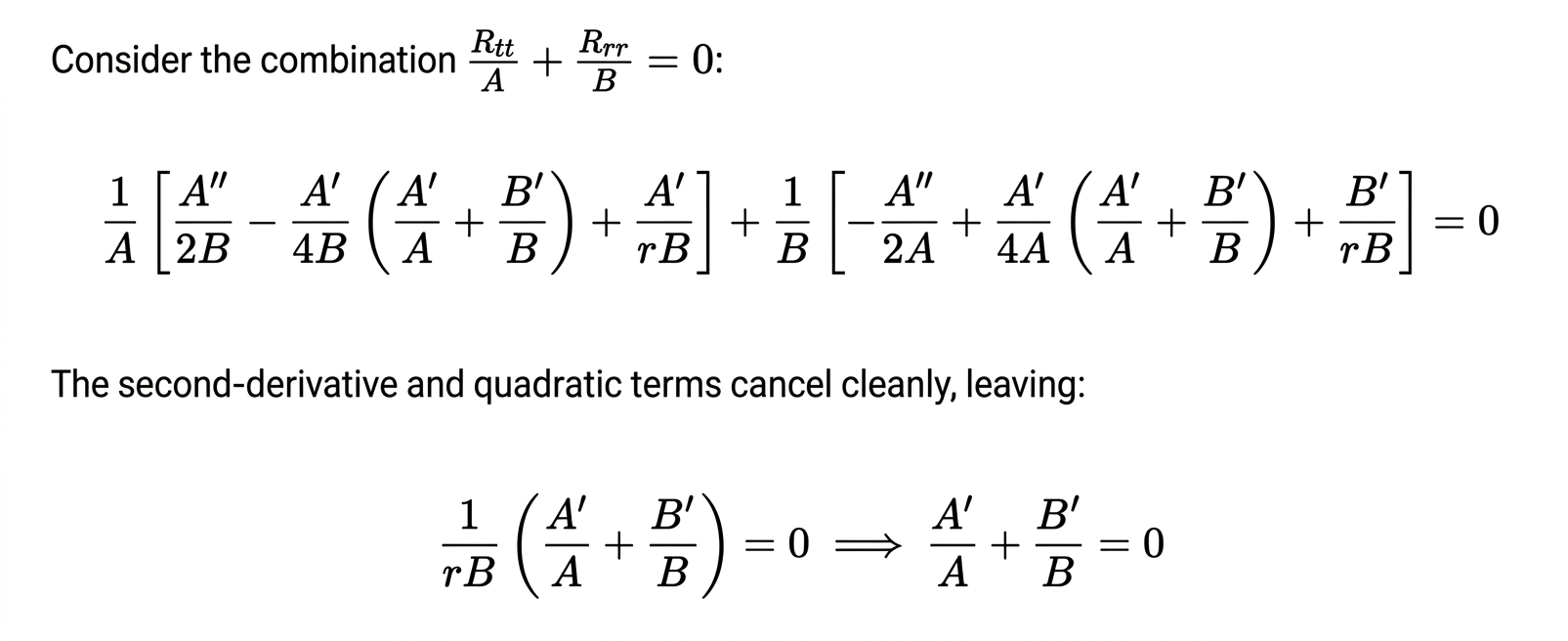
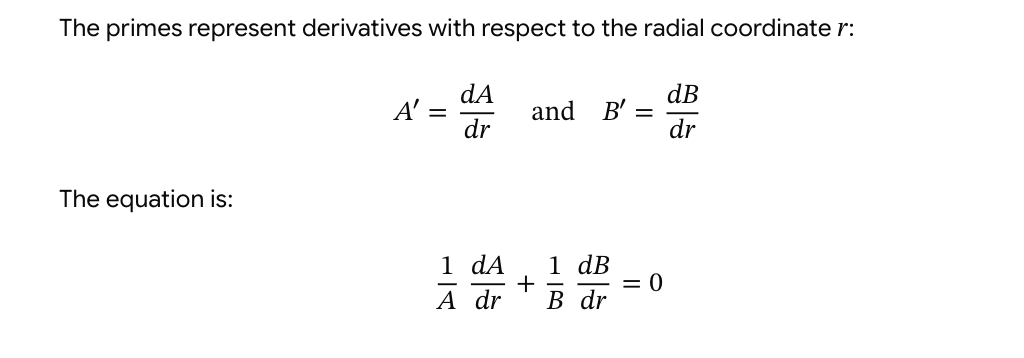
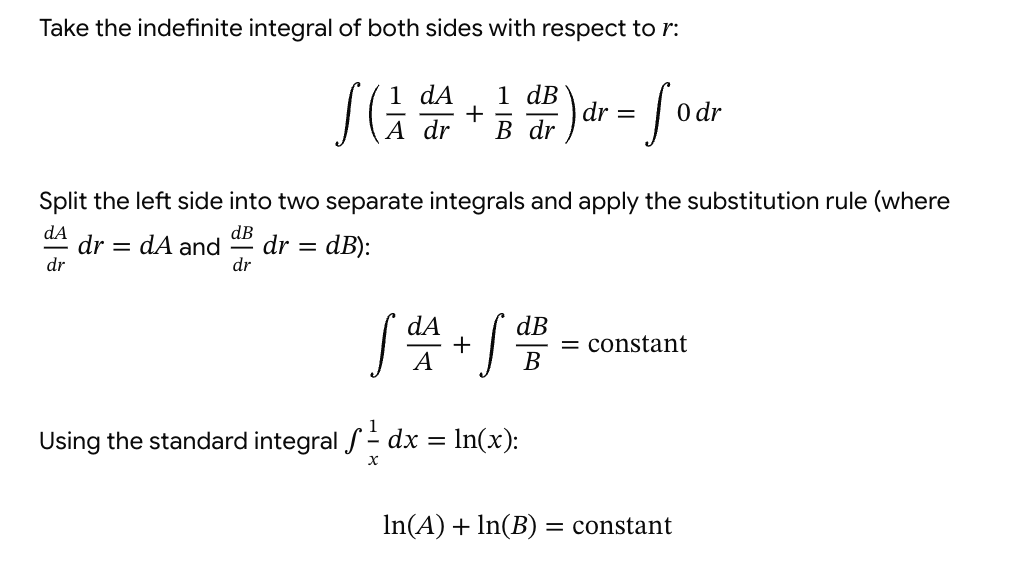
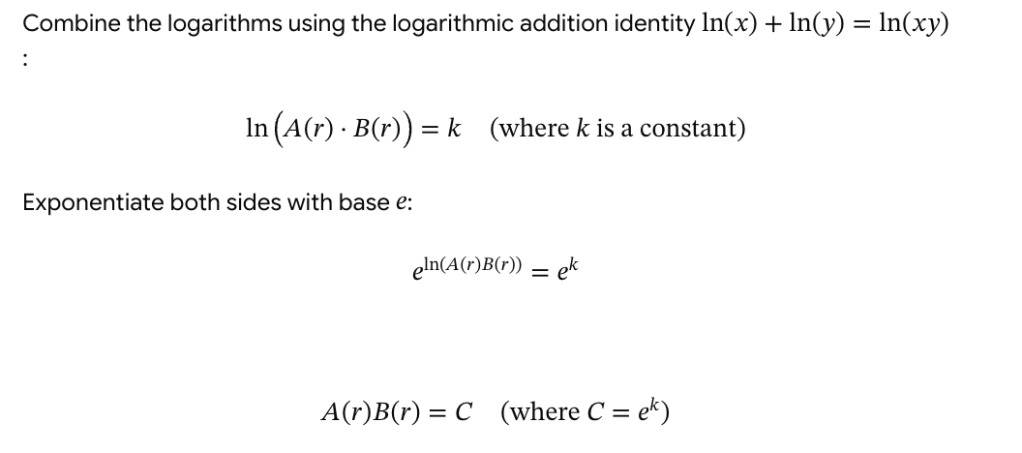
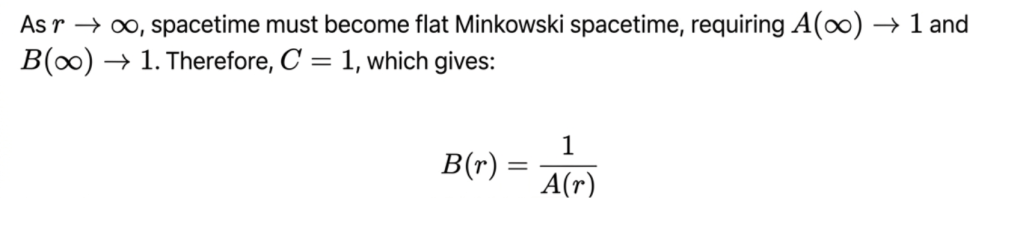
The above is true because as a constant, C must be a constant at all values, such that it is the same whether or not r approaches infinity (and we luckily know the value when r approaches infinity!).
So after all this our Schwarzschild metric becomes:

That was a lot of work just to get the second coefficient to be in terms of the first. Now we have to solve for A(r), which we can do by firstly using the Ricci Tensor with respect to time and plugging in B in terms of A, and then using the weak-field Newtonian limit (see #appendix4 for derivation) to solve.
First we return to Rtt:
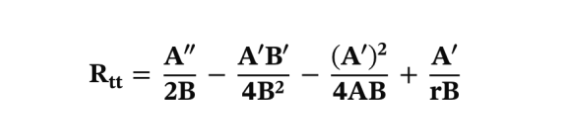
If we factor out an A’/4B for the two middle terms we get:
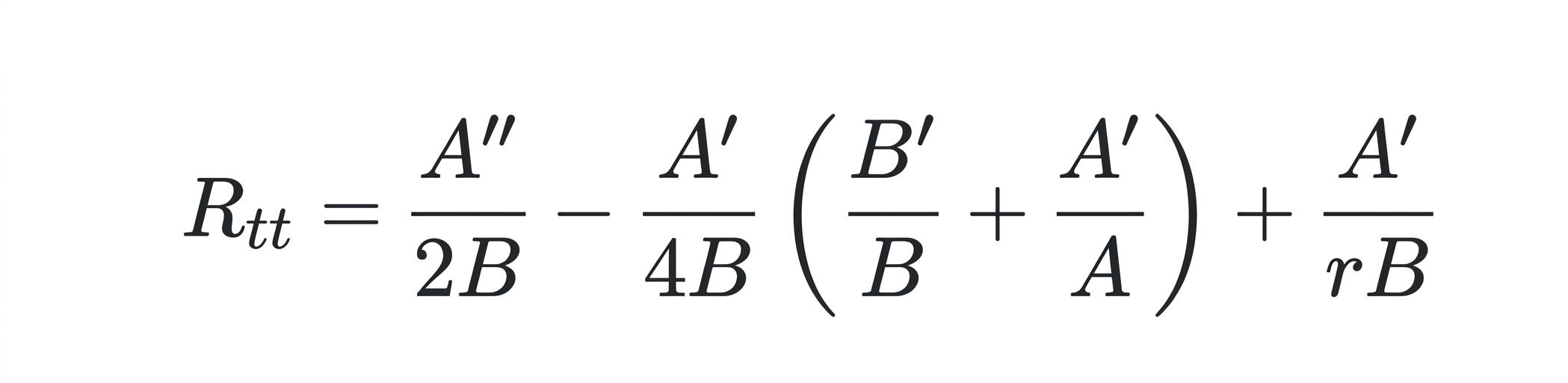
If we substitute the value for B(r) in terms of A(r) , the first term and last terms are easy to generate since they just involve B and not B’:
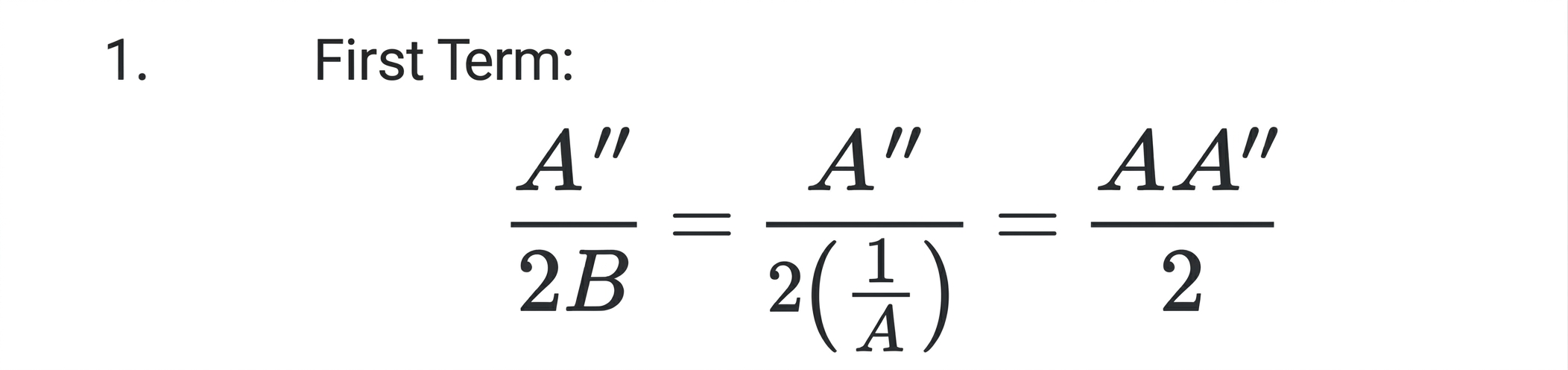
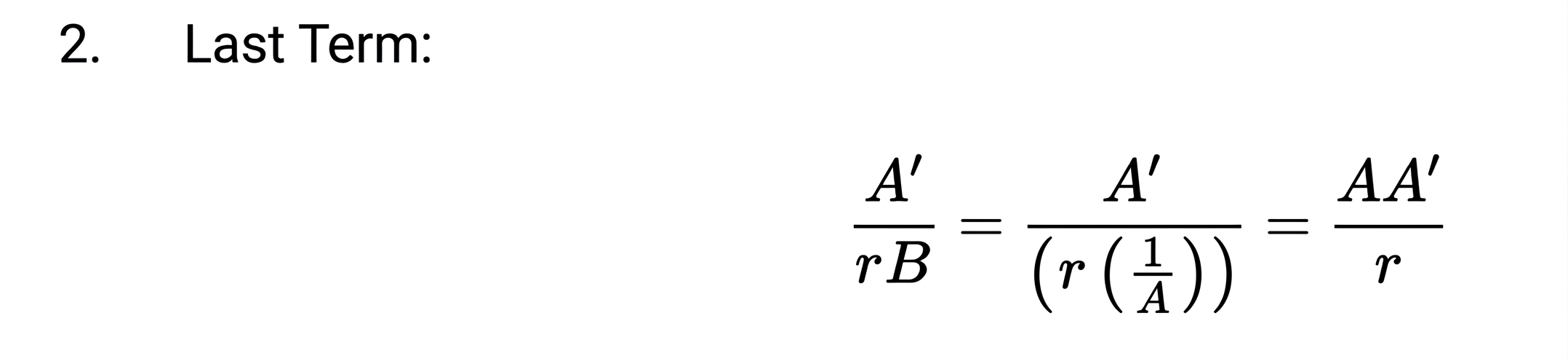
Now to figure out the parenthetical factor in the middle term, we must first solve for what B’ is in terms of A:
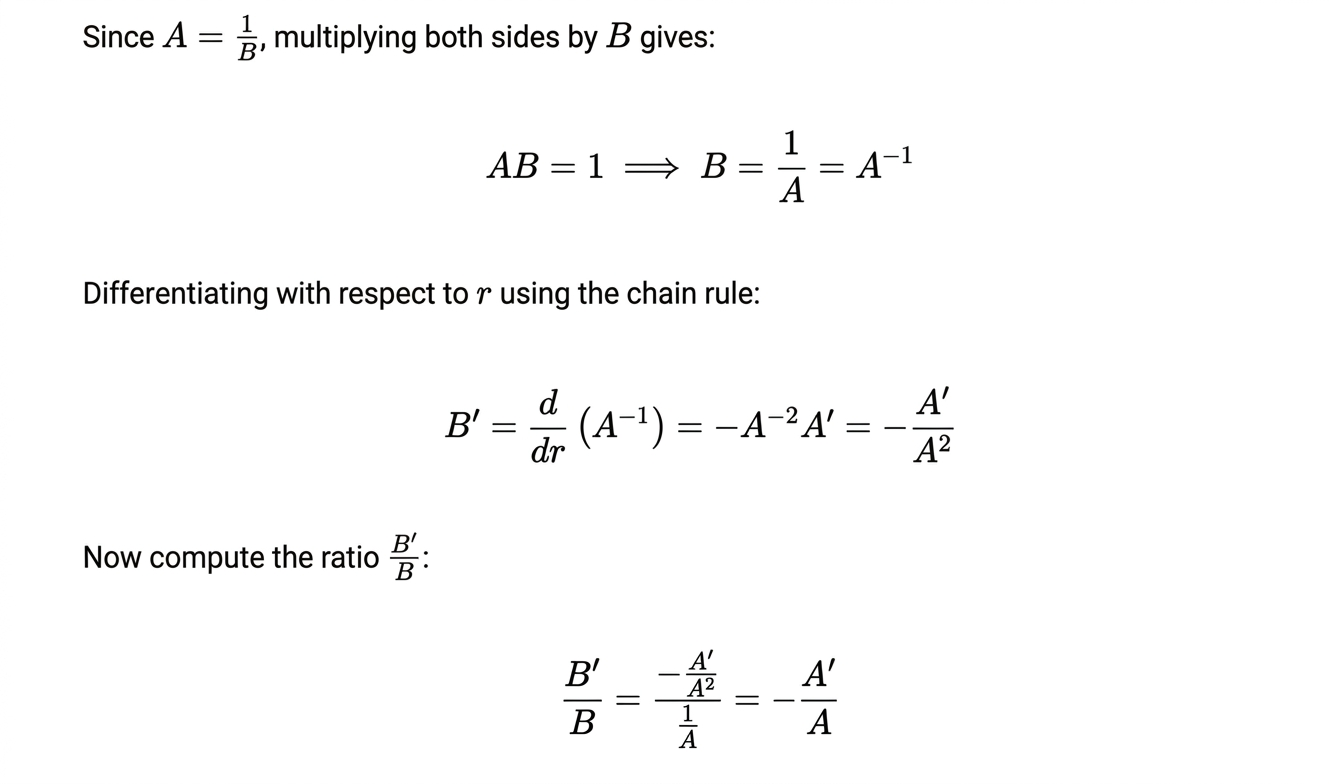
Finally we can substitute this back into the middle parenthetical factor:
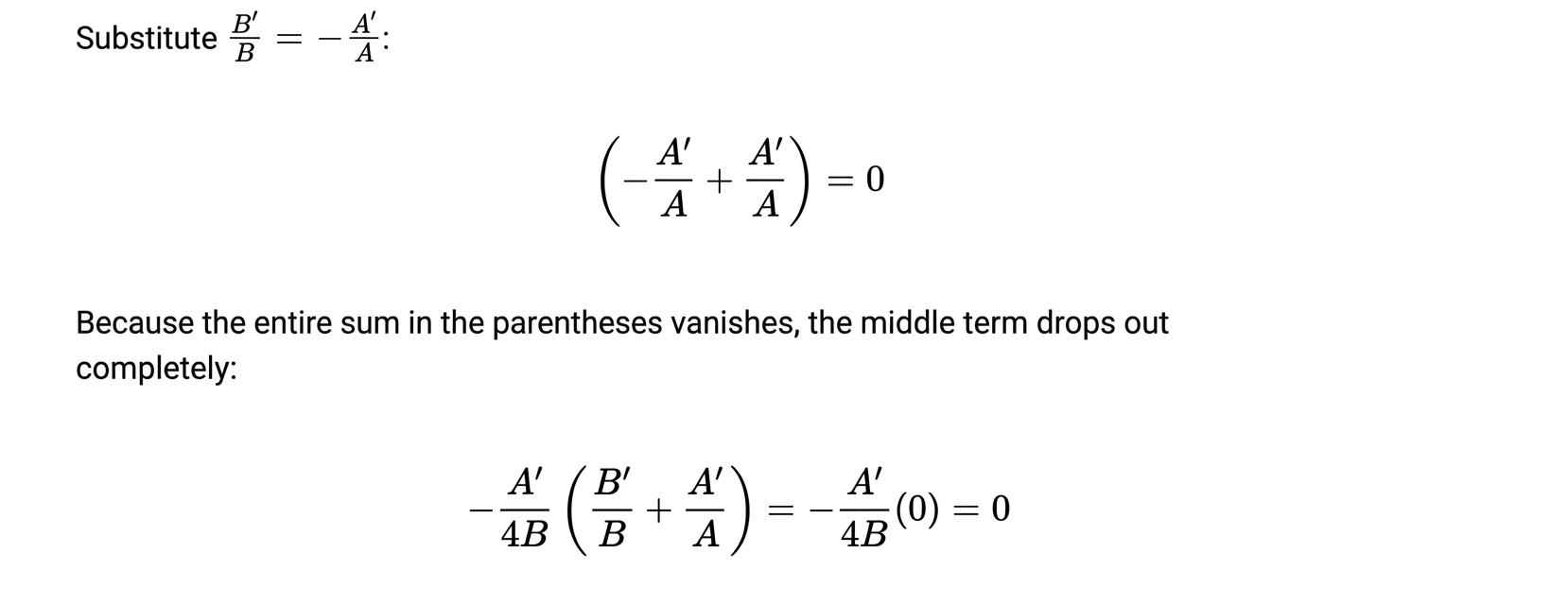
Thus we are left with only the first and last terms:
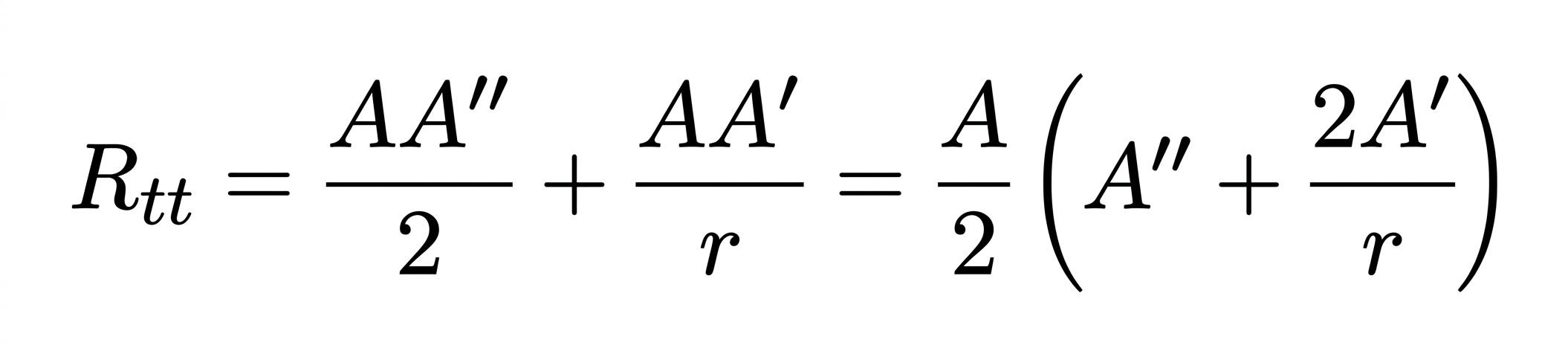
If we set this equation equal to zero since Rtt is 0 in empty space and then divide each side by A/2 and multiply by r2, we get:
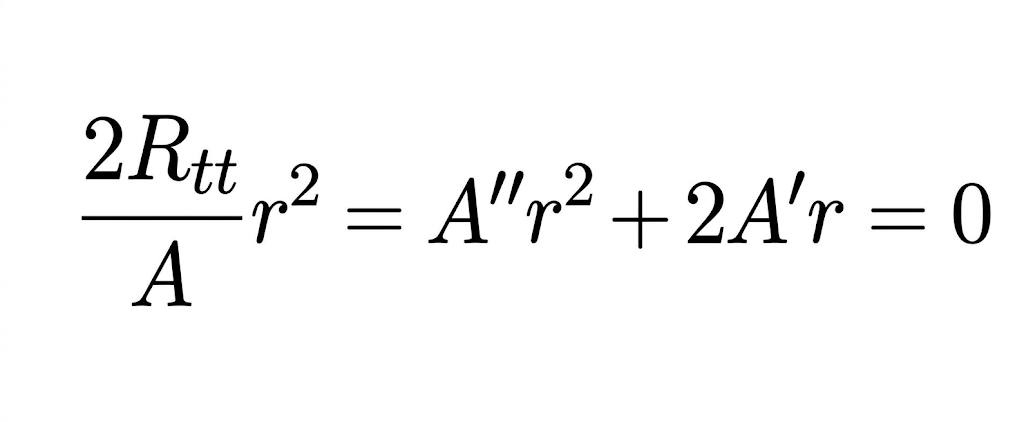
This manipulation was done in order to recognize that the middle equation is the same as a derivative, which is:
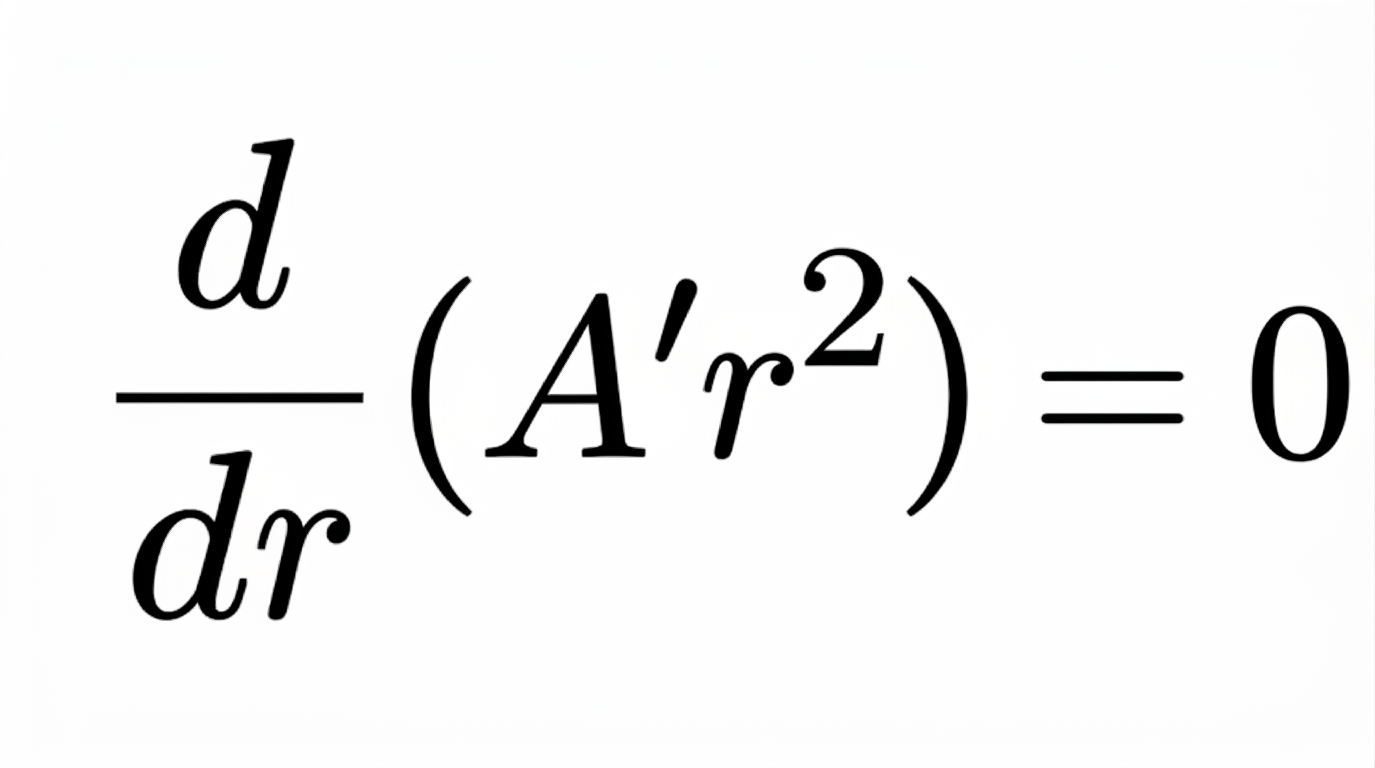
When using the product rule we see that the above is exactly equal to the middle equation, A”r2+ 2A’r.
Now we can integrate both sides with respect to dr:
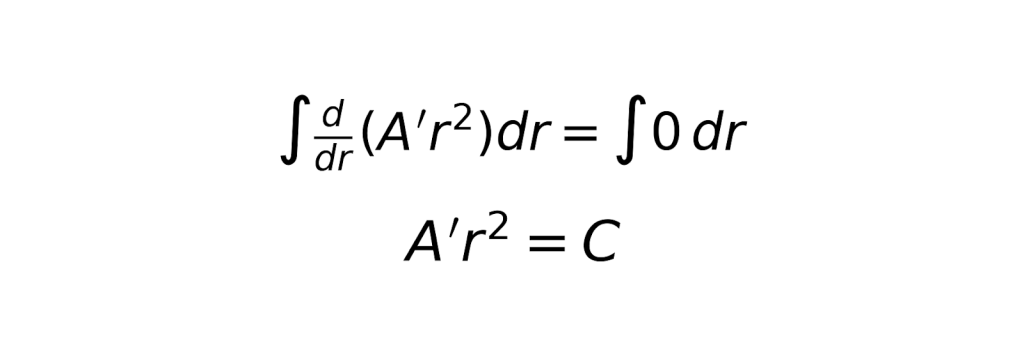
so A’ is equivalent to:
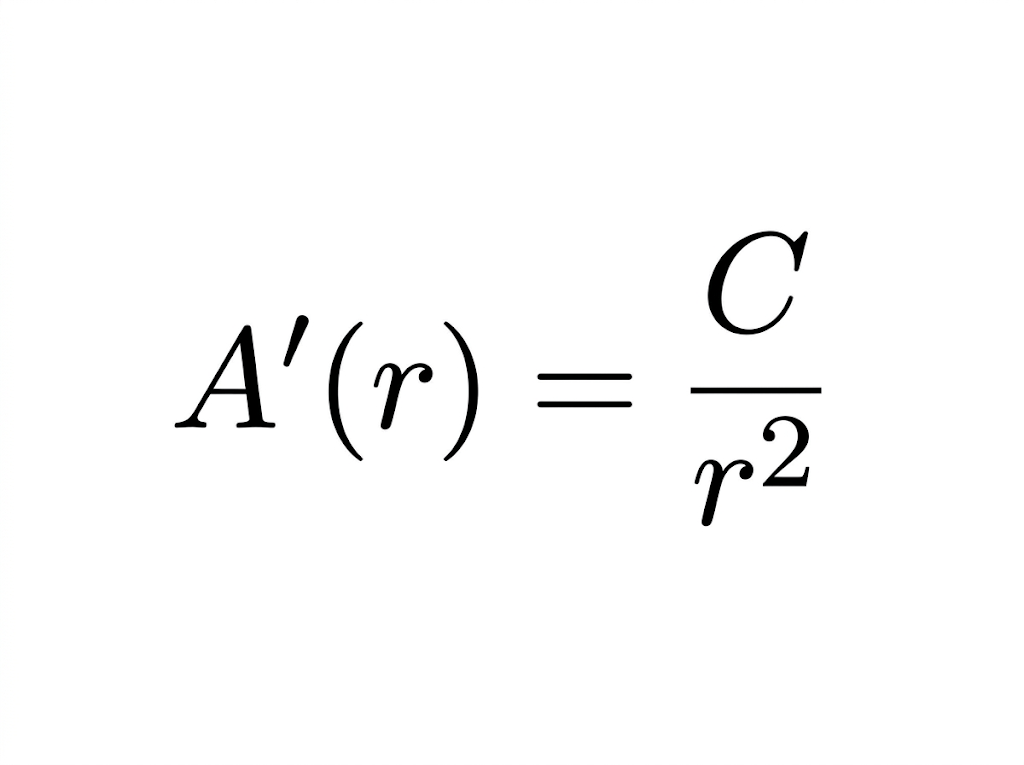
Finally, integrating both sides again with respect to dr to solve for A(r), we get:
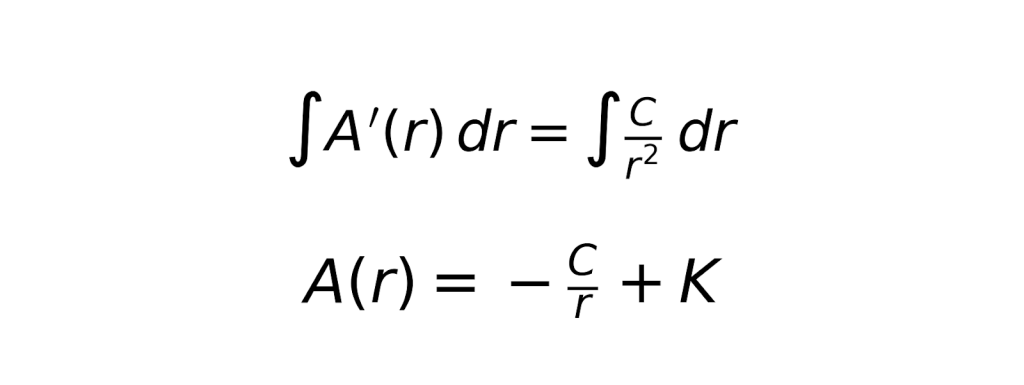
Which means that A(r) is equivalent to a constant divided by r plus another constant (note the capital C is an unknown constant, whereas a lowercase c is the constant of the speed of light)!
Luckily, we already know what these constants are from the weak field Newtonian limit (see #appendix4 for the derivation of the weak field Newtonian Limit)!
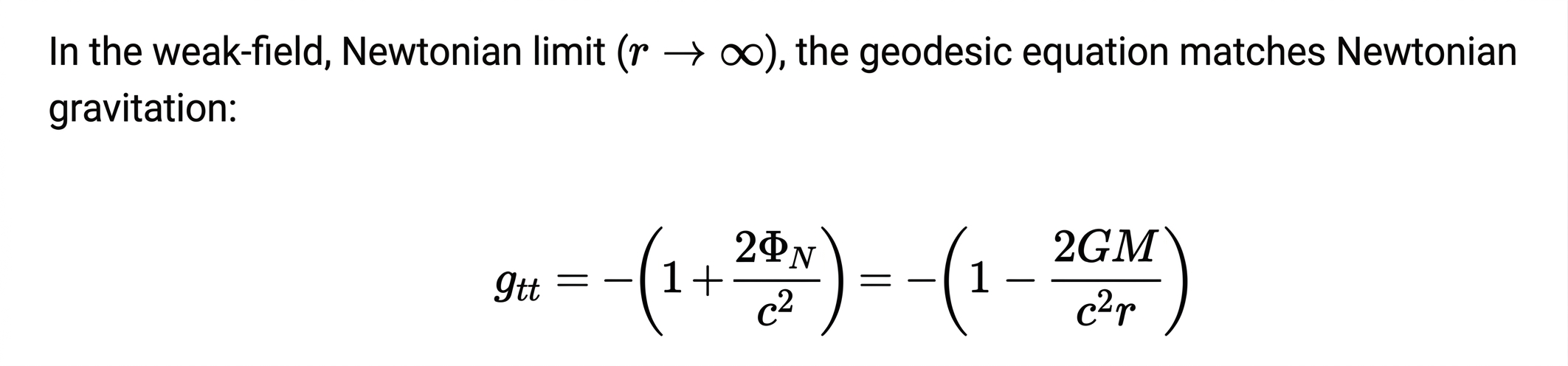
In our Schwarzschild metric, we already know that -A(r)= gtt so we can solve for A(r):
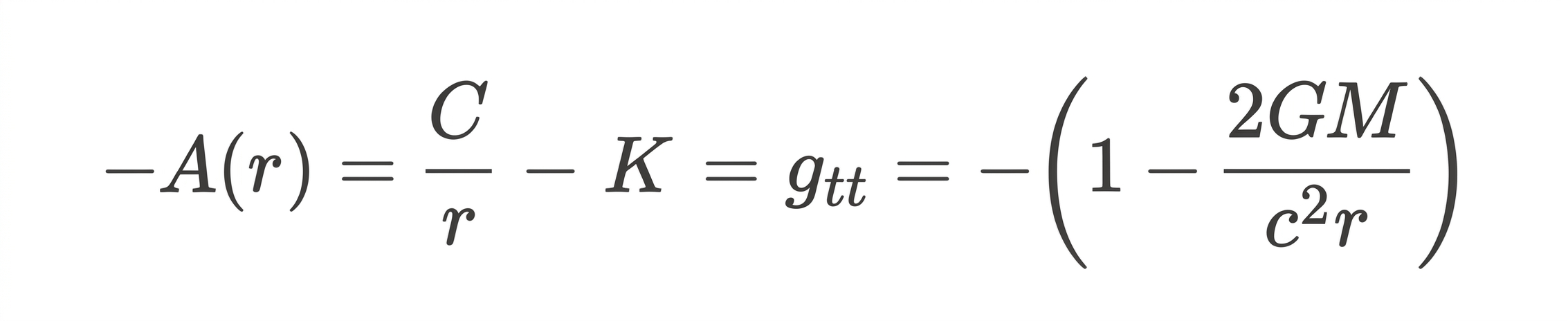
Clearly, K equals 1 and C=2GM/c2, and we also know that B(r)=grr= 1/A(r), so we now have our final version of the Schwarzschild metric:

Now let’s look at the beautiful and terrifying aspects of the Schwarzschild metric:
Let’s assume that an object is sitting at some areal radius r from the center of a gravitational mass, but that the object is not moving at all through space. Thus our spacetime invariant reduces to
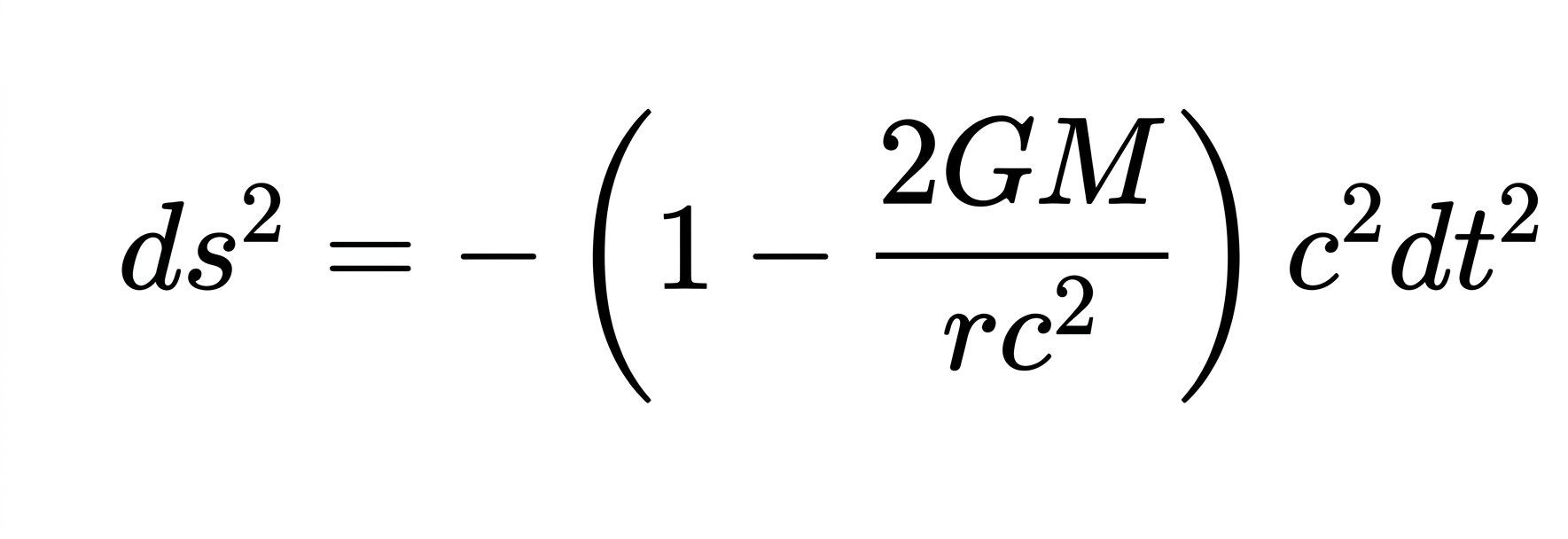
Our ds2 is also equivalent to -(cdT)2 (see #appendix4), where T is the proper time of the object sitting at areal distance r from the gravitational mass, so we can rewrite the equation as
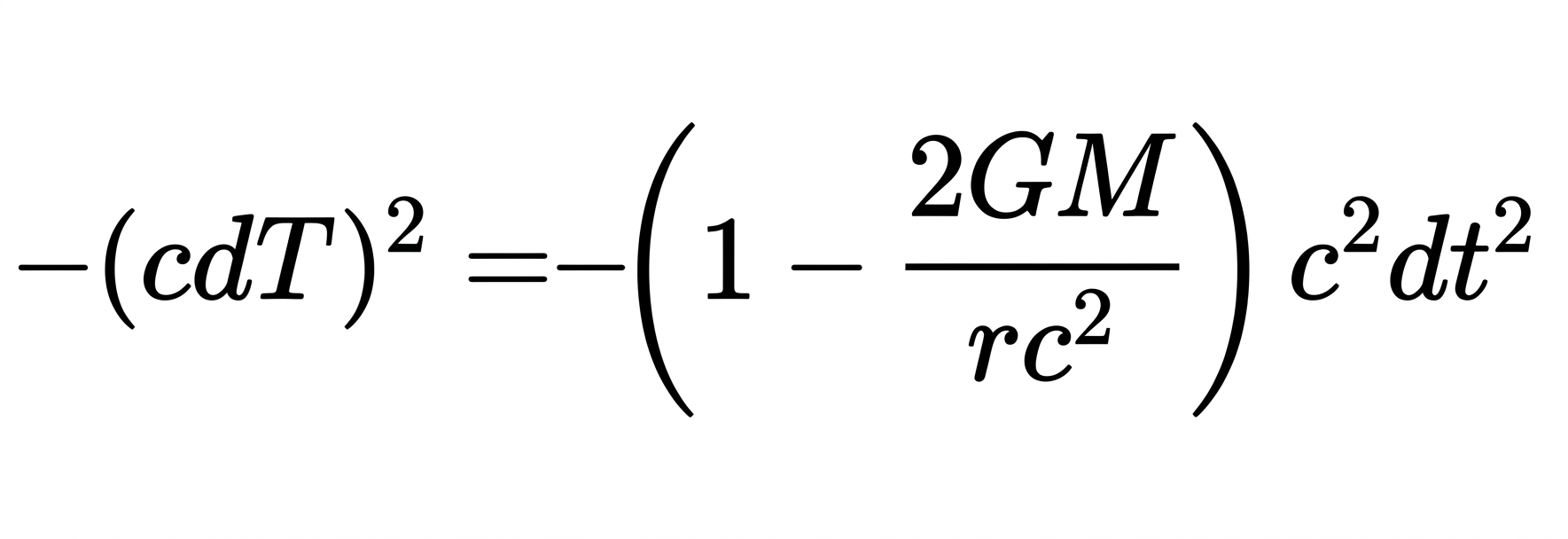
But this may cause confusion in that we may forget what dt means; dt is actually measured by someone who is in flat space, for whom r (the areal distance from the mass) approaches infinity and whose first metric coefficient thereby reduces to the Minkowski metric coefficient, -(c2t2).
If we divide both sides by c2, we get
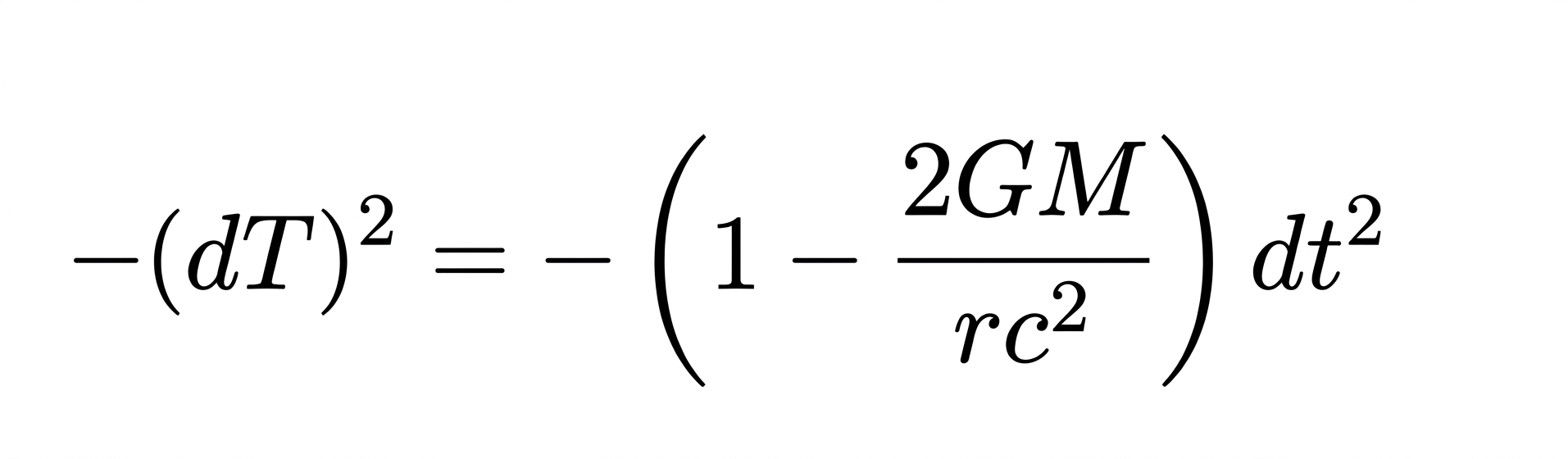
Then upon cancelling the negative signs and taking the square root we get:
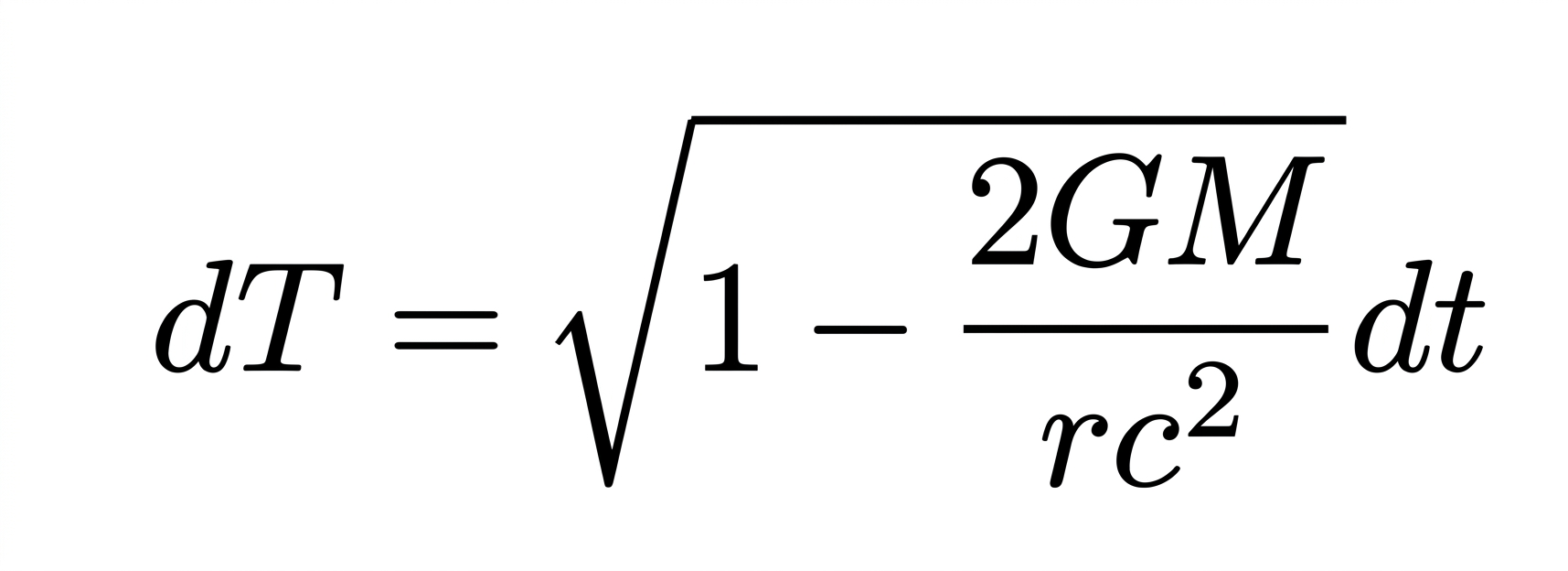
As the areal radius r decreases towards r=2GM/c2, we see that the entire term 2GM/rc2 approaches 1, meaning the entire factor outside dt gets smaller and smaller, meaning that the clock inside the gravitational field with decreasing areal distance r measuring time dT ticks much, much slower than the clock at a nearly infinite distance from the gravitational mass measuring time dt. Note that when r=2GM/c2, it would seem that dT=0, but this is actually a coordinate artifact and can be seen differently through a change in coordinates.
Of course, this effect of time dilation as we approach a strong gravitational mass is completely absent in the Minkowski metric, where for a stationary object cdT=cdt and thus dT=dt.
Now, let’s assume we freeze in time and are only traveling along the areal radius distance. What happens then?
Our only relevant term would be:
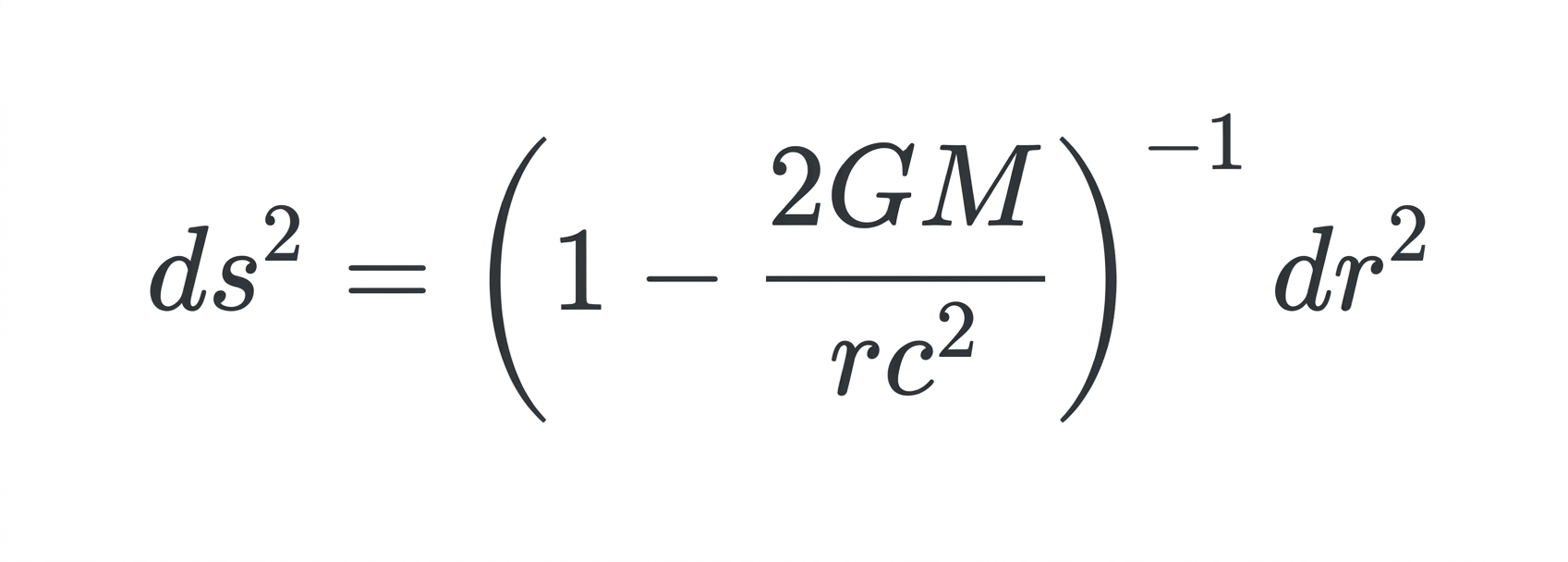
since we are restricting movement to dr. After taking the square root, of each side we would get:
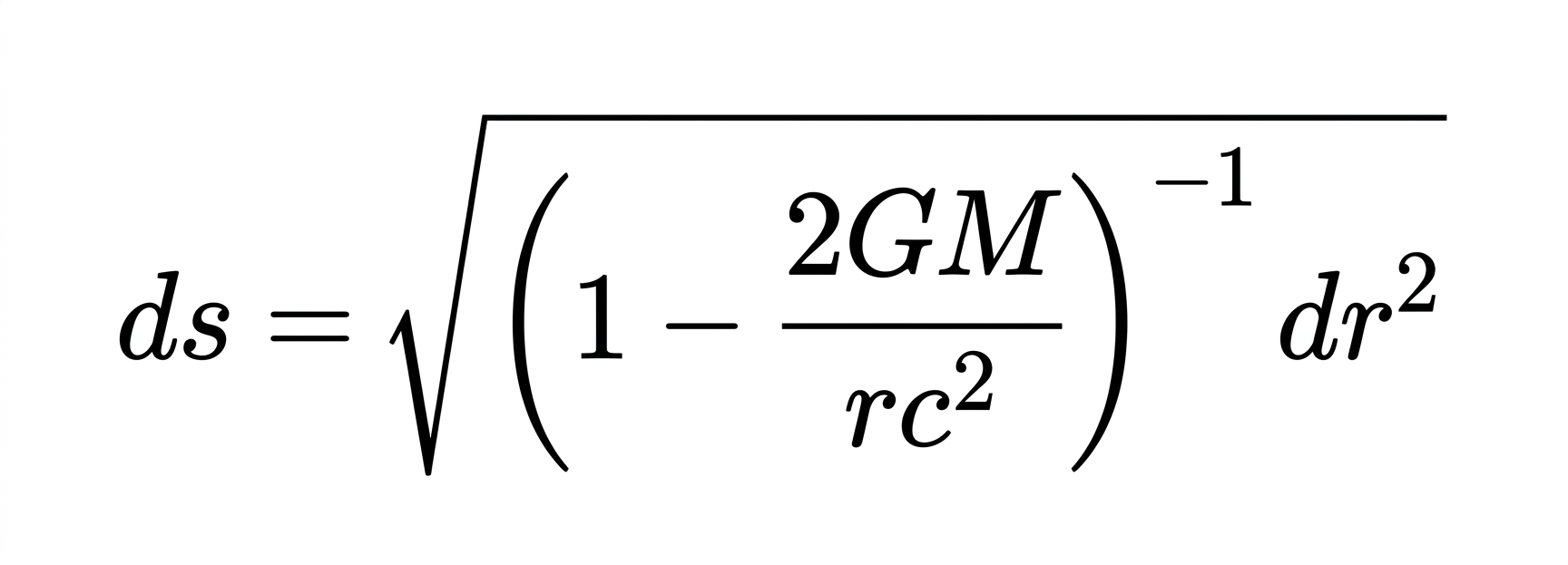
This means that as r approaches 2GM/c2, 1 step of the areal radius dr (which is equivalent to 1 step of ds in flat space, infinitely far from the gravitational mass) leads to the proper distance, ds, to get larger and larger. This means that 1 unit of areal radius near a black hole (which begins where r=2GM/c2) takes a lot more distance to cross than 1 unit of areal radius in flat space. One common visualization of space near a massive gravitational mass is depicted by Flamm’s Paraboloid, which was derived in a prior post https://mathintuitions.com/2023/08/09/its-all-relative-a-different-visualization-for-the-warping-of-space-time-in-general-relativity/. However, a better analogy may be that light and all other objects bend in a gravitational field, just as light bends in a refractive medium; therefore, in a gravitational field, the straightest possible path from A to B is actually curved!. Of course, time itself “bends” too in this field.
The last implication of the Schwarzschild metric is the most terrifying: the existence of black holes. It was this metric that first predicted the existence of black holes. Note that a black hole begins at the Schwarzschild radius, when r= 2GM/c2.
To discover more about black holes, let’s simplify the metric by assuming movements only in dt and dr, and that we set the value of 2GM/c2 = rs, the Schwarzschild radius, which is the value r needs to be to mark the event horizon, or beginning edge of the black hole.
Note that when the areal radius r is greater that rs, we get our conventional Schwarzschild metric (see #appendix4 for why ds2= -(cdT)2 for objects traveling with their own clocks):

Now ds2 must be less than 0 (which we call “timelike”), since for any observer carrying a clock (which records the measurement of proper time) light must travel a greater distance than any recorded movement of that observer, given that the speed of light is faster than all other objects in motion. On the other hand, if ds2 is positive, then it is called a space-like interval, and is not measured by ticking proper time, since no observer with a clock could possibly span the positive distance recorded. Why can’t an observer with a clock record the positive ds2? Since the positive ds2 means that the positive spatial distance covered outweighs the negative time metric coefficient, the spatial distance covered is therefore greater than the distance light travels within the time that the spatial separation is recorded. Additionally, we see that if we stood still in space with dr=0 and r is greater than rs, time would still march forward in both dt and dT since each has a negative coefficient attached and a forward ticking in dt corresponds to a forward ticking in dT.
But when r is less than rs, the term inside the first parentheses becomes negative, which when multiplied by the negative outside the parentheses creates a positive metric coefficient; on the other hand, for the metric coefficient multiplying dr2 , when r is less than rs , we ultimately get a negative metric coefficient, as seen below:

Now, if we stood still in space by setting dr=0, we in fact see that if dt marches forward we would only get a space-like interval where ds2 is positive. This is only possible if dt is no longer the change in time but instead has become one of the three spatial coordinates, each with a positive metric signature. To get more of an intuition as to why this must be true, if we set dr=0, there is no possible way to get a negative time-like interval when recording a change in dt.
So how can we make the above equation stay negative on the right-side and thereby record a time-like interval for a real object recording proper time on its own clock? Only if we consider that our coordinate dt is actually now a spatial coordinate, and dr is our clock, or time coordinate. We can ask ourselves: is it possible to freeze at dt=0 and still record proper time, just as it was possible in the conventional metric to freeze at dr=0 and record proper time? The math says yes: when dt=0 and our dr changes, it also makes dT change as well (since both are attached to negative coefficients). Moreover, it must be true that in order for dT to change legitimately, r must continue to shrink to 0 after r first becomes less than rs. If r somehow began to increase again after first becoming less than rs (showing an object climbing out of the black hole), then there must be a moment where the tangent to the path traveled along r and parameterized by proper time T must have a value where dr/dT=0. Assuming dT is always ticking with a positive value for the object carrying the clock, this implies that dr=0 as you turn around, and that would mean our equation is once again invalid for any real object carrying its own clock sincewe would be recording a space-like distance
The fact that r must continually decrease after it is less than rs is the very reason why dr has become the recording of time: time is the only coordinate that is “forced” to move in one direction, and this is now what dr has taken on. The time of the object inside the black hole is kept by the radial distance it inevitably traverses towards the black hole’s center, with each radial marker serving effectively as a time stamp. As a time, dr can only move in one way- towards the black hole’s center. On the other hand, as a spatial coordinate, dt can move forward or backward and still contribute to the positive spatial differential. Note that inside the black hole, the coordinates dt and dr have been decoupled from their ordinary flat space meanings and we can no longer convert between observers inside or outside the black hole.
APPENDIX 1- Derivation of Metric Compatibility and of the Christoffel Symbol in terms of the Metric
We will first derive the fact that the covariant derivative of the metric tensor is 0, which is known as metric compatibility (to see the derivation of the covariant derivative itself, skip to #appendix2).
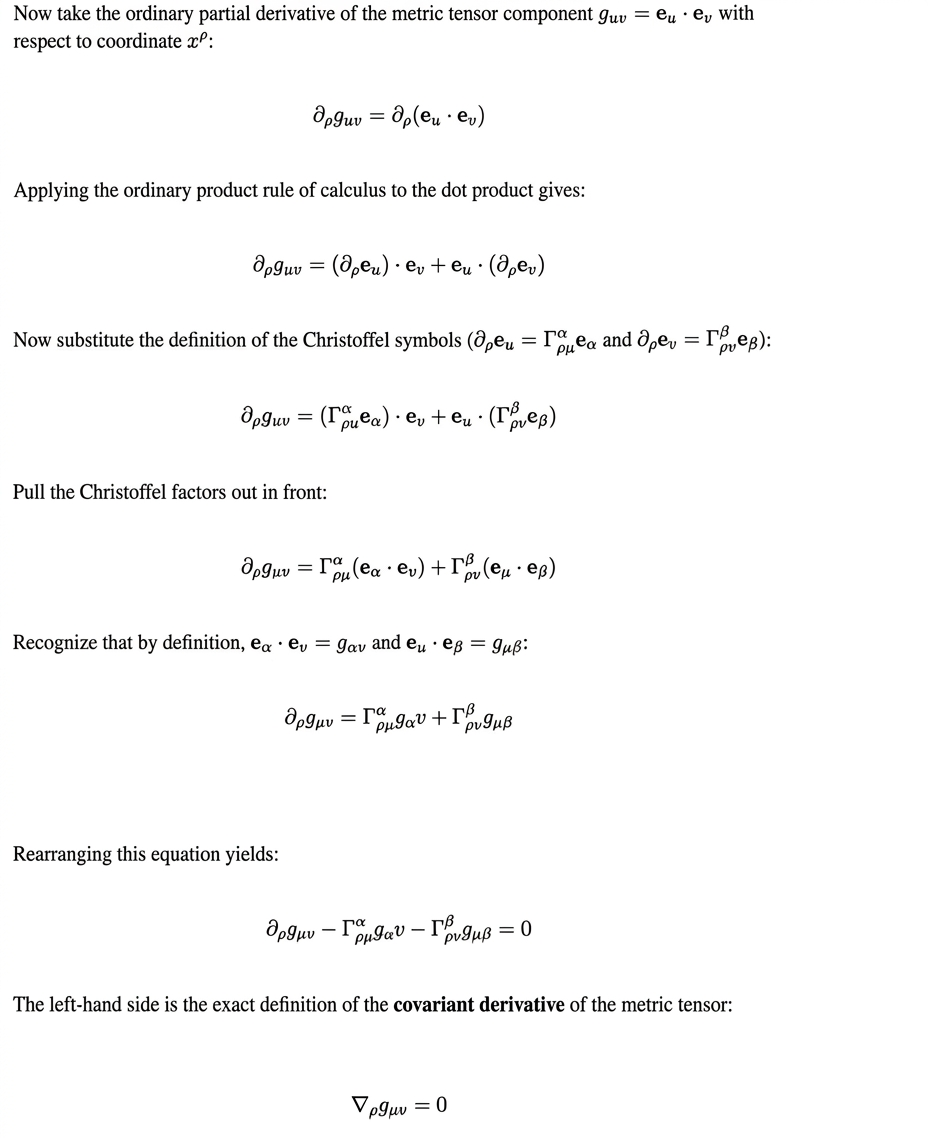
The fact that the covariant derivative of the metric tensor is 0 is known as metric compatibility. It tells us that a vector’s length remains unchanged no matter where you transport it, since if the covariant derivative of the metric tensor is 0, the change in the length of a physical vector is also 0:
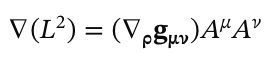
Again, to see the derivation of the covariant derivative of the metric tensor, skip to #appendix2.

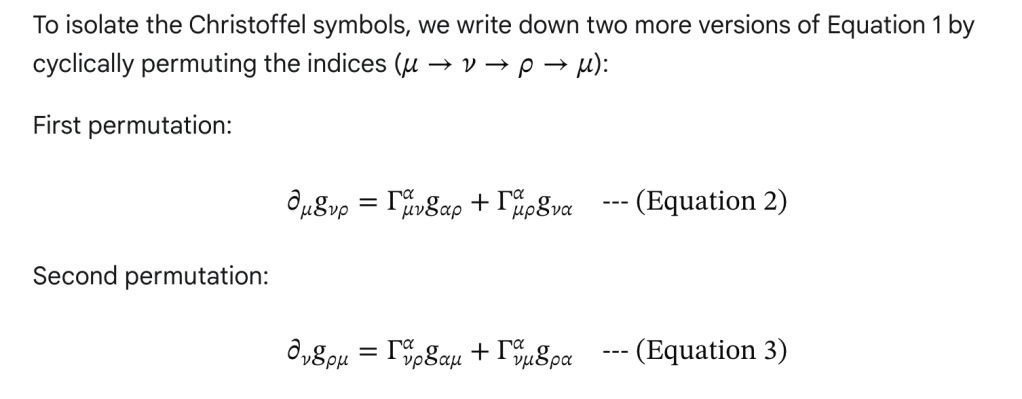
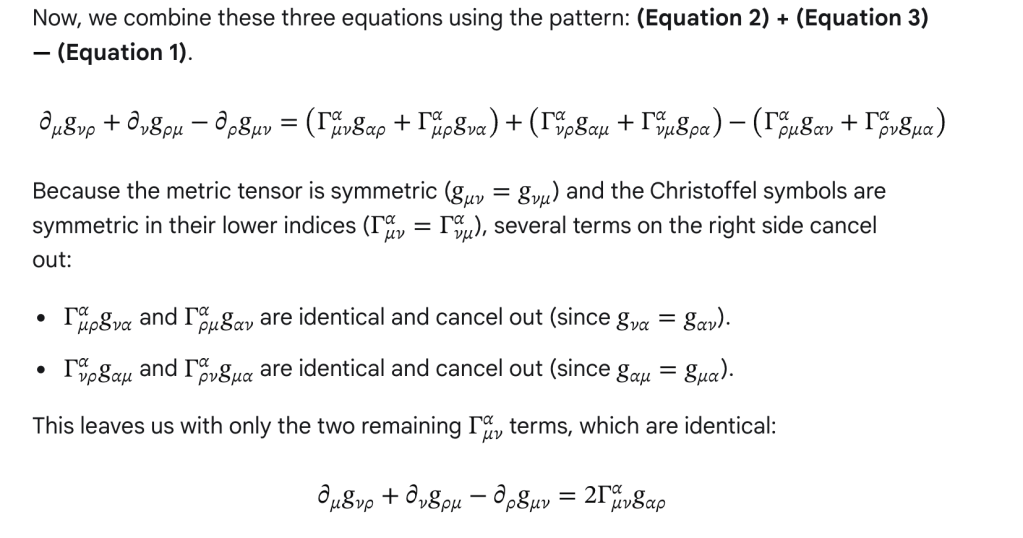
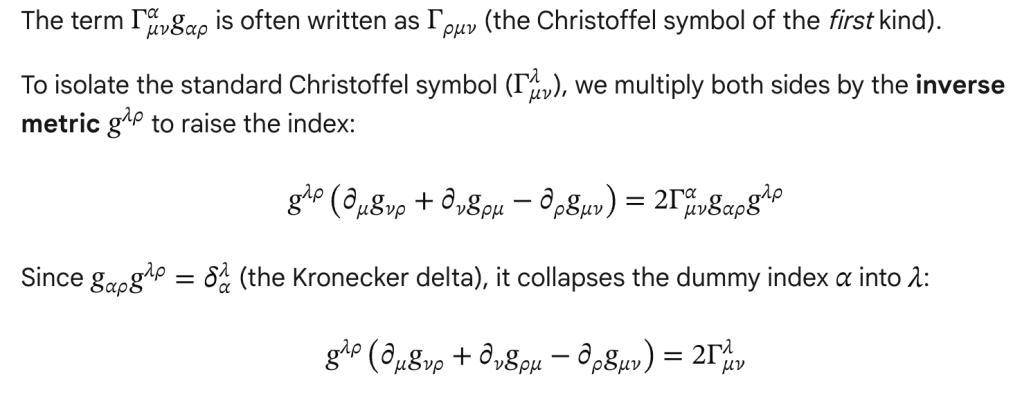
Appendix 2- Proof of the Covariant Derivative of the Metric Tensor and any arbitrary 0,2 Tensor
We define the covariant derivative of the metric tensor along with the test vectors U and V (whose components will eventually not be needed in the proof):
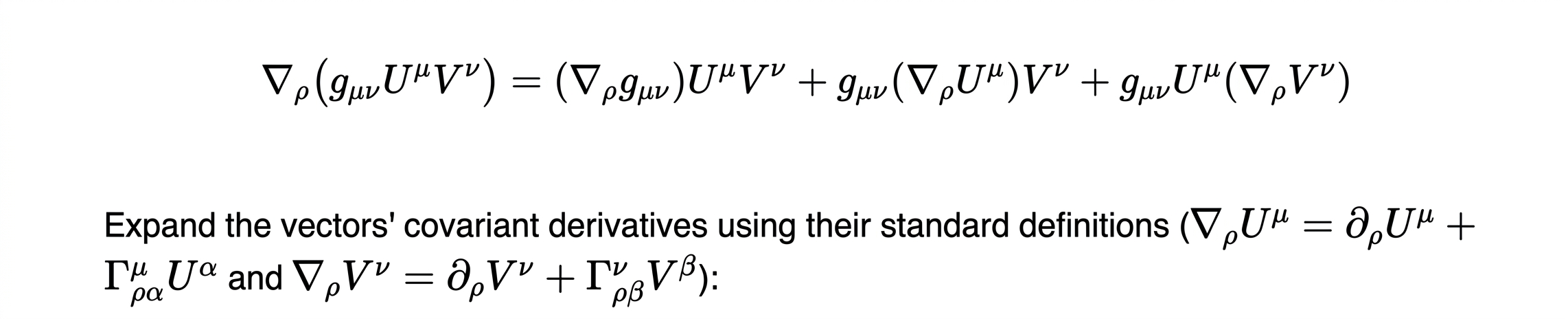


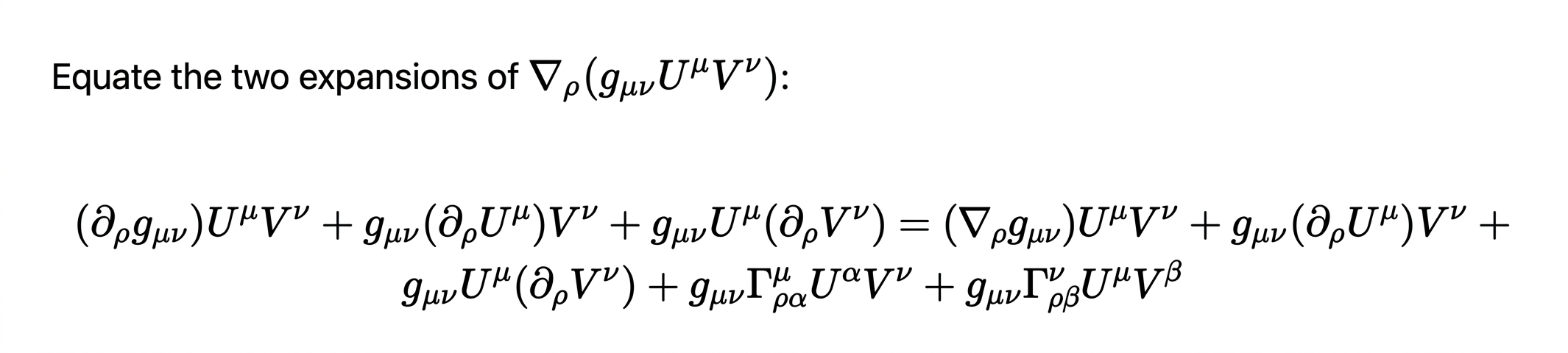
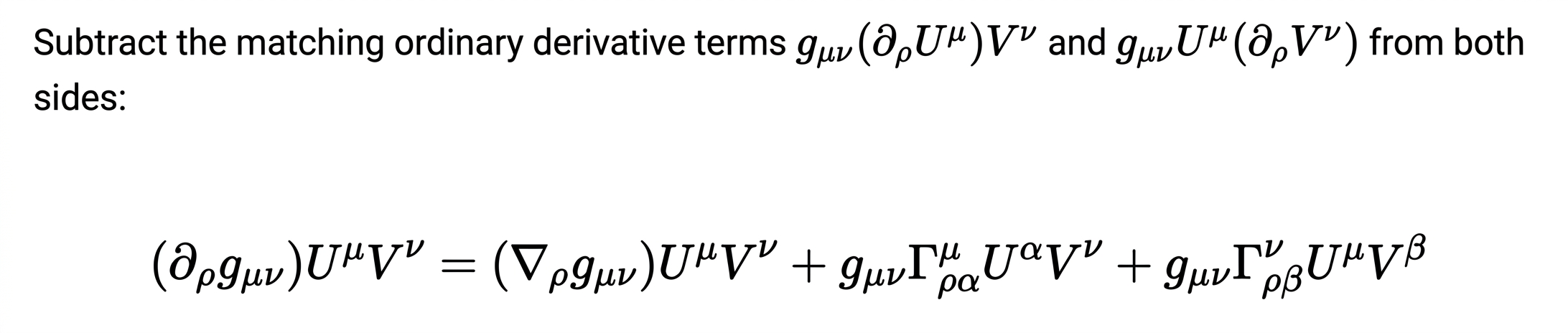
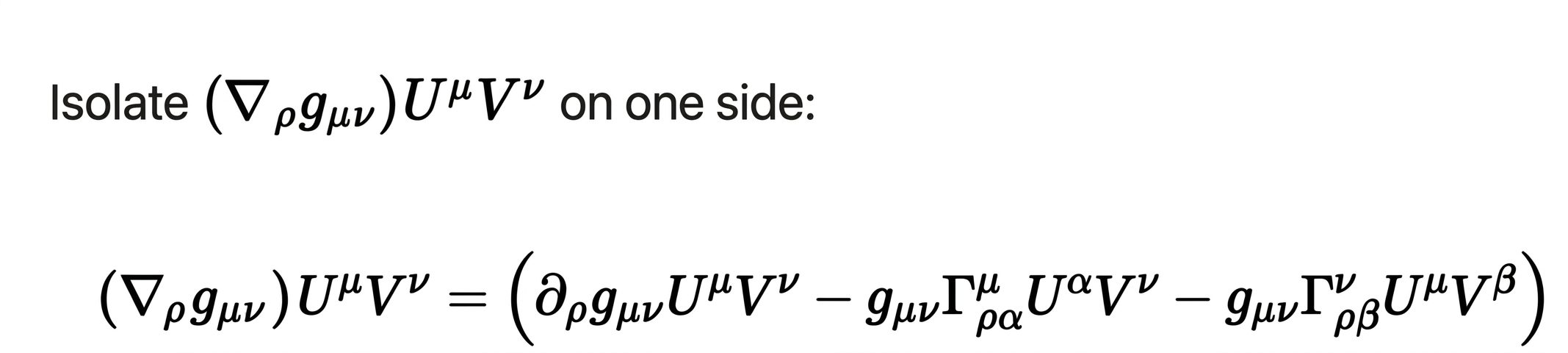
We now want to relabel the dummy indices so that we can factor out the vector components of U and V. In order to do so, we must:



The above is the covariant derivative for any 0.2 tensor, including the metric tensor.
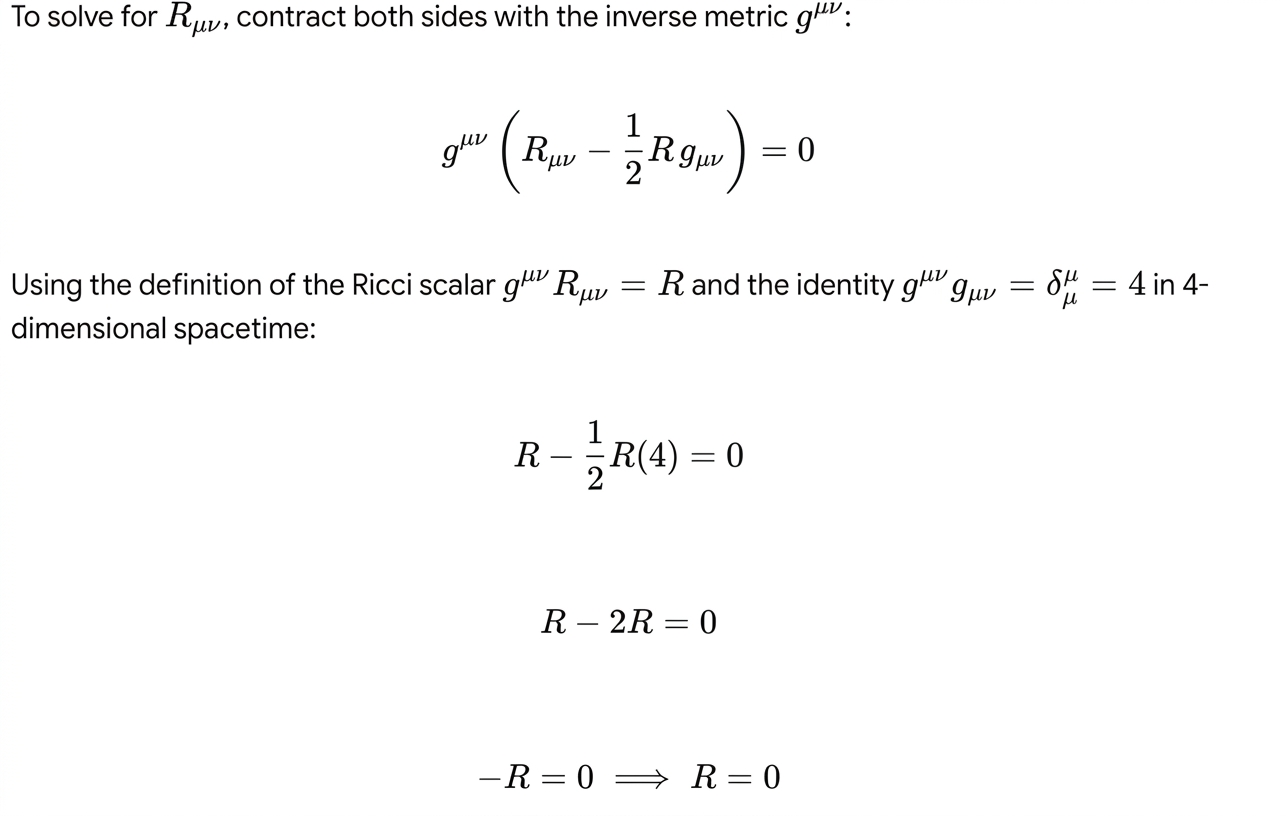
APPENDIX-3 – Why the Ricci Tensor is 0 in empty space
Given the Einstein field equation (perhaps a derivation of this will be in a future post):
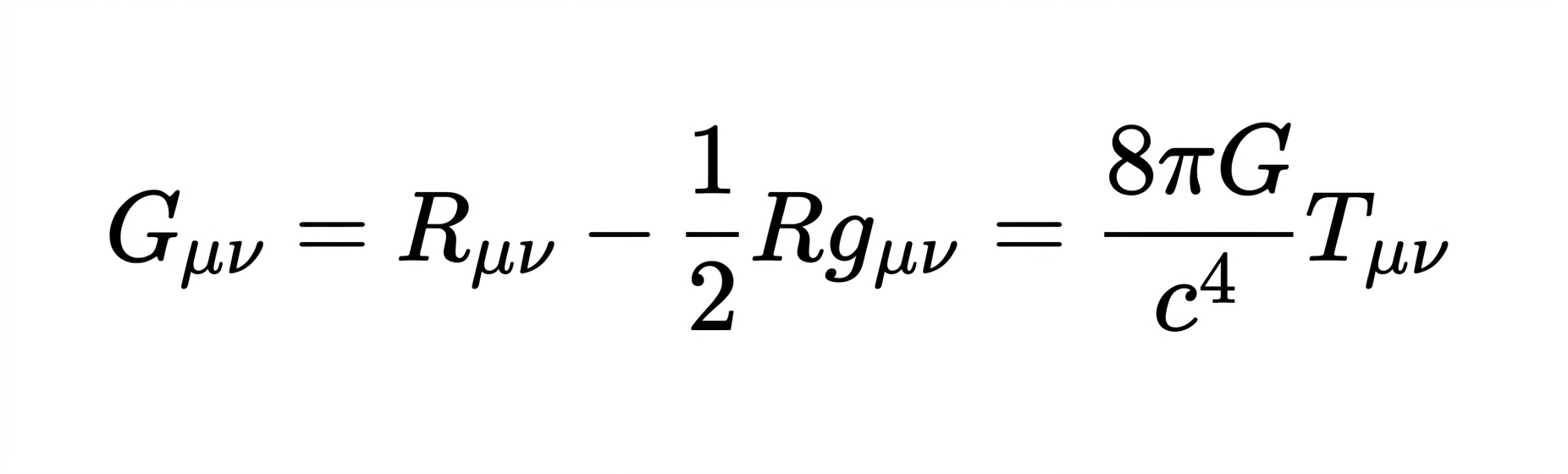
In empty space, there is no matter, energy density or radiation present, so the energy momentum tensor must be 0
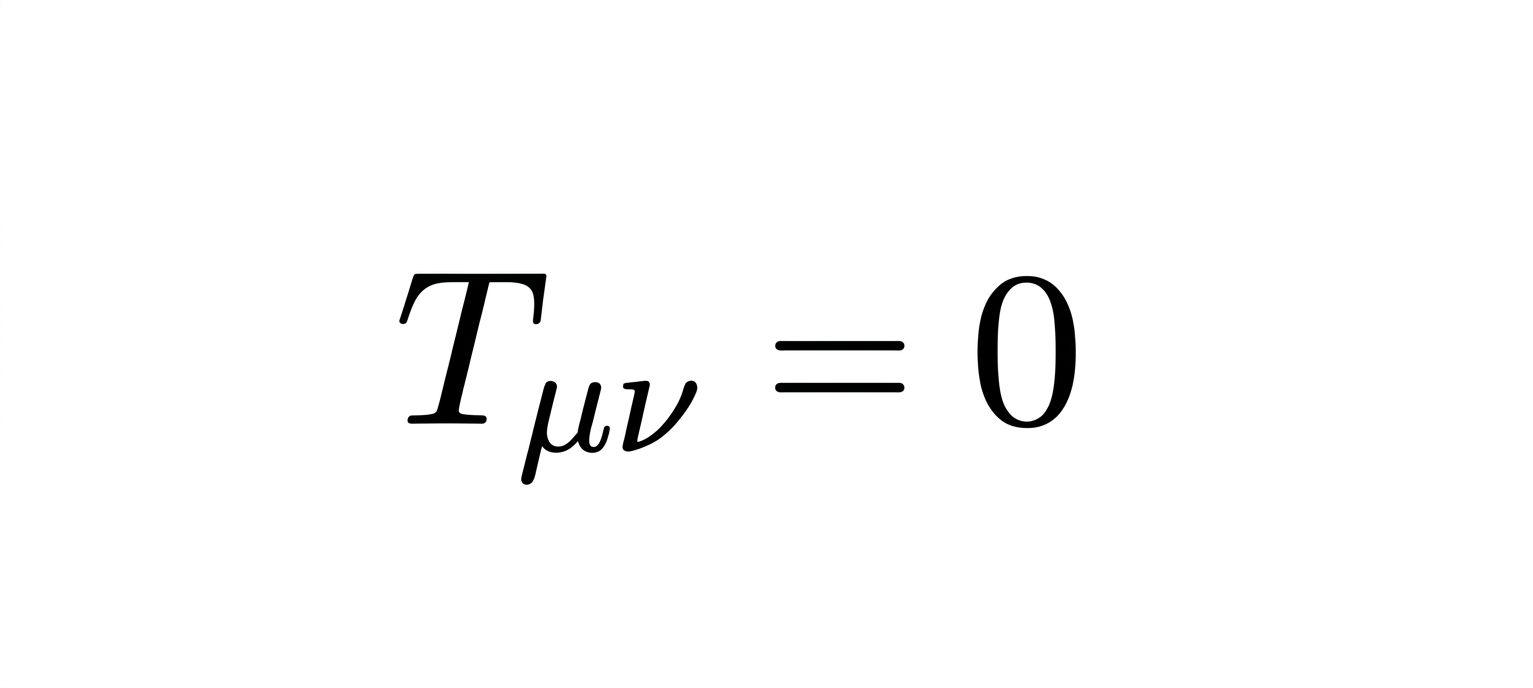
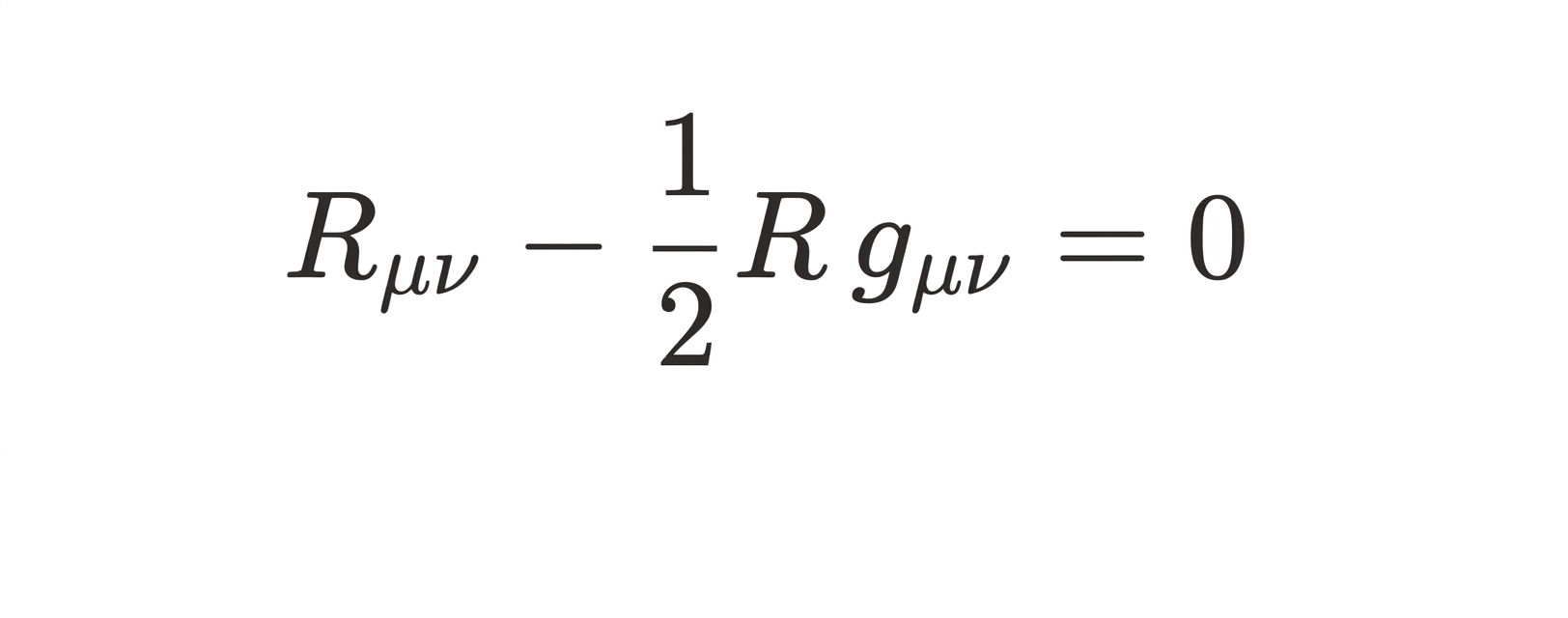
which means
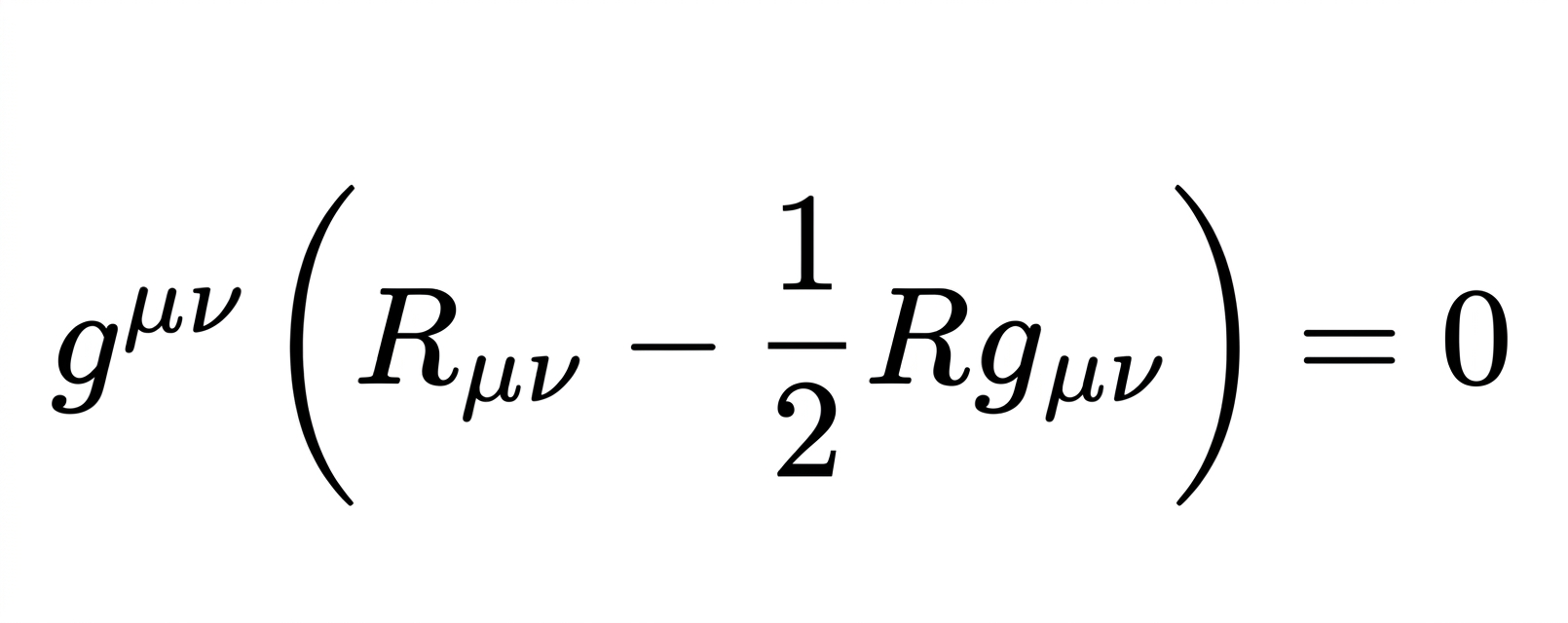
Let’s multiply by the inverse metric:
APPENDIX 4- Derivation of geodesics and the Weak field
To find the geodesic path we do the following:
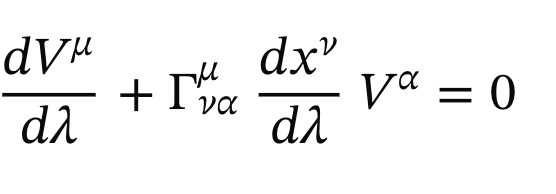
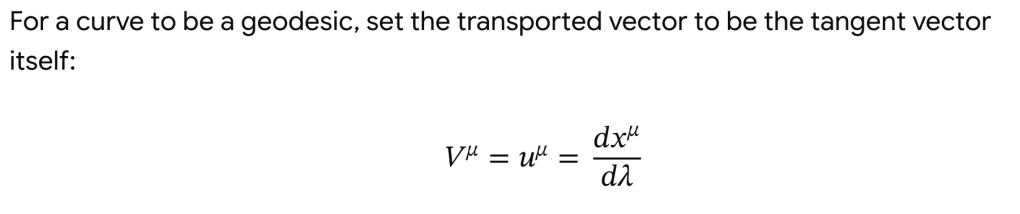
which shows how the coordinate of the path is changing along itself per 1 unit of the parameter.
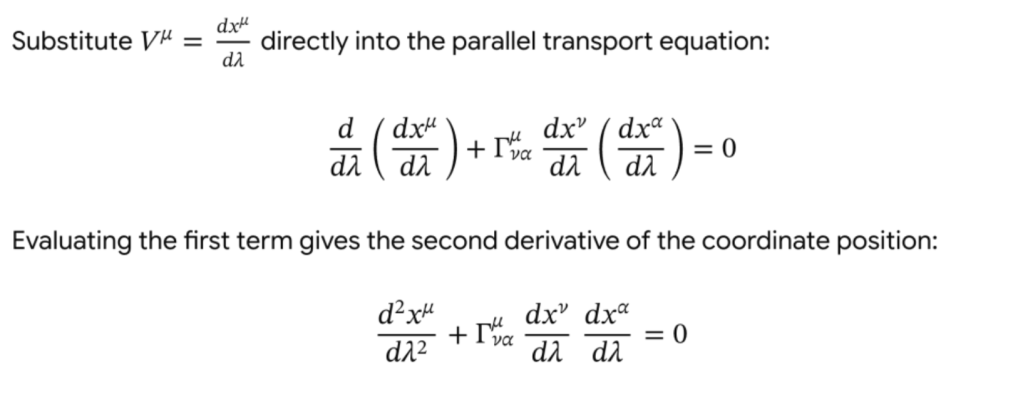
The above equation is our geodesic equation, which shows a parallel-transported path, implying that the vector is traveling in the shortest-distance path between two points since it is not twisting or turning. Essentially it shows a “straight line ” path in any geometry.
Now, for our weak field approximation, we assume that the object is moving at extremely slow speeds through space such that the time component dominates. Our parameter is proper time T.
We also assume we are dealing with a very weak gravitational field such that there is only a small perturbation from the normal Minkowski metric that is with respect to G00 since only the time is affected.
We now solve for the Christoffel symbol with 2 time components in the lower indices using the metric plus the small perturbation. We can then use the inverse metric to help us solve this with the small perturbation.
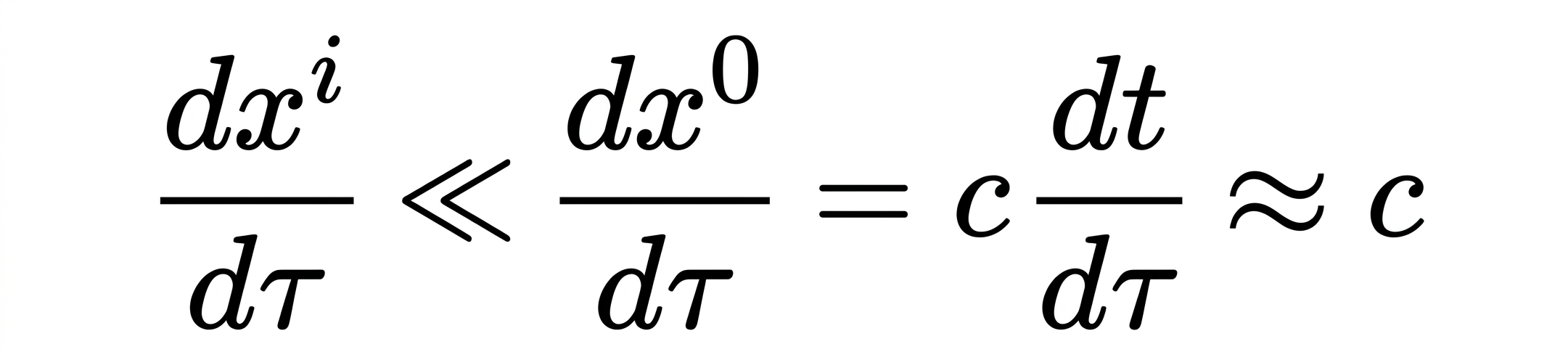
The i components are the spatial components, so spatial velocity will be much smaller than movement through time:
Given our geodesic equation:
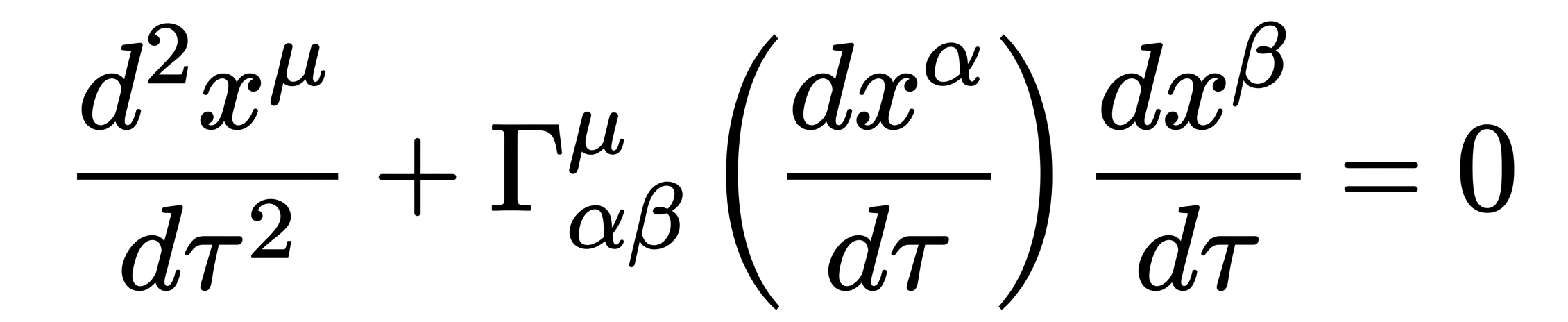
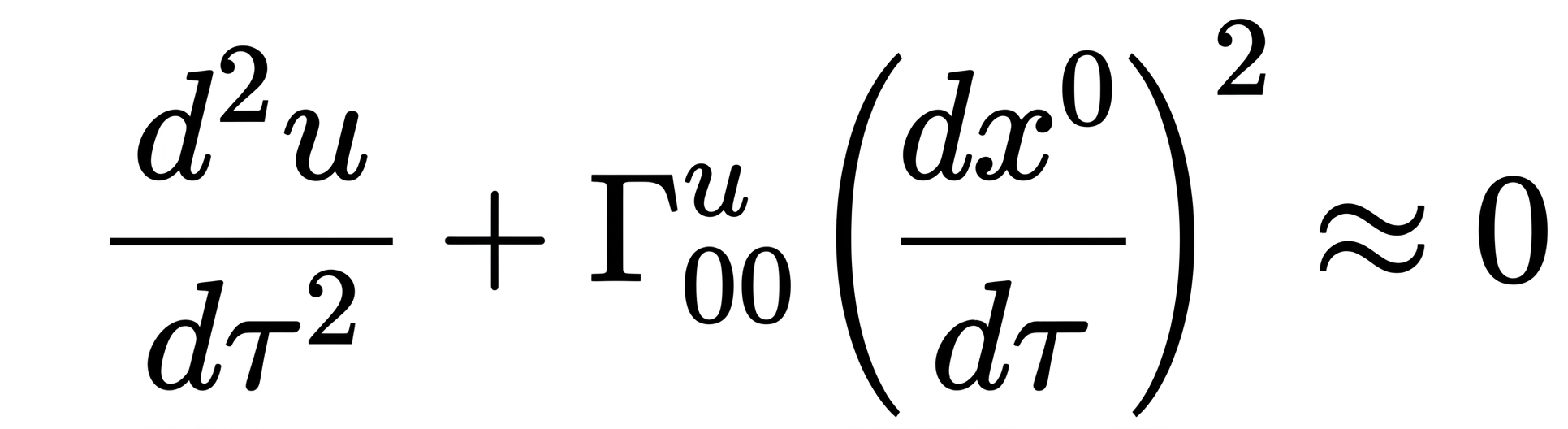
we only need to solve for the Christoffel symbol with lower indices both equal to 0 (the time components),
since the spatial components are dwarfed by the time components and any inclusion of one or more of the spatial components after the Christoffel symbol are infinitely smaller than the time components:
Given that the Christoffel symbol is equivalent to
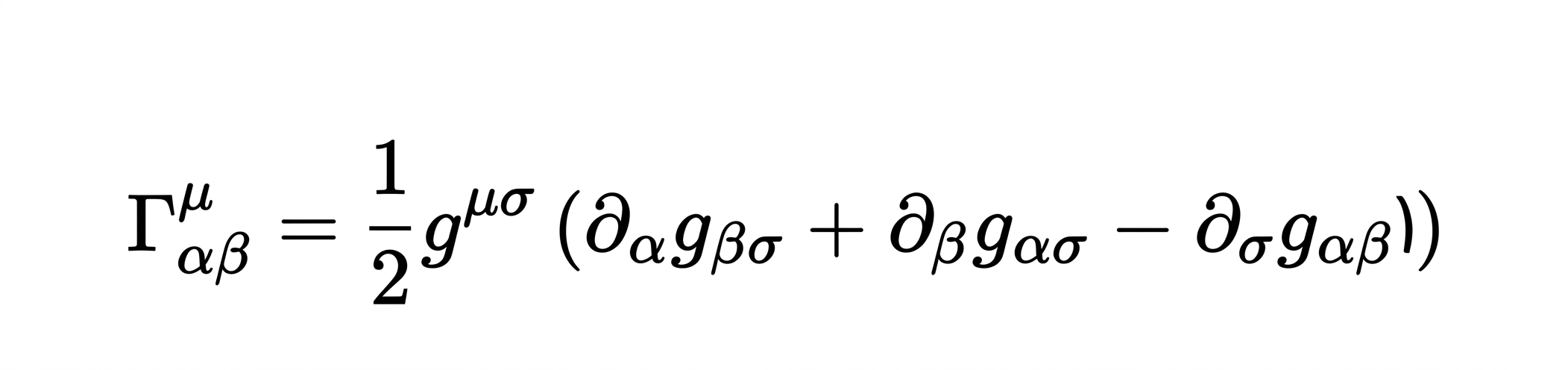
we can set the lower indices to 0, the time indices.
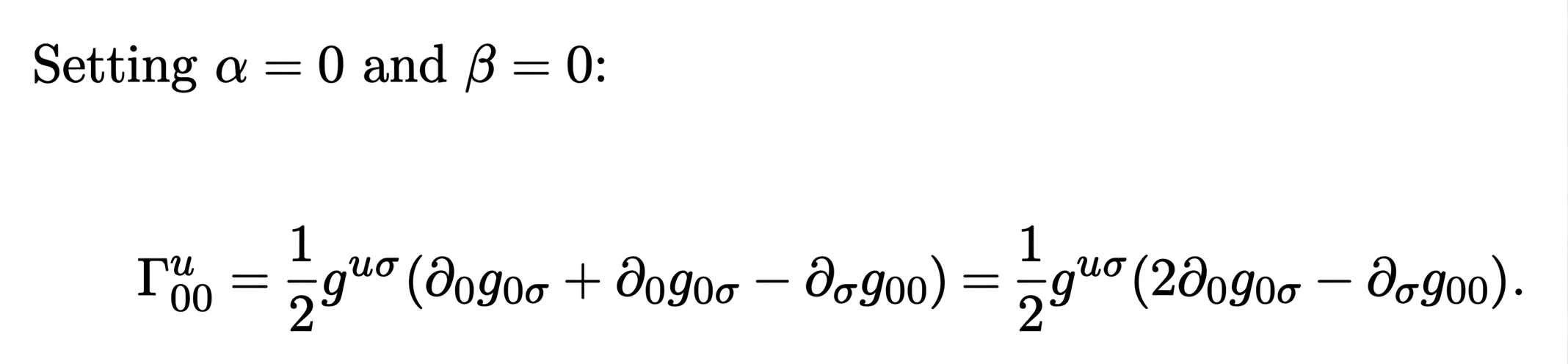
If we look at the first derivative term in parentheses in the right-most equation, we see that it must be zero because of time symmetry (the metric doesn’t change with respect to time). The second term in parentheses has derivatives with the spatial coordinates (indices 1,2, and 3), but not with the time coordinate (index 0).
So we have
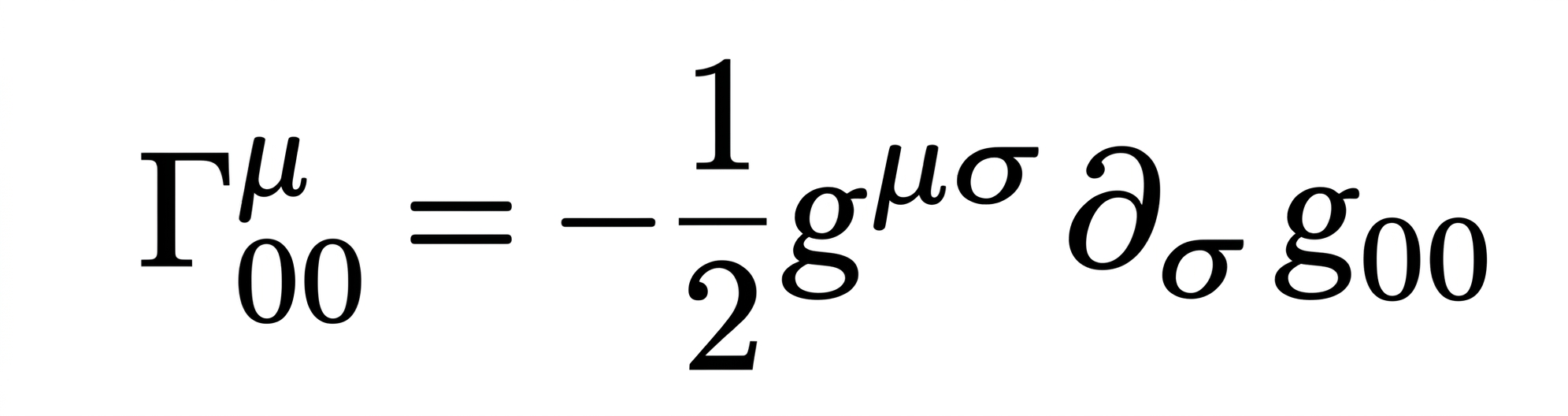
and if we substitute i (which denotes only the spatial coordinates with indices 1, 2 and 3) for sigma, we get:
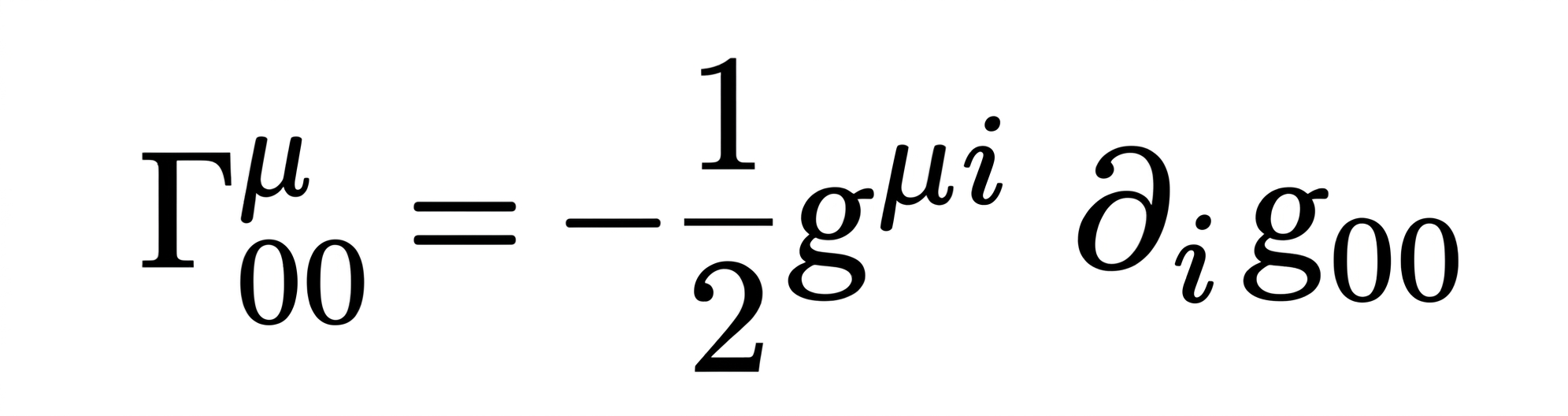
We can also conclude the u=i, since only when u=i do we get a nonzero metric term. Therefore we can substitute i for u:
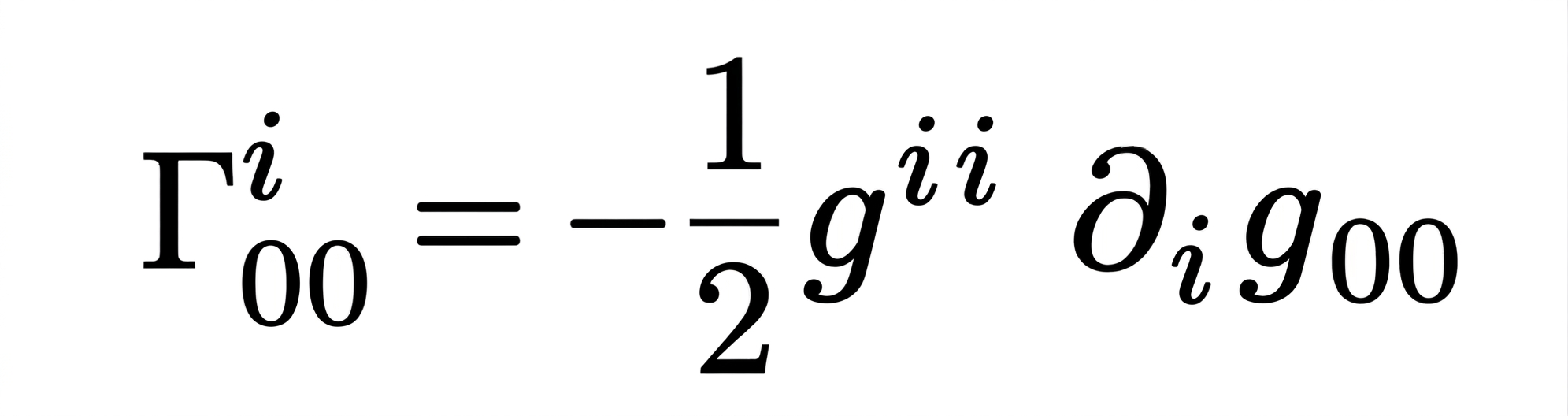
Now we bring in the second assumption: we can assume that there is only a very small perturbation to the Minkowski metric in a very weak gravitational field so that the metric becomes :

and its inverse is:

now guv = nuv + huv, but because huv is so small guv = nuv. However, the derivative of guv= nuv + huv does not reduce to nuv, because the derivative of nuv is always 0 (the Minkowski metric is unchanging with coefficient values of -1, 1, 1,1). So, the derivative of nuv + huv actually reduces to just the derivative of huv with respect to the coordinate change.
Given that our Christoffel symbol is
we can plug in 1 for gii (since gii=nii+hii and nii=1 while hii goes to 0) and the plug dih00 for dig00 (since din00 goes to 0). Then we get:
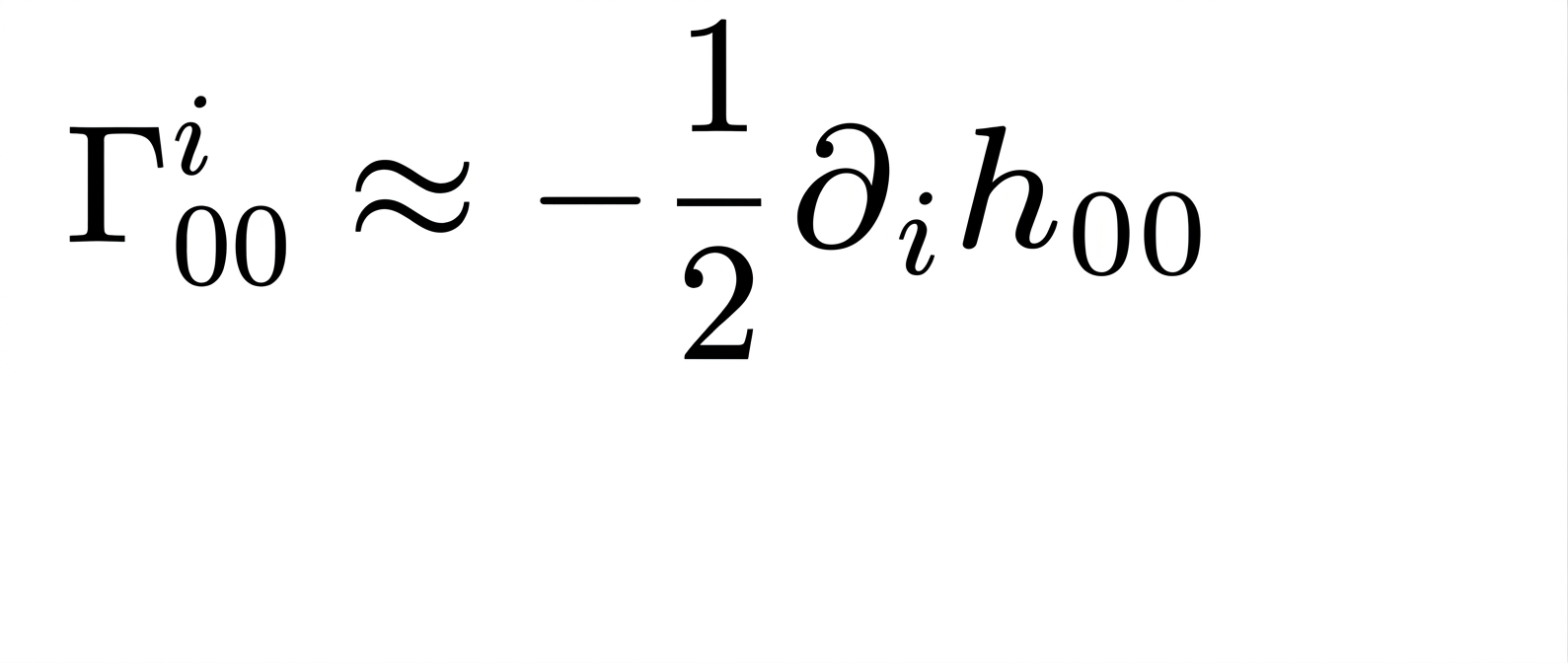
Returning our geodesic equation with the only relevant Christoffel symbol, which dictates that :
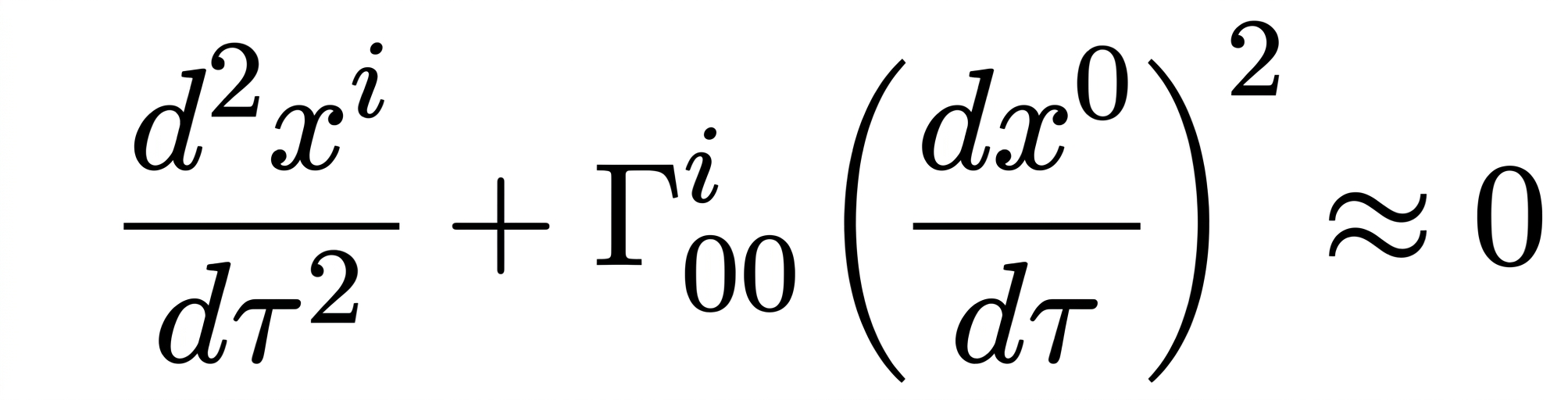
and when plugging in our newfound value for our Christoffel symbol we get
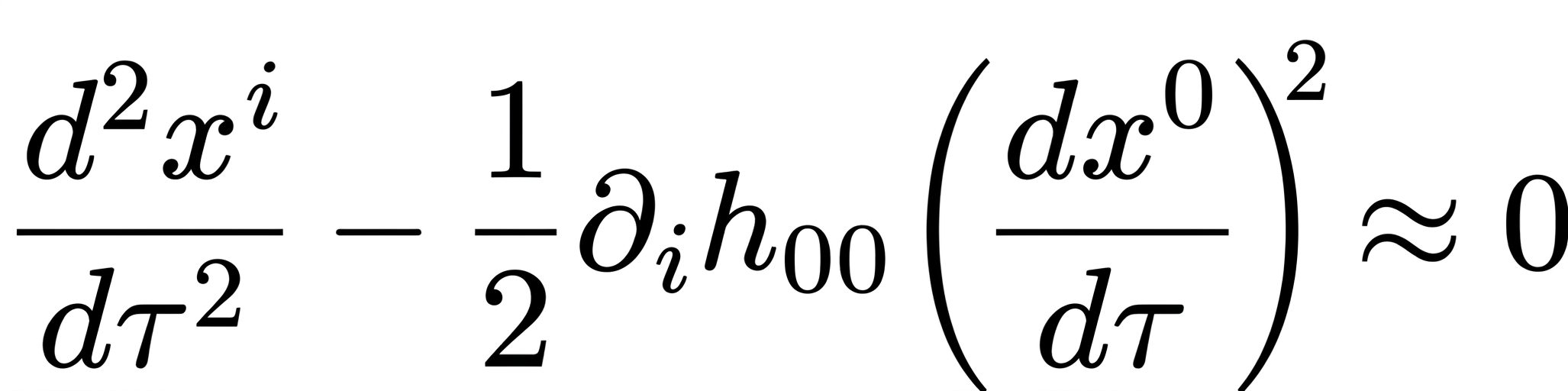
Now know that dx0/dT must equal C, since all objects travel through time and space at velocity c and dx0/dT is the only meaningful velocity given our assumptions. If we go back to the fact that ds2 = -c2 dt2 + dx2 + dy2 + dz2
Given the spacetime invariant of (see https://mathintuitions.com/2025/01/23/the-lorentz-factor-and-the-invariance-of-relativity/ for the derivation of the invariant)
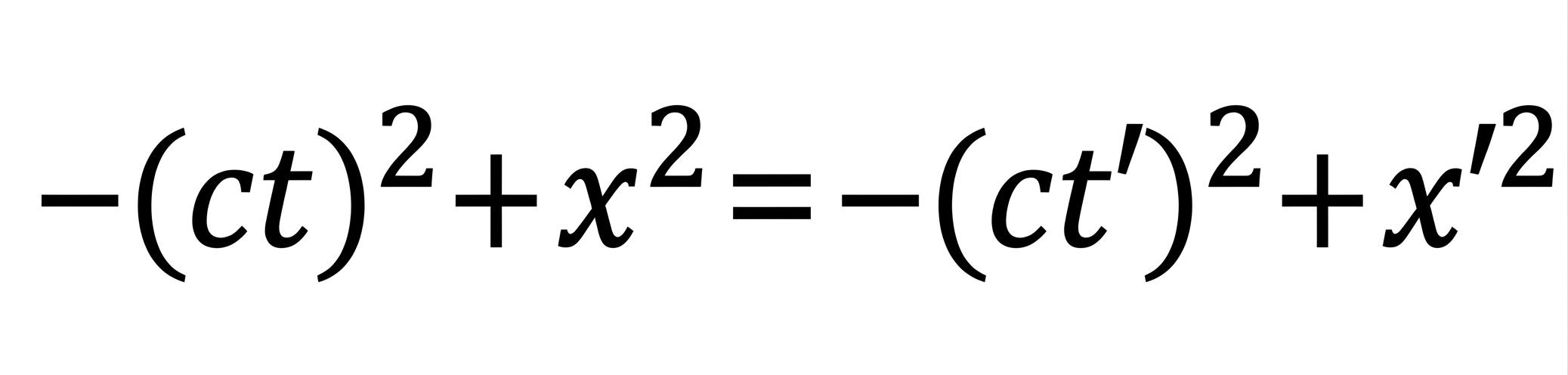
we can assume that the unprimed coordinates belong to the object who is traveling with the clock (there will always be one observer for whom this must be true) who records 0 change in the spatial coordinates and whose time is thus the proper time T. So the equation becomes:
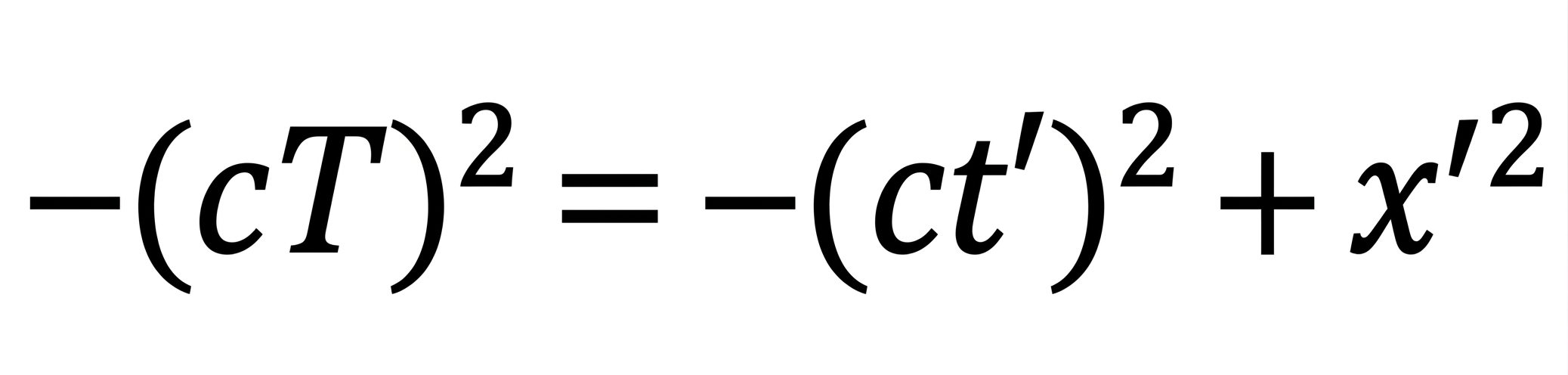
Thus the invariant ds2 is equivalent -(cdT)2 . Because ds2 is negative for any time-like worldline, we can define the positive invariant spacetime distance traversed as
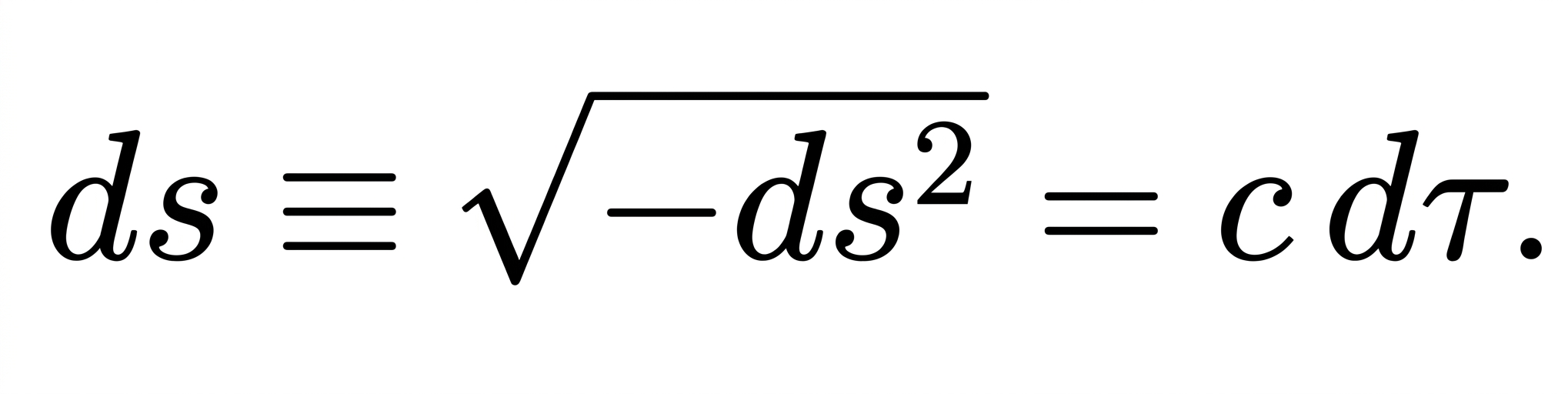
So now if we divide each side of ds=cdT by dT, we get ds/dT= c, which is the velocity through space-time with respect to proper time. So now we can plug in c for dx0/dT given this is the only velocity (since we assumed negligible velocity in the spatial dimensions) in our geodesic equation. Remembering that our geodesic equation was:
We now plug c in for the velocity term in parentheses:
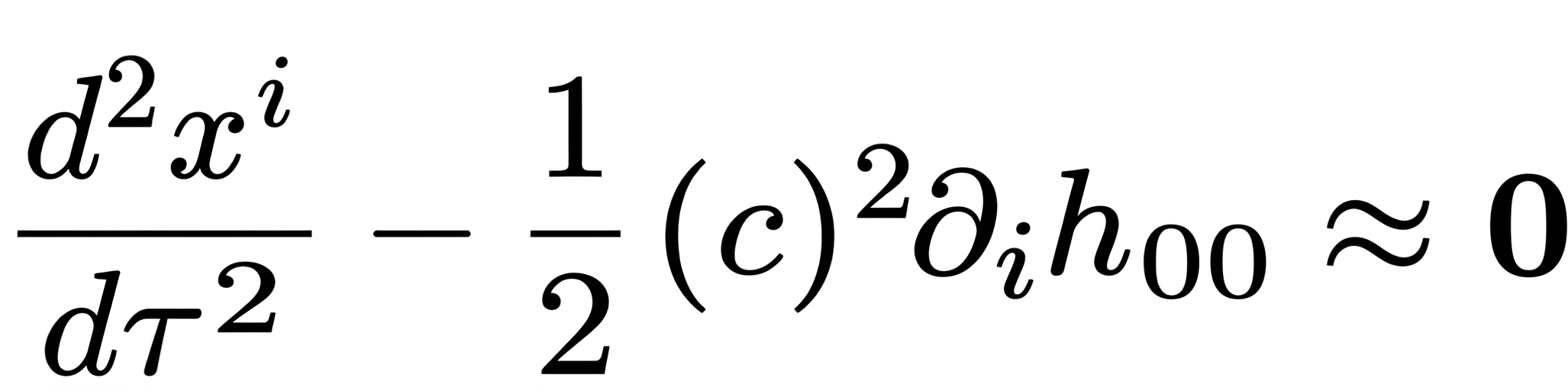
Then we can add the negative term to each side to get:
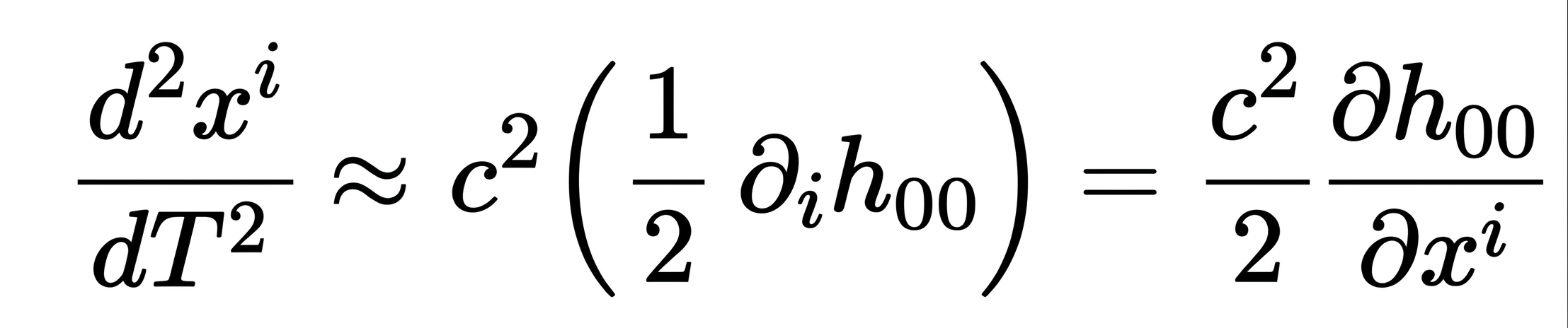
Now because we assumed that we are dealing with extremely slow speeds proper time T= coordinate time t (there is no lorenz time dilation applied).
We already know that acceleration of a freely fallen object is given by:

where the final term is the derivative of the scalar gravitational potential is equivalent to our acceleration (to see how the scalar gravitational potential is derived, please see #appendix5).
and we can plug in the acceleration value in terms of the small perturbation h00 to get:
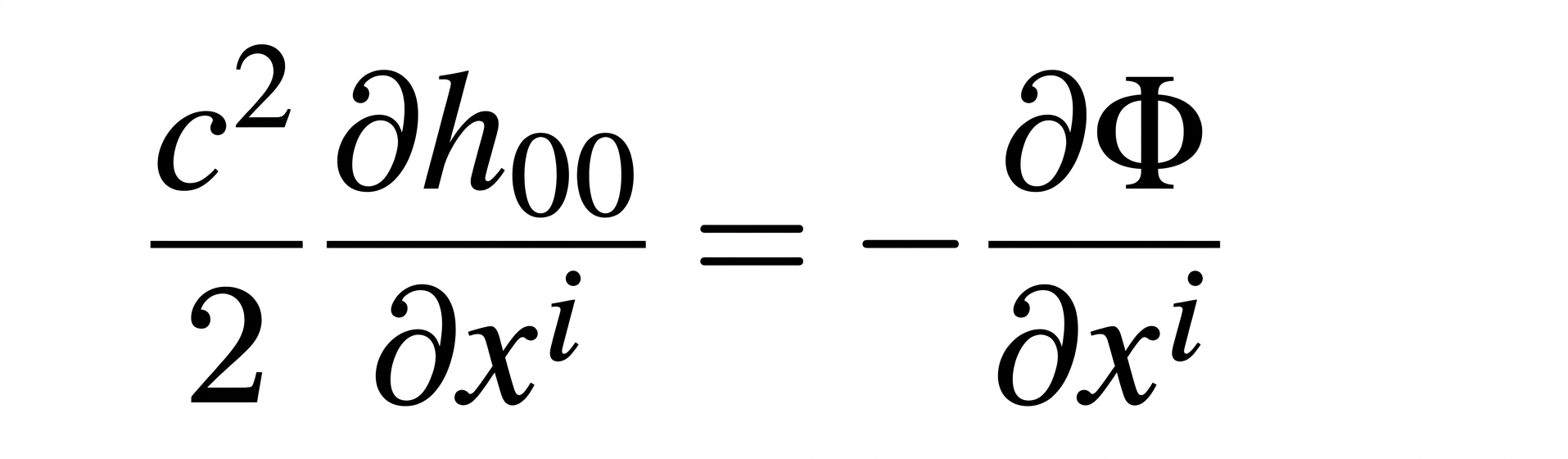
Therefore, after isolating and integrating we get:
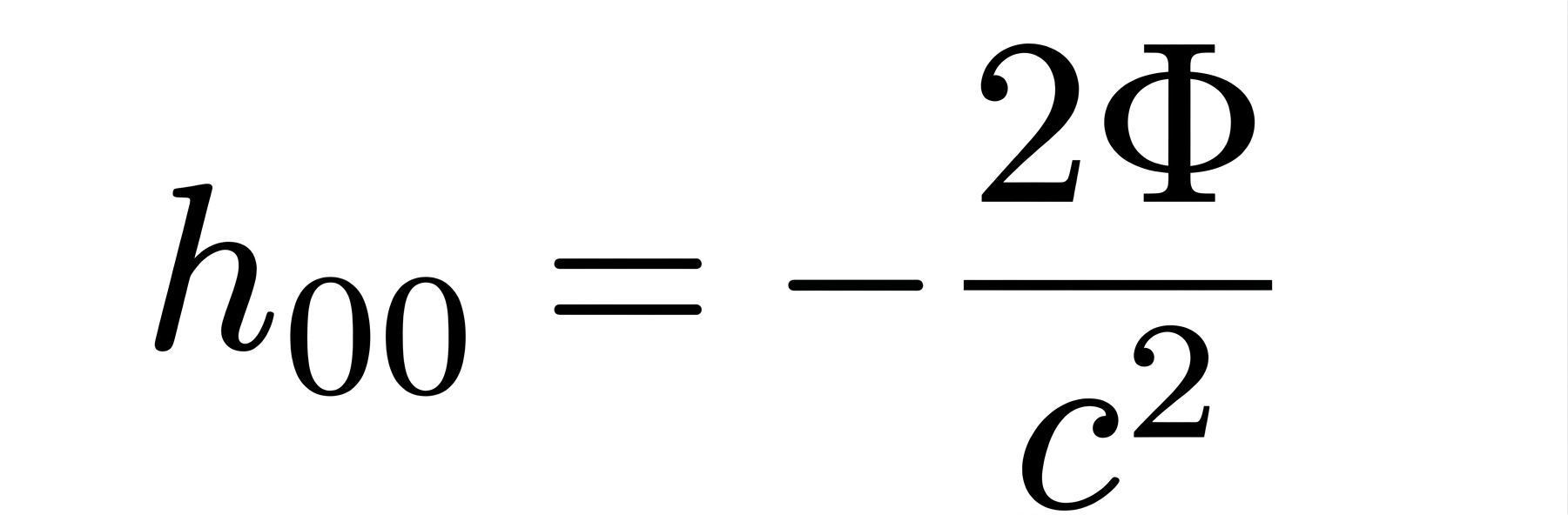
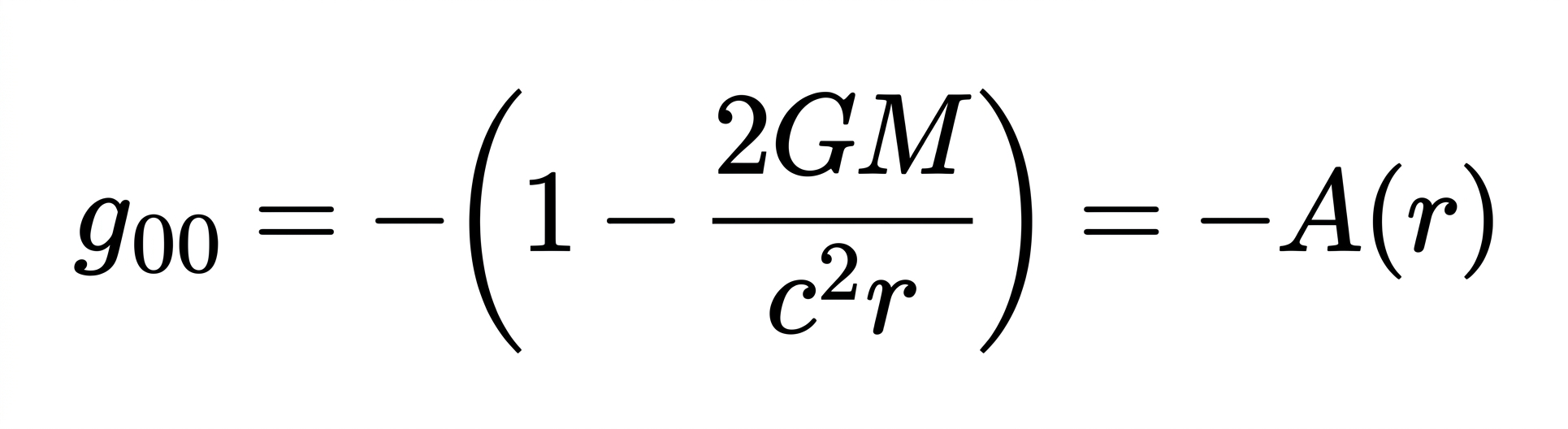
and plugging this value back into g00 with the minus coefficient , meaning n00=-1 (using the – +++ metric signature is allowable in that we get:

and plugging in yet again for our gravitational scalar potential which is -GM/r:
Appendix 5- Derivation of the Gravitational Potential
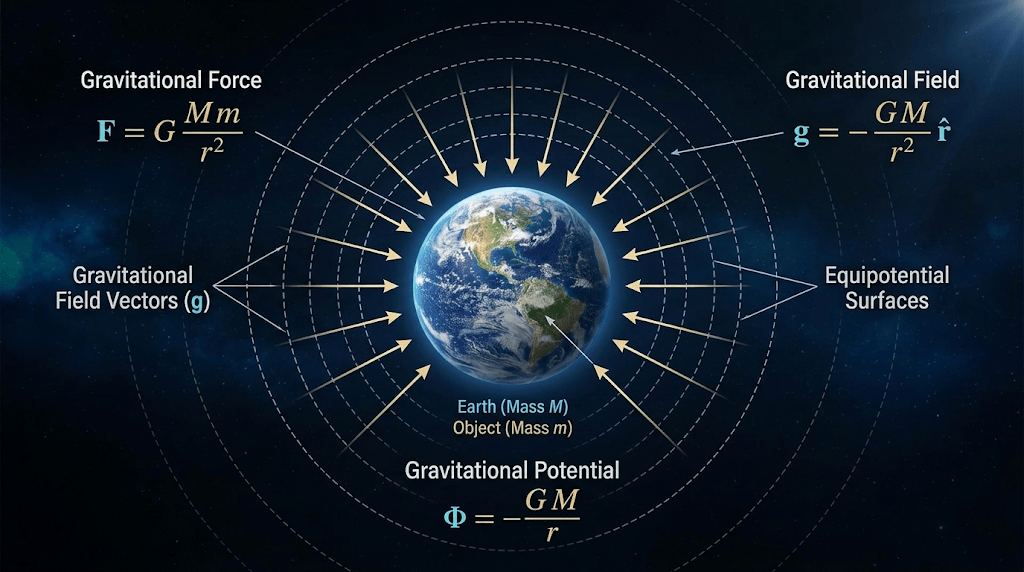
Gravitational potential is a scalar field , and when taking its radial derivative along r, we get the gravitational force (a vector). Gravitational potential is a scalar because it is composed of three scalars: G, M, and the distant invariant r (which is not a vector but a distance). Now, because gravitational force acts along the radius , we take the covariant derivative of the scalar field along r to create the gravitational vector field. But we use the scalar field because it is coordinate-invariant, rather than the gravitational field that is frame dependent because of the r basis vector.
Thus we have that our gravitational force equation, which must act in the opposite direction of the vector r that points outward from the origin of the planet to a point (thus we have a negative sign below):