It is amazing that light is actually an electromagnetic wave, but how can we actually "illuminate" this through mathematics? It was James Clerk Maxwell back in the 19th century who built upon his predecessors' scientific observations of electric and magnetic fields and then applied mathematical analysis to these observations to enlighten us all about the … Continue reading How the Curl of Curl Gives Light on Electromagnetic Waves and other Phenomena
Tag: mathematics
Divergence, Curl and the Taylor Series Approximation
I wanted to examine two crucial principles in understanding the physics behind how systems flow- divergence and curl- and to fully explain both the mathematical assumptions and intuitions that underlie these bedrock foundations of field motion. I think what is most often overlooked in the explanations of divergence and curl is the fundamental importance in … Continue reading Divergence, Curl and the Taylor Series Approximation
Of Unwavering Importance: The Wave Equation Derivation
(Also, note that to achieve these boundary conditions, the sine waves across L must all be increments of half wavelengths- this is covered more in the Appendix section.) (Note: in the above the imaginary number i was dropped from multiplying the Dn coefficient. This can be done by constructing the original Cn and Dn coefficients … Continue reading Of Unwavering Importance: The Wave Equation Derivation
The Lorentz Factor and the Invariance of Relativity
In many ways, the theory of relativity could have been named the theory of constancy, since it relies upon things that are invariant like the speed of light and the Lorentz factor. This post aims to derive the mysterious Lorentz factor using the fewest assumptions possible along with the most mathematical proof possible. Before relativity … Continue reading The Lorentz Factor and the Invariance of Relativity
Orbiting Around the Truth Part II: Adjusting the Orbital Path Equation Using General Relativity
In the previous post https://mathintuitions.com/2024/08/14/orbiting-around-the-truth-approximations-involved-in-newtons-and-einsteins-orbital-equations-part-i/, we were able to derive the elliptical orbital path of a planet, where its radial length r is a function of its angle, phi: where L, the angular momentum, is equal to Before arriving at the above expression for r in terms of phi, we arrived at a simpler, more … Continue reading Orbiting Around the Truth Part II: Adjusting the Orbital Path Equation Using General Relativity
To Infinity and Beyond: The Parabola as an Infinite Ellipse
A few weeks back I came upon the claim that a parabola is just an infinite ellipse, with one focus of the ellipse at infinity. I wasn't entirely convinced until I started to look deeper into the properties of ellipses with the help of Desmos. Here is a picture of an ellipse from https://commons.wikimedia.org/wiki/File:Ellipse-param.svg#/media/File:Ellipse-param.svg The … Continue reading To Infinity and Beyond: The Parabola as an Infinite Ellipse
The Most Irrational Number and Its Rational Beauty in Nature
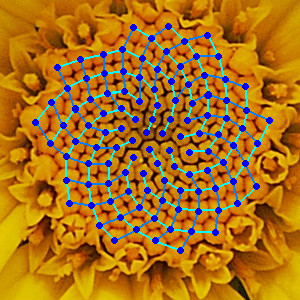
Image By User:Alvesgaspar:derivative work: RDBury (talk) - Mother_and_daughter.jpg, CC BY 2.5, https://commons.wikimedia.org/w/index.php?curid=15047443
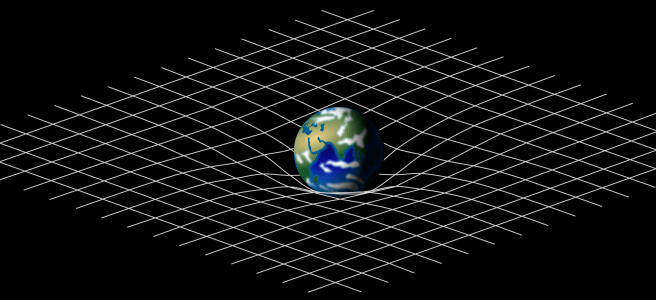
It’s All Relative: Various Visualizations for the Warping of Space-Time in General Relativity
Imaginary Numbers and Wormholes
In Paul J. Nahin's book "An Imaginary Tale," a very interesting mathematical puzzle is introduced regarding imaginary numbers that leads to connections to wormholes in the space-time continuum. (image of wormhole is from Wikipedia AllenMcC. Vector: KES47 - Own work based on: Lorentzian Wormhole.jpg by AllenMcC., CC BY-SA 3.0, https://commons.wikimedia.org/w/index.php?curid=30231987 ). He discusses the discovery of … Continue reading Imaginary Numbers and Wormholes
Geometrical Proof of the Cross Product
From our previous discussion (https://mathintuitions.com/2022/09/22/stranger-than-fiction-a-derivation-of-the-coriolis-force-to-explain-the-path-of-hurricanes-and-snowballs-on-carousels/), the cross product of the angular velocity (with components vi and vj) with the position vector was and is the tangential velocity vector. It can also be written more specifically as xivj - yjvi). The cross product of two vectors A and B with 2 dimensions is calculated as AiBj … Continue reading Geometrical Proof of the Cross Product