In many ways, the theory of relativity could have been named the theory of constancy, since it relies upon things that are invariant like the speed of light and the Lorentz factor. This post aims to derive the mysterious Lorentz factor using the fewest assumptions possible along with the most mathematical proof possible. Before relativity … Continue reading The Lorentz Factor and the Invariance of Relativity
Category: Uncategorized
Orbiting Around the Truth Part II: Adjusting the Orbital Path Equation Using General Relativity
In the previous post https://mathintuitions.com/2024/08/14/orbiting-around-the-truth-approximations-involved-in-newtons-and-einsteins-orbital-equations-part-i/, we were able to derive the elliptical orbital path of a planet, where its radial length r is a function of its angle, phi: where L, the angular momentum, is equal to Before arriving at the above expression for r in terms of phi, we arrived at a simpler, more … Continue reading Orbiting Around the Truth Part II: Adjusting the Orbital Path Equation Using General Relativity
Orbiting Around the Truth Part I: Approximations Involved In Newton’s and Einstein’s Orbital Equations
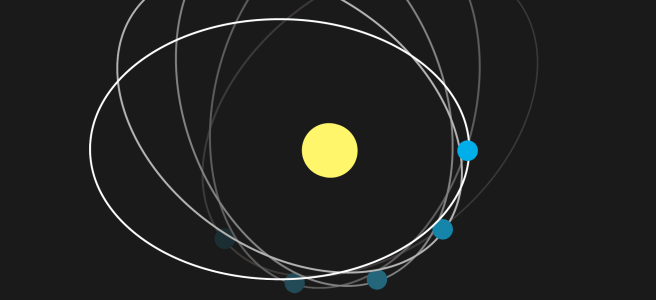
The precession of Mercury according to Einstein's equations, shown in the image, from https://en.wikipedia.org/wiki/Tests_of_general_relativity#/media/File:Apsidendrehung.png
To Infinity and Beyond: The Parabola as an Infinite Ellipse
A few weeks back I came upon the claim that a parabola is just an infinite ellipse, with one focus of the ellipse at infinity. I wasn't entirely convinced until I started to look deeper into the properties of ellipses with the help of Desmos. Here is a picture of an ellipse from https://commons.wikimedia.org/wiki/File:Ellipse-param.svg#/media/File:Ellipse-param.svg The … Continue reading To Infinity and Beyond: The Parabola as an Infinite Ellipse
The Most Irrational Number and Its Rational Beauty in Nature
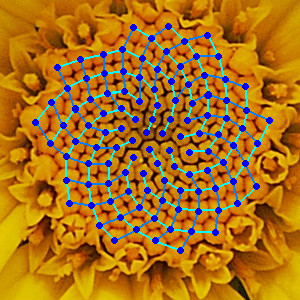
Image By User:Alvesgaspar:derivative work: RDBury (talk) - Mother_and_daughter.jpg, CC BY 2.5, https://commons.wikimedia.org/w/index.php?curid=15047443
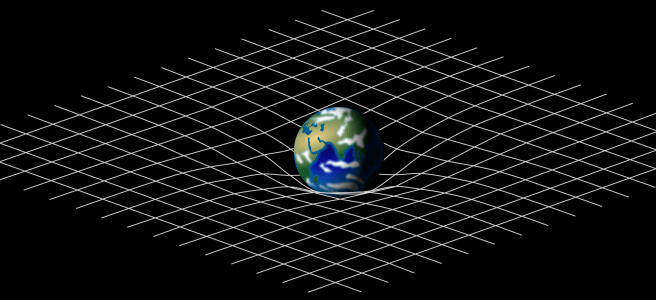
It’s All Relative: Various Visualizations for the Warping of Space-Time in General Relativity
A Mystery with Gravity: The Gravitational Constant “G” Derived from Newtonian Principles
Image attributed to Wikipedia:https://commons.wikimedia.org/wiki/File:Merging_Group_Arp_194.png
Imaginary Numbers and Wormholes
In Paul J. Nahin's book "An Imaginary Tale," a very interesting mathematical puzzle is introduced regarding imaginary numbers that leads to connections to wormholes in the space-time continuum. (image of wormhole is from Wikipedia AllenMcC. Vector: KES47 - Own work based on: Lorentzian Wormhole.jpg by AllenMcC., CC BY-SA 3.0, https://commons.wikimedia.org/w/index.php?curid=30231987 ). He discusses the discovery of … Continue reading Imaginary Numbers and Wormholes
The Tiniest Changes Add Up: How Infinitesimals Preserve Constant Area in Geometry and Unit Elasticity in Economics
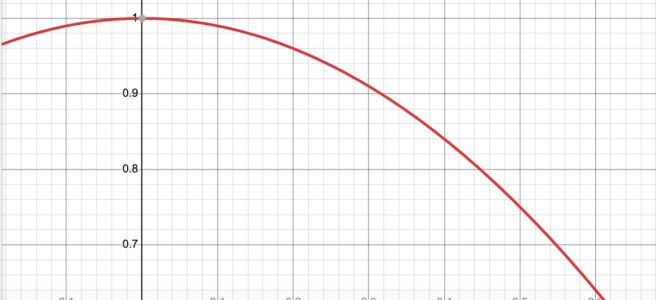
In our previous post, we found that area cannot be maintained through equal but opposite percent changes in length and width using algebraic techniques. We determined that when we increased length by a certain percentage and decreased width by the same percentage, our new area calculation was derived through a downward sloping parabola of the … Continue reading The Tiniest Changes Add Up: How Infinitesimals Preserve Constant Area in Geometry and Unit Elasticity in Economics
Algebra’s “Constant” Problem: Why we can’t Maintain Constant Area Given Equal Percent Changes in Length and Width
As a teacher of SAT Math problems, I was stumped when I thought about the implications of the following SAT math problem more deeply: what happens to the area of a rectangle when its length increases by 30% and its width decreases by 30%? Solving the problem itself is algebraically straightforward. We start by letting … Continue reading Algebra’s “Constant” Problem: Why we can’t Maintain Constant Area Given Equal Percent Changes in Length and Width