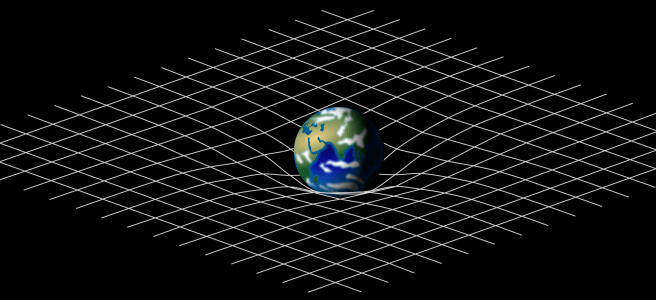
image from https://en.wikipedia.org/wiki/General_relativity#/media/File:Spacetime_lattice_analogy.svg
It’s All Relative: Various Visualizations for the Warping of Space-Time in General Relativity
Intuitive discussions in mathematics, by Josh Fialkow

Image attributed to Wikipedia:https://commons.wikimedia.org/wiki/File:Merging_Group_Arp_194.png

In Paul J. Nahin's book "An Imaginary Tale," a very interesting mathematical puzzle is introduced regarding imaginary numbers that leads to connections to wormholes in the space-time continuum. (image of wormhole is from Wikipedia AllenMcC. Vector: KES47 - Own work based on: Lorentzian Wormhole.jpg by AllenMcC., CC BY-SA 3.0, https://commons.wikimedia.org/w/index.php?curid=30231987 ). He discusses the discovery of … Continue reading Imaginary Numbers and Wormholes

From our previous discussion (https://mathintuitions.com/2022/09/22/stranger-than-fiction-a-derivation-of-the-coriolis-force-to-explain-the-path-of-hurricanes-and-snowballs-on-carousels/), the cross product of the angular velocity (with components vi and vj) with the position vector was and is the tangential velocity vector. It can also be written more specifically as xivj - yjvi). The cross product of two vectors A and B with 2 dimensions is calculated as AiBj … Continue reading Geometrical Proof of the Cross Product

For a long time I wondered how we can mathematically intuit the fictitious Coriolis Force (title image taken from en.wikipedia.org/wiki/Coriolis_force) . For those unacquainted with this force, the best place to understand it is on a carousel. While riding this carousel, imagine you are on the southern most spot and your friend is on the … Continue reading Stranger than Fiction: A Derivation of the Coriolis Force to Explain the Path of Hurricanes and Snowballs on Carousels
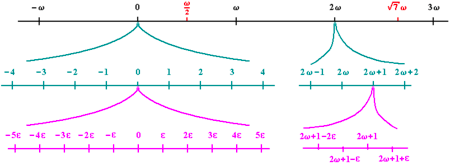
In our previous post, we found that area cannot be maintained through equal but opposite percent changes in length and width using algebraic techniques. We determined that when we increased length by a certain percentage and decreased width by the same percentage, our new area calculation was derived through a downward sloping parabola of the … Continue reading The Tiniest Changes Add Up: How Infinitesimals Preserve Constant Area in Geometry and Unit Elasticity in Economics
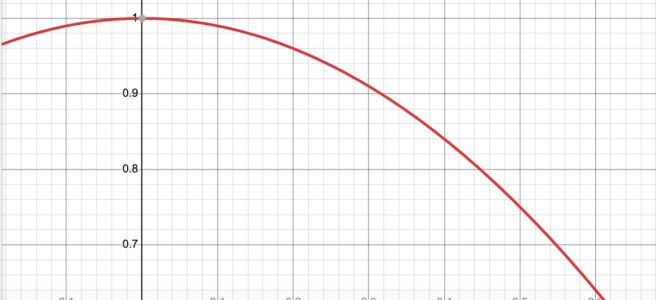
As a teacher of SAT Math problems, I was stumped when I thought about the implications of the following SAT math problem more deeply: what happens to the area of a rectangle when its length increases by 30% and its width decreases by 30%? Solving the problem itself is algebraically straightforward. We start by letting … Continue reading Algebra’s “Constant” Problem: Why we can’t Maintain Constant Area Given Equal Percent Changes in Length and Width
 Mathintuitions

