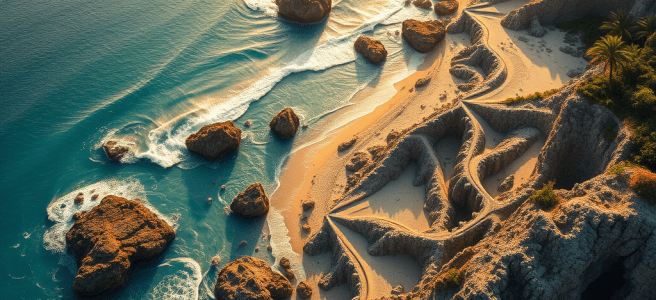
This post is about how an entire geological story can be embedded in a single number, a number that weaves together the degree of volcanic activity, rock type, river flow, sea level rise and presence of coral reefs, amongst other influences. And from the implications of this number in the geological story, we can derive general principles that apply to biology too. This special kind of number is the fractal dimension, used to measure a fractal shape, which is defined as a shape with meaningful detail at every scale, so zooming in reveals new structure rather than a smooth edge. Many patterns in nature exhibit fractal-like behavior over a variety of scales: for example, a few famous fractal patterns include cloud perimeters, river networks, tree branching, and coastlines. We will focus on the last of these- the fractal quality of coastlines- to help us understand the unique stories of a few islands in one of my favorite places in the world: the Caribbean. We will also derive a new way to understand fractal dimension in terms of a race between two dimensions.
To first understand what a fractal is (for video reference, please visit 3 Blue, 1 Brown’s video https://www.youtube.com/watch?v=gB9n2gHsHN4 for the best introduction to understanding fractals), we must define the concept of dimension in an intuitive fashion.
Let’s start with the first dimension: a line is one dimensional because it has a single axis of measurement, let’s call it the x-axis, and only needs a single number to describe a point’s location along that axis. A piece of paper is two dimensional because it has two axes of measurement, the x-axis and y-axis, and needs two numbers to describe a point’s location in that space. Our spatial world is three dimensional because we have 3 axes to describe location: x, y and z. On the other hand, a single point of infinitesimal size is 0 dimensional, since there is no number necessary to describe where you are on the point (if on the point, you can only be on the point and not anywhere else). But is there any room for dimensions between 0 and 1 or 1 and 2? Can we properly think of a dimensionality of 1.2? The fractal dimension is the answer to our dimensional dilemma.
There are different ways to define fractal dimension, but we will mainly use two. The first definition relates a shape’s “mass” to how it scales. By “mass,” we mean the number of self-similar copies needed to rebuild the original shape, where each copy is just a smaller version of the whole. For instance, a square of side length 1 can be reconstructed from 4 smaller squares, each with side length 1/2. Thus, when the length scale is reduced by a factor of , the number of self-similar copies is 4 (it would take 4 copies of s=1/2 to rebuild the original square).
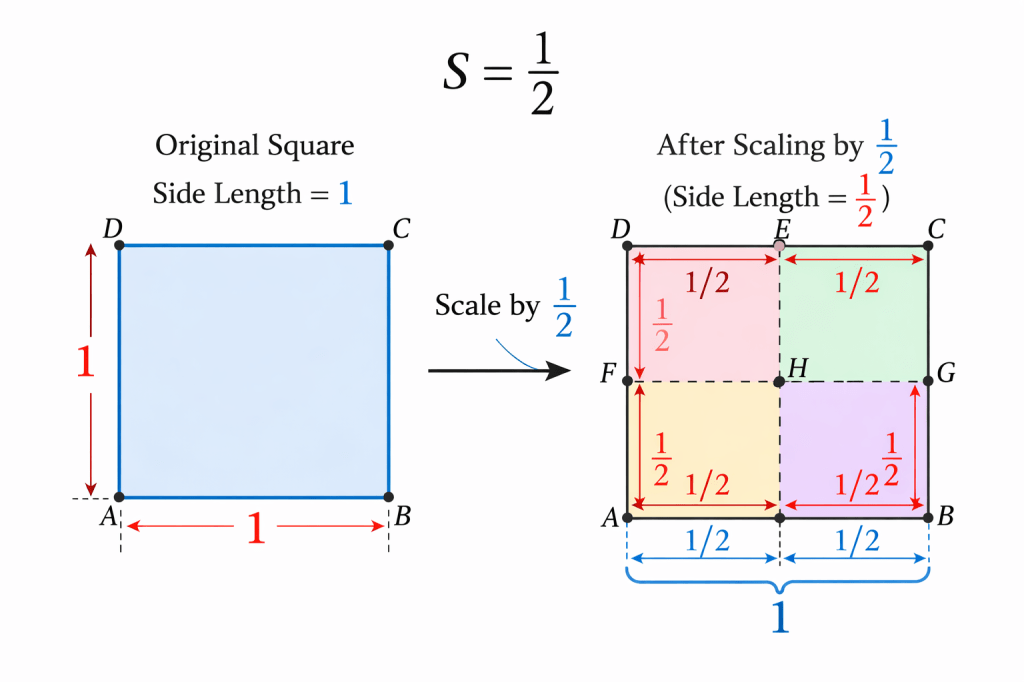
We can relate the mass, or number of self-similar copies, and the scale factor s by raising s factor to the power -d, as in:
Using our previous example where the mass of the figure is 4 after scaling by 1/2, our equation would become


If we continued this process of scaling the square by 1/2 in multiple iterations, for any given iteration for our square our equation for fractal dimension would become 
Now let’s examine the properties of a true fractal, the Sierpinski triangle:
In order to generate the Sierpinski Triangle:
- Start with an equilateral triangle.
- Remove the central triangle whose vertices are at the midpoints each side.
- Continue to remove the central triangles of any of the newly formed triangles using the method in 2., to infinity:
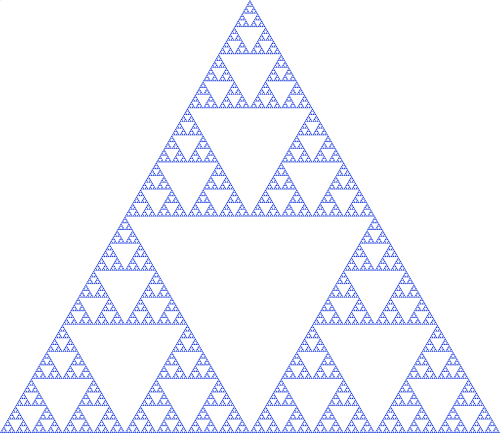
from https://commons.wikimedia.org/wiki/File:Sierpinski_triangle.svg
We can see that there are 3 copies of the whole when we apply a scaling factor of 1/2, or in other words, we can rebuild the entire fractal by using 3 copies that are scaled at 1/2.. Thus, M=3, S=1/2, so our equation 
![\displaystyle \log 3=\log\left[\left(\frac{1}{2}\right)^{-d}\right]](https://s0.wp.com/latex.php?latex=%5Cdisplaystyle+%5Clog+3%3D%5Clog%5Cleft%5B%5Cleft%28%5Cfrac%7B1%7D%7B2%7D%5Cright%29%5E%7B-d%7D%5Cright%5D&bg=eeeeee&fg=666666&s=0&c=20201002)


The following proof shows that the Sierpinski triangle is somewhere between 1 and 2 dimensions because its length (1st dimension) is infinite but its area (2nd dimension) is 0, according to the following proof:
Let’s start with area:
At each iteration of the Sierpiński triangle construction, the center 1/4 of each remaining triangle is removed, so 3/4 of the area is retained at each step.
Let 


The area after
Since 
Therefore, the Sierpiński triangle has area zero.


We can also show how the Sierpinski triangle has infinite perimeter: Our initial perimeter is for a single equilateral triangle, for which each side has length L:

After the first Sierpiński iteration, there are 3 smaller triangles, each with 3 sides of length 
So the total perimeter after the first iteration is: 
After the second iteration, there are 

So , 


Starting from 


From our calculations of perimeter and area, it seems that the perimeter increases more quickly to infinity than the area decreases towards 0, which yields the intuition that perhaps the Sierpinski triangle is more area-like than line-like, since for each successive iteration in the fractal we have the following relationship:

In other words, the perimeter increases by 50% while the area decreases by 25% after each iteration, meaning that the perimeter becomes infinite “faster” than the area gets to 0 so the Sierpinski seems to be more area-like.
This seems to hint that there is a way to calculate the fractal dimension based on how quickly perimeter increases relative to how quickly area decreases, and that if perimeter increases faster than area, then the fractal dimension should be above 1.5, showing it is closer to a 2d area than a 1d line.
In order to calculate the fractal dimension based on the relative increases and decreases of perimeter and area, we must first address how perimeters and areas generally scale according to their mass M (self-similar copies) and scaling factor s.
We can derive how perimeters generally scale by first using the Sierpinski triangle as an example. We assume it is built from Mn+1 triangle copies, each of whose 3L lengths is scaled by factor s compared to the previous step’s Mn copies, so our perimeter scaling after each consecutive iteration is 


Our 2-d area scaling for the Sierpinski triangle and more generally for any self-similar fractal begins by scaling each of the 2 lengths needed to calculate area by s in each of the Mn+1 copies, so we get: 


We can actually now figure out what s and


Now we must solve for


We are now ready to get our fractal dimension in terms of perimeter and area alone. As we already know, fractal dimension is 

In order to make more intuitive sense of this equation, let’s let 


This final equation tells us that if the log ratio of the perimeter iteration is larger than the log ratio of the area iteration, we get a fractal dimension above 1.5, and thus more 2-d like than 1-d like, just as we predicted earlier. Let’s first get a deeper understanding of the denominator. The log of the area ratio is always negative, since An+1 is always less than An, so that when we subtract the term in the denominator, 

But what about when there is a fractal that does not contain self-similar copies? How can we measure the fractal dimension? After all, our fractal dimension formula
The basic box counting formula (we will be modifying it shortly) is 
Let’s solve for d in our box counting formula:

Since , you can also write it as

Using the example of the Sierpinski triangle, we already know that when we use the mass-scaling formula for self similar fractals, we have 3 copies of the original, each copy shrunken by 1/2 length compared to the whole. Will the box counting method result in the same fractal dimension? Let’s use the more straightforward example of the Sierpinski Right triangle, formed using the same repetitive process of connecting midpoints and removing the middle 1/4 of each triangle. The Sierpinski right triangle makes the box counting method most clear. We assume we started with a box of side length 1 that had the entire triangle inside it, and then scaled that box with the scaling factors shown below:
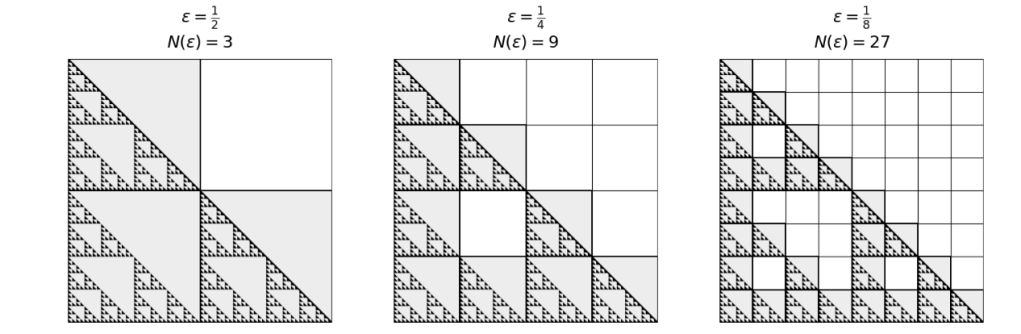
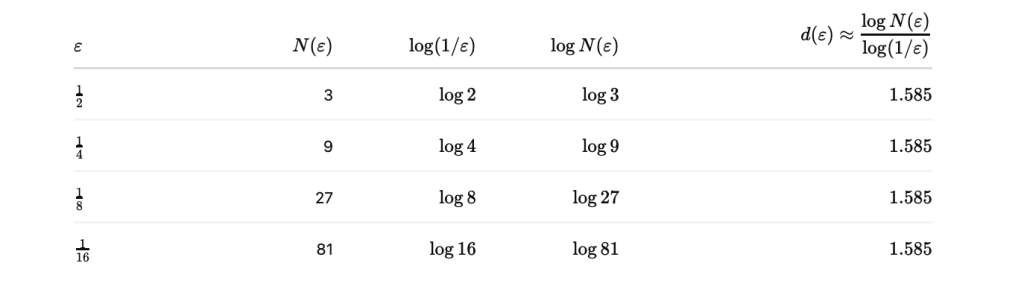
Here we see that we get exactly the same fractal dimension using the box counting method as we did using the fractal self-similar mass method, since each box maps perfectly to count exactly 1 self-similar copy of the fractal at every scale ! However, when we use the equilateral Sierpinski triangle, there is a slight difference in the fractal dimension calculation: as we shrink the box size , we get closer and closer to d=1.585, as shown below, rather than calculating d=1.585 at every scale:
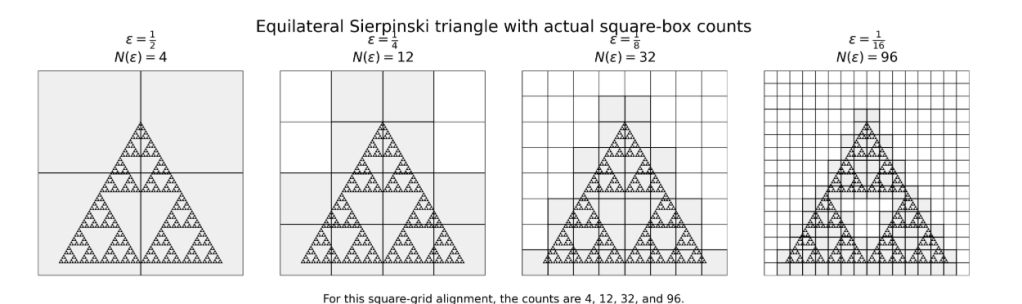
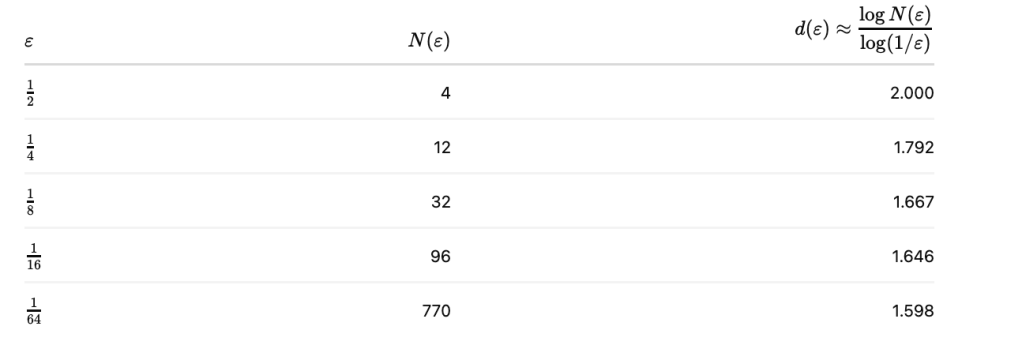
The above shows that our approximation to the true fractal dimension improves as 

There is one last modification we need to make to the box counting formula. The meaning of 


So our general box counting formula becomes 


Now solving for d we get 


Let’s put this box counting formula to work by using the classic example of how to calculate the fractal dimension of the coastline of Great Britain:
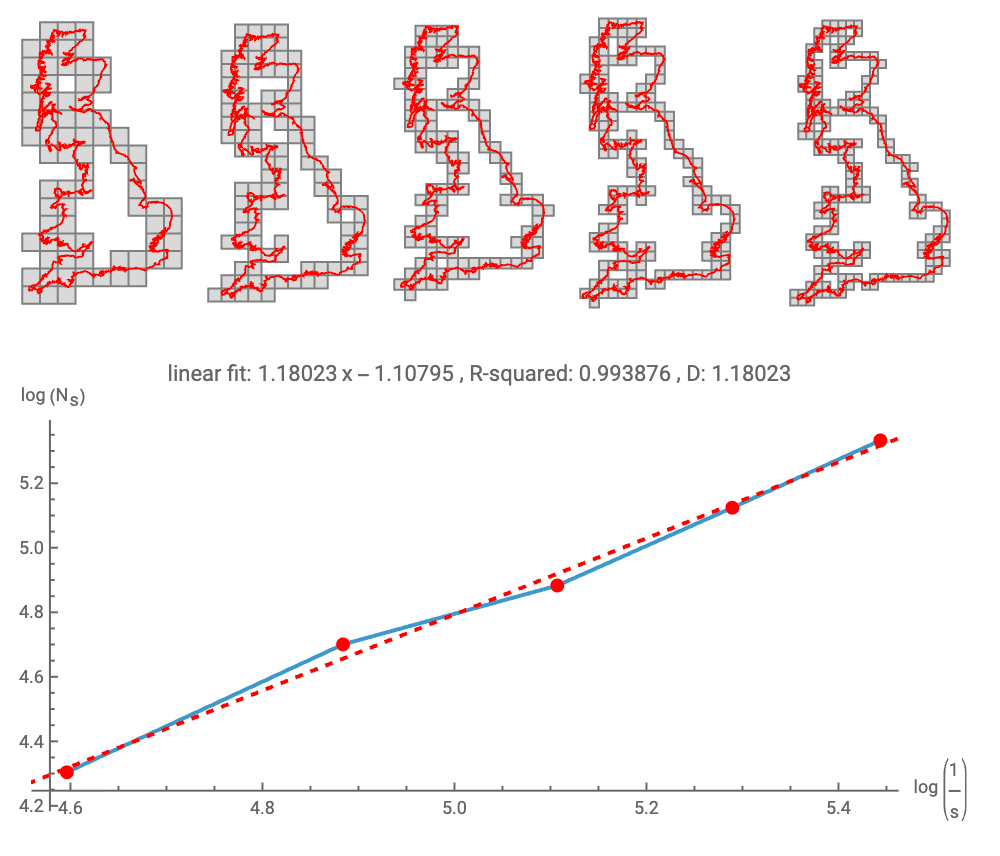
We see from the above that the fractal dimension, or the slope of this line, is approximately 1.18, We know that the fractal dimension is the slope because the formula is 
As promised, we finally return to the notion that this simple number, the fractal dimension of a coastline, can tell us so much about an island’s geological history. Below are some of the fractal dimensions calculated through the box counting method, where a specific range of smaller scales of the boxes reveals a relatively stable calculation for the fractal dimension:
Fractal Dimensions of Caribbean Coastlines
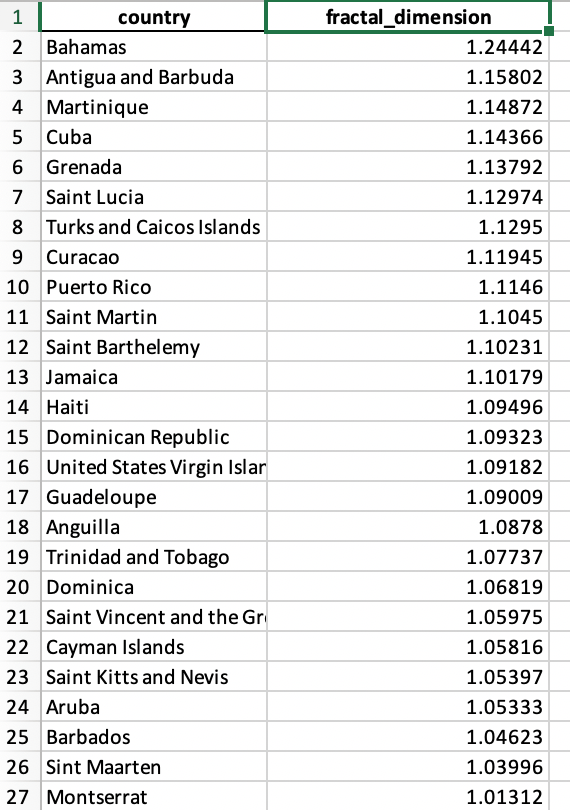
from https://datarepository.wolframcloud.com/resources/WolframSummerCamp_Coastline-Fractal-Dimensions/
We will use three of these groups of islands, the Bahamas (the highest fractal dimension on this list at d
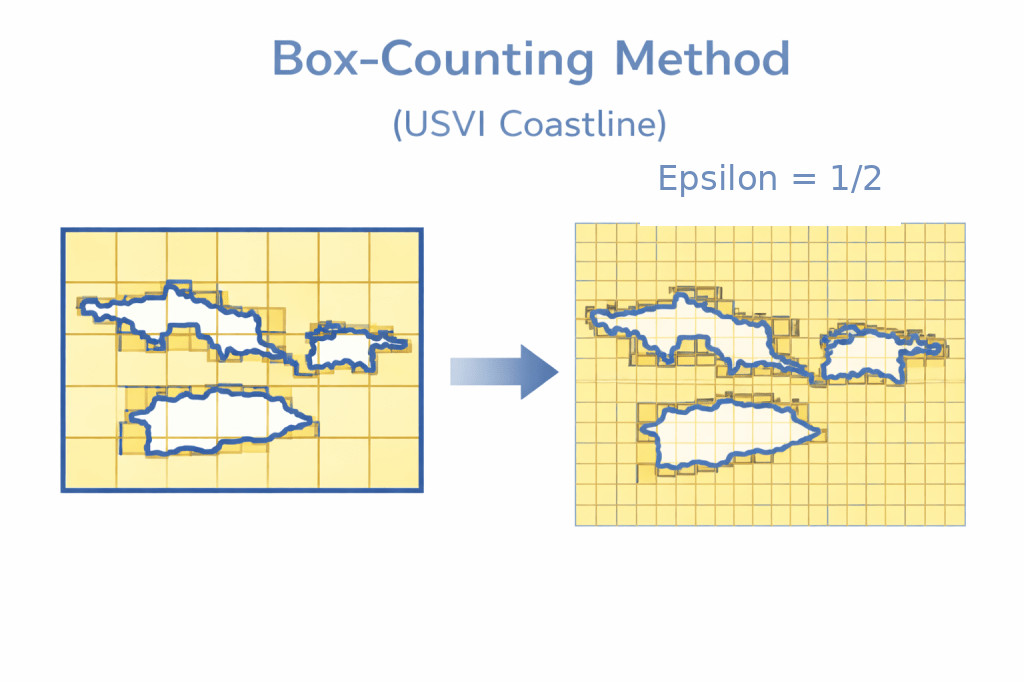
The Bahamas has the highest fractal dimension of all the Caribbean islands at approximately 1.244, which makes sense for a low-lying archipelago built on shallow carbonate banks rather than a single steep island. The Bahamas is largely composed of limestone and carbonate, formed from the remains of coral and other marine skeletons. Much of the country sits on very shallow platforms, often 10 meters deep or less. That setting gives wave action more ways to create complexity: instead of hitting one direct shoreline, waves refract and break across the easy-to-erode, low lying carbonate banks, creating complex patterns due to the repeated iterations of wave action carving into the shoreline. It is this easily repeatable carving out of the Bahamas shoreline that makes its fractal dimension the highest out of all the islands.
The U.S. Virgin Islands sits in the middle of the list with a fractal dimension of approximately 1.092. The islands are mostly volcanic in origin, and were formed 100 million years ago. Because these islands were built by ancient volcanoes (which have not been active since), they contain steeper slopes along the coastlines than the Bahamas. Additionally, the volcanic rock is harder to erode than the carbonate of the Bahamas. These factors, namely the steeper slope and the harder-to-erode rock, make it harder for waves to carve out the shoreline. This helps explain why St. Thomas has a lower fractal dimension than the Bahamas.
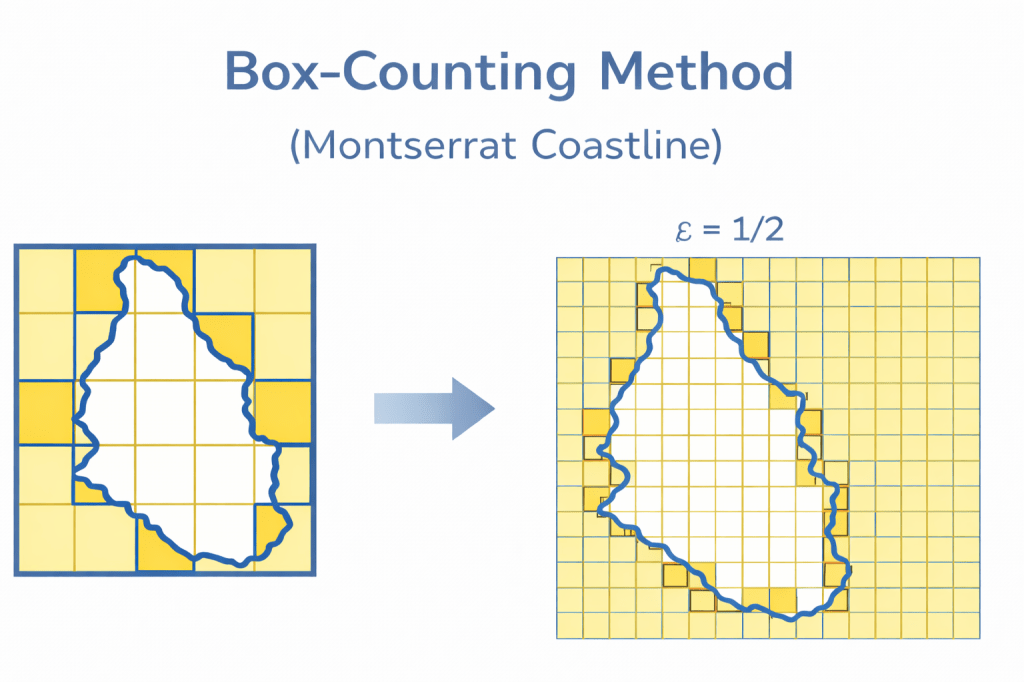
Montserrat has the lowest fractal dimension value of approximately 1.013, suggesting a coastline that is comparatively smooth at the scale measured. This makes a lot of sense: similar to St. Thomas, Montserrat is built from volcanic action, but unlike St. Thomas, Montserrat has had very recent eruptions in which the coastline has been smoothed over by lava flows. Thus, in Montserrat, the very recent volcanic action has smoothed over many of the coastline irregularities, resulting in a very low fractal dimension closest to 1.
We can understand through these three examples that nature often forms fractals because of repetitive processes that iterate similar to the process that creates the Sierpinski triangle. In the case of the coastlines, we see that the repetitive process of waves crashing into the shoreline can create very intricate patterns, whose complexity increases depending on how amenable the geological structure is for waves to carve out patterns. The very complexity of this action means that we do not get self similar fractals that are produced with ideal mathematical constructions (like the Sierpinski Triangle), but rather we get imperfect and jagged structures whose dimensions are between 1 and 2. Nevertheless, we see that from our previous discussion, we can still calculate the fractal dimension of these imperfect shapes using the box counting method, which can produce a reliable estimate of how a coastline consistently behaves over defined ranges of scaling factors. Moreover, we now know that behind the box-counting of the coastlines lurks an even deeper principle: a race between the perimeter and area of the fractal, with perimeter ballooning to infinity and area shrinking to 0. It is this mathematical race that lies at the very foundation of understanding whether a fractal behaves more like a line or more like an area, and such understanding can extend to the inter-dimensionality of other fractal shapes as well. For instance, if we have a fractal shape between the second and third dimension , we can view such a shape’s fractal dimension as a race between its area ballooning to infinity and its volume shrinking to zero. Fractal dimension, then, is not just a number. It’s a way of describing where a shape lives within a dimensional race, and it’s nature’s way of revealing hidden structure.

 Mathintuitions
