- Waves and Young’s Double Slit Experiment
The quantum world reveals an astonishing truth: light, electrons, and indeed all matter in the universe — including ourselves — are described by mathematical wavefunctions that represent the probabilities of finding each particle in a particular location. These wavefunctions remain spread out until a measurement or interaction with the environment, which causes them to entangle with the environment, destroying observable interference and yielding a discrete location for the particle. Before exploring how matter exhibits wave-like behavior, we must first understand how Young, in 1804, seemed to prove that light itself was a wave, rather than a particle. His famous double slit experiment is shown below:

When shining a light through a partition with two openings, Young observed that the projection on the back screen formed the characteristic interference patterns of waves, where we see light and dark bands signifying two separate waves either interfering constructively with each other (crests adding to crests or troughs adding to troughs) creating light bands, or destructively with each other (crests adding to troughs), creating dark bands. This type of pattern is a fundamental characteristic of the wave equation, which shows how waves can add linearly to each other (for more on the linearity of waves, see https://mathintuitions.com/2025/04/28/of-unwavering-importance-the-wave-equation-derivation/?preview_id=1449&preview_nonce=1c838f4945&preview=true&_thumbnail_id=1491). Later on in the 19th century, James Clerk Maxwell showed mathematically that light is indeed a wave: an electromagnetic wave (for Maxwell’s derivation, see https://mathintuitions.com/2025/06/25/how-the-curl-of-curl-gives-light-on-electromagnetic-waves-and-other-phenomena/?preview_id=1788&preview_nonce=6b97f120bc&preview=true&_thumbnail_id=1892 . But this was not the end of the story.
As Planck, Einstein, and other early twentieth-century physicists demonstrated, light and electrons are BOTH waves and particles! The picture below shows what happens when you shoot single electrons through double slits. Each individual electron or photon makes one discrete mark on the screen, showing its particle nature rather than wave nature. However, after firing many individual particles, the classic interference pattern emerges. What does this tell us? That until the particle is detected, it is acting as a probability wavefunction, passing through both slits simultaneously, interferes with itself after passing the slits, and finally shows up as a single dot in one of the characteristic bright bands. A single particle NEVER appears in the dark bands; the dark bands show those areas where the wavefunction interfered with itself as a wave, before it appeared as a discrete particle on the detector screen. Thus, as a wave function, the electron seems to be exploring all possible paths (it is not in any one definite location), until detection forces it to become localized; before detection, we can only speak about the probability amplitude describing where the electron might be found if measured. The wavefunction itself is this amplitude, whose squared, normalized magnitude gives the actual probability distribution of finding the particle at a certain location upon detection.

The equation first developed to deal with the dual wave and particle nature demonstrated by the above experiment is Schrodinger’s Equation, which can be derived through the wave equation itself. As a reminder, the wave equation, in this case for an electromagnetic wave traveling at speed = c, is 


We can show that 

Plugging these values into the wave equation, we get the following:

This means that as long as w=ck, we have satisfied the wave equation! Let’s try to make sense of why it must be true that w=ck, in a more mathematically intuitive way. Firstly, we know that frequency times wavelength equals speed; for example, if a wave that is 10 meters long travels 5 wavelengths per second, that means it travels
10m/

Furthermore, we know that k=w/c, so we can then substitute: 

2. From Classical Waves to Quantum Energy and Momentum
Now that we have established a solution to the wave equation, we must adjust it according to the early 20th century developments in quantum mechanics in order to better understand the dual wave-particle nature of light. We can start our story with Max Planck, an early 20th-century physicist, who found that E=nhf, which states that the energy of radiation is equal to its frequency multiplied by Planck’s constant and n, where n is an integer. He introduced this idea to explain the behavior of the spectrum of blackbody radiation, though he still thought of light itself as a continuous wave. Planck’s formula for radiation, E=nhf, meant that the radiation was NOT absorbed or emitted continuously, but rather in discrete “quanta” — packets of energy proportional to the frequency of radiation. Classical physics, on the other hand, assumed that frequency did not matter for energy; rather, wave energy was seen to be dependent on intensity (which is reflected by light’s brightness and is defined by amplitude, or wave height). Then, Einstein proposed that light itself was composed of Planck’s discrete energy when he explained the cause of photoelectric effect: by increasing the frequency of light, you can eject more electrons from a metal surface, but you cannot eject more electrons by increasing its intensity (or wave amplitude). So whereas classical physics said that wave amplitude was the determinant for light’s energy, now, thanks to Planck and Einstein, we know that frequency is the determinant for light’s energy. Moreover, Einstein realized that when he applied Planck’s formula , the implication was that light is localized (acting like a particle) rather than spread out (acting like a wave). According to classical physics, the energy of light is spread out continuously across the wavefront, so an electron would need to absorb small amounts of this energy over time in order to be ejected. It might therefore take a measurable interval for the energy to build up sufficiently to eject the electron, but this never happens! Instead, because the electron was ejected instantaneously when light had a high enough frequency, Einstein realized that the energy transfer happens in quantized, instantaneous chunks — something only possible if light sometimes behaves as a particle of energy, which when packed with enough punch (a high enough frequency) can instantaneously eject the electron. Each individual particle’s energy is governed by Planck’s formula, E=nhf; n signifies a discrete number of photons, as opposed to a dispersed wave.
Not only did the definition of energy change, but so did the definition of momentum. In 1924, French physicist Louis de Broglie took Einstein’s idea of photons one step further. If light waves could behave like particles, he reasoned, perhaps particles of matter could also behave like waves. He proposed that every moving particle has an associated wavelength given by 
2.5. Derivation of Particle Momentum using Relativity


where

For an observer outside the particle’s rest frame, we know that the ratio of his time dt to the proper time dT is 

We can now substitute the above expression for dT in 


Furthermore, knowing that

we can express momentum as

The above expression gives momentum as a 4 vector, and is now in terms of the observer’s time dt- much more intuitive compared to the proper time dT, which is more difficult to grasp intuitively since it would only belong to the clock traveling with the moving particle. We see from the equation that that the zeroth component for momentum actually equals E/c, because of the following relation:

DeBroglie then used E=hf to make some substitutions for momentum, shown below, for photons and other massless particles:

Although at first glance it appears that only the zeroth component of momentum equals only for massless particles, Lorentz invariance requires energy–momentum and frequency–wavevector to transform consistently as four-vectors (see the appendix entitled Understanding the Invariance of the Klein-Gordon Equation). While neither momentum nor wavelength is itself invariant, this relation holds for all matter in all inertial frames, and may be written in any given frame as where is the de Broglie wavelength (for more on Lorentz invariance see, https://mathintuitions.com/2025/01/23/the-lorentz-factor-and-the-invariance-of-relativity/?preview_id=1344&preview_nonce=a649a25931&preview=true&_thumbnail_id=1758).
3. From the Wave Equation to the Klein-Gordon Equation
In the light of Planck’s and Einstein’s discoveries, we can now modify our wave equation knowing that E=hf and 


Plugging this into our wave equation, we get 
This confirms that 
In order to address this, we can first contract the contravariant components of P with its covariant components in order to get a scalar invariant (more on this idea to come in a future post, but for now familiarity with tensors is required to understand the next idea). To figure out the covariant components of momentum, we can multiply the contravariant components by the Minkowski metric tensor for flat space, which is +1, -1, -1, -1, and then contract our contravariant and covariant components:

So now we can make use of two results of the momentum contraction:


and set them equal to each other to solve for the energy term:: we get 

We can now plug this into our wave equation, which for massless particles is :


We can further rewrite the momentum and energy terms in the above equation by treating them not as independent parameters, but as operators acting on the wavefunction, reflecting the fact that momentum and energy are encoded in the wave’s spatial and temporal oscillations. In the above equation, we see that energy and momentum are one discrete quantity, but most wavefunctions contain many independent waves, each with their own energy and momentum, so the energy and momentum operators can extract these across many linear combinations of waves. Starting with our wavefunction, 

and after multiplying each side by 


If we repeat the previous sequence by taking the derivative with respect to x and then multiplying each side by ih, we get:

Now let’s do the same for energy:


If we repeat the previous sequence by taking the derivative with respect to t and then once again multiplying each side by ih, we get:

In terms of operators on the phase wave and considering more than 1 dimenison, we get


Plugging in these for our energy and momentum in
![\displaystyle -\frac{1}{\hbar^{2}}\left[(-i\hbar\nabla)^{2}-\frac{(i\hbar\,\partial/\partial t)^{2}}{c^{2}}+m^{2}c^{2}\right]\psi=0](https://s0.wp.com/latex.php?latex=%5Cdisplaystyle+-%5Cfrac%7B1%7D%7B%5Chbar%5E%7B2%7D%7D%5Cleft%5B%28-i%5Chbar%5Cnabla%29%5E%7B2%7D-%5Cfrac%7B%28i%5Chbar%5C%2C%5Cpartial%2F%5Cpartial+t%29%5E%7B2%7D%7D%7Bc%5E%7B2%7D%7D%2Bm%5E%7B2%7Dc%5E%7B2%7D%5Cright%5D%5Cpsi%3D0&bg=eeeeee&fg=666666&s=0&c=20201002)
Redistributing and cancelling yields:

This equation is called the Klein-Gordon equation, which is the relativistically invariant wave equation that combines quantum mechanics with special relativity. Please see the appendix called Understanding the Invariance of the Klein-Gordon Equation to understand more about how the phase wave is invariant, and energy and momentum are relativistically invariant.
From the Klein-Gordon equation, we will now attempt to derive the Schrodinger Equation, which is non-relativistic and relies on low speeds. We start by modifying our energy term 


Now evaluating at x=0 yields:

We can plug these values for the function and derivatives into the general Taylor series, which is


![\displaystyle E(p)\approx mc^2\Big[1+\frac{1}{2}x-\frac{1}{8}x^2+\frac{1}{16}x^3\Big]=mc^2\Big[1+\frac{1}{2}\frac{p^2}{m^2c^2}-\frac{1}{8}\Big(\frac{p^2}{m^2c^2}\Big)^2+\frac{1}{16}\Big(\frac{p^2}{m^2c^2}\Big)^3\Big]\approx mc^2+\frac{p^2}{2m}-\frac{p^4}{8m^3c^2}+\frac{p^6}{16m^5c^4},\quad x=\frac{p^2}{m^2c^2}](https://s0.wp.com/latex.php?latex=%5Cdisplaystyle+E%28p%29%5Capprox+mc%5E2%5CBig%5B1%2B%5Cfrac%7B1%7D%7B2%7Dx-%5Cfrac%7B1%7D%7B8%7Dx%5E2%2B%5Cfrac%7B1%7D%7B16%7Dx%5E3%5CBig%5D%3Dmc%5E2%5CBig%5B1%2B%5Cfrac%7B1%7D%7B2%7D%5Cfrac%7Bp%5E2%7D%7Bm%5E2c%5E2%7D-%5Cfrac%7B1%7D%7B8%7D%5CBig%28%5Cfrac%7Bp%5E2%7D%7Bm%5E2c%5E2%7D%5CBig%29%5E2%2B%5Cfrac%7B1%7D%7B16%7D%5CBig%28%5Cfrac%7Bp%5E2%7D%7Bm%5E2c%5E2%7D%5CBig%29%5E3%5CBig%5D%5Capprox+mc%5E2%2B%5Cfrac%7Bp%5E2%7D%7B2m%7D-%5Cfrac%7Bp%5E4%7D%7B8m%5E3c%5E2%7D%2B%5Cfrac%7Bp%5E6%7D%7B16m%5E5c%5E4%7D%2C%5Cquad+x%3D%5Cfrac%7Bp%5E2%7D%7Bm%5E2c%5E2%7D&bg=eeeeee&fg=666666&s=0&c=20201002)
We are only really interested in the first two terms above in the approximation, since the higher order terms quickly go to 0 with the assumption of a very small
The second term of the above series is actually the kinetic energy, since 

We can now return to our Klein Gordon equation and begin to rewrite it with this new knowledge. The Klein-Gordon equation is 


Plugging 

4. Born’s Interpretation and Normalization of the Wave Function
Max Born reinterpreted the wavefunction 

Therefore, the total probability of finding a particle somewhere in space is given by


Now we can return to the equation 
Because our probability density is defined as 

Therefore, the rapidly oscillating term does not affect the probability density since it multiplies to 1 inside the integral that multiplies the wave function and its conjugate, which is designated with the bar over it:

To more simply calculate derivatives, we can redefine our wave function as 


Our first derivative of

and our second derivative with respect to time is therefore:

We can prove that the final term above, 


and

Now, let’s take the absolute value (only the relative absolute size matters) of the ratio of the second derivative term to the first derivative term, along with their coefficients in the equation:

where the kinetic energy is much smaller than the denominator since we are assuming much lower speeds (non relativistic assumption) compared to the speed of light.
Thus, leaving out the negligibly small final term, our equation becomes:

![\displaystyle \frac{\partial^2 \Psi}{\partial t^2} = e^{-\frac{i mc^2 t}{\hbar}} \left[ -\frac{m^2 c^4}{\hbar^2}\phi - \frac{2 i m c^2}{\hbar}\frac{\partial \phi}{\partial t} \right]](https://s0.wp.com/latex.php?latex=%5Cdisplaystyle+%5Cfrac%7B%5Cpartial%5E2+%5CPsi%7D%7B%5Cpartial+t%5E2%7D+%3D+e%5E%7B-%5Cfrac%7Bi+mc%5E2+t%7D%7B%5Chbar%7D%7D+%5Cleft%5B+-%5Cfrac%7Bm%5E2+c%5E4%7D%7B%5Chbar%5E2%7D%5Cphi+-+%5Cfrac%7B2+i+m+c%5E2%7D%7B%5Chbar%7D%5Cfrac%7B%5Cpartial+%5Cphi%7D%7B%5Cpartial+t%7D+%5Cright%5D&bg=eeeeee&fg=666666&s=0&c=20201002)
We can now return to our Klein-Gordon equation, which is
Our value for the 2nd derivative of the wave function with respect to space is :

![\displaystyle e^{-\frac{i mc^2 t}{\hbar}}\nabla^2\phi - \frac{1}{c^{2}}e^{-\frac{i mc^2 t}{\hbar}}\left[-\frac{m^2 c^4}{\hbar^2}\phi - \frac{2 i m c^2}{\hbar}\frac{\partial \phi}{\partial t}\right] - \frac{m^{2}c^{2}}{\hbar^{2}}e^{-\frac{i mc^2 t}{\hbar}}\phi = 0](https://s0.wp.com/latex.php?latex=%5Cdisplaystyle+e%5E%7B-%5Cfrac%7Bi+mc%5E2+t%7D%7B%5Chbar%7D%7D%5Cnabla%5E2%5Cphi+-+%5Cfrac%7B1%7D%7Bc%5E%7B2%7D%7De%5E%7B-%5Cfrac%7Bi+mc%5E2+t%7D%7B%5Chbar%7D%7D%5Cleft%5B-%5Cfrac%7Bm%5E2+c%5E4%7D%7B%5Chbar%5E2%7D%5Cphi+-+%5Cfrac%7B2+i+m+c%5E2%7D%7B%5Chbar%7D%5Cfrac%7B%5Cpartial+%5Cphi%7D%7B%5Cpartial+t%7D%5Cright%5D+-+%5Cfrac%7Bm%5E%7B2%7Dc%5E%7B2%7D%7D%7B%5Chbar%5E%7B2%7D%7De%5E%7B-%5Cfrac%7Bi+mc%5E2+t%7D%7B%5Chbar%7D%7D%5Cphi+%3D+0&bg=eeeeee&fg=666666&s=0&c=20201002)
after dividing by 


We can further simplify by eliminating the terms that subtract to 0:

We can add a term on each side to get:

and multpily by 


This is the form of the Schrodinger equation we wanted because the left hand side actually expresses the kinetic energy. It shows energy because, firstly, as we know from Planck, 


After multiplying by 

Schrödinger’s equation builds probability directly into time evolution, and is useful for measurements made in nonrelativistic, slow-speed quantum mechanics . The Klein–Gordon equation, by contrast, describes relativistic fields rather than particles, and probability only enters after the theory is quantized and measurements are defined.
Schrodinger’s equation is a fascinating equation that demonstrates the inherently probabilistic nature of the wave function, and possibly nature itself.
This post was inspired by https://chem542.class.uic.edu/wp-content/uploads/sites/720/2020/08/SEDerivation.pdf , which shows a derivation of the Schrodinger equation from the Klein-Gordon equation
APPENDIX: Understanding the Invariance of the Klein-Gordon Equation
The energy and momentum terms given by the Klein-Gordon equation as spatial and temporal derivatives are relativistically invariant, (measurements of space and time do depend on velocity of observer) but the wave phase is truly invariant no matter what inertial frame the observer is in.
We can show how the wave phase px-Et is invariant by first showing the relations between the invariant speed of light and the wave phase first expressed as kx – wt. Every frame must calculate that the speed of a wave equals frequency times wavelength, or in terms of k, w, and c (if our wave is traveling at the invariant speed of light c), then the relationship must be 

To first understand the invariance of kx-wt, let’s assume that our space and time coordinates can transform (as we know they do from https://mathintuitions.com/2025/01/23/the-lorentz-factor-and-the-invariance-of-relativity/. We will also assume for now that it’s possible for k and w to transform, so our new phase is k’x’ -w’t’. Now we must see why this phase must equal the kx-wt phase in a different frame. To do so, we will assume that k’x’-w’t’ can be expressed as kx-wt plus another angle function in terms of x and t: 
First derivatives: 
![\displaystyle \frac{\partial^2}{\partial x^2}e^{\,i(kx-\omega t+\theta)}=\Big[i\,\frac{d^2\theta}{dx^2}-(k+\frac{d\theta}{dx})^2\Big]e^{\,i(kx-\omega t+\theta)},\;\frac{\partial^2}{\partial t^2}e^{\,i(kx-\omega t+\theta)}=\Big[i\,\frac{d^2\theta}{dt^2}-(\omega-\frac{d\theta}{dt})^2\Big]e^{\,i(kx-\omega t+\theta)}](https://s0.wp.com/latex.php?latex=%5Cdisplaystyle+%5Cfrac%7B%5Cpartial%5E2%7D%7B%5Cpartial+x%5E2%7De%5E%7B%5C%2Ci%28kx-%5Comega+t%2B%5Ctheta%29%7D%3D%5CBig%5Bi%5C%2C%5Cfrac%7Bd%5E2%5Ctheta%7D%7Bdx%5E2%7D-%28k%2B%5Cfrac%7Bd%5Ctheta%7D%7Bdx%7D%29%5E2%5CBig%5De%5E%7B%5C%2Ci%28kx-%5Comega+t%2B%5Ctheta%29%7D%2C%5C%3B%5Cfrac%7B%5Cpartial%5E2%7D%7B%5Cpartial+t%5E2%7De%5E%7B%5C%2Ci%28kx-%5Comega+t%2B%5Ctheta%29%7D%3D%5CBig%5Bi%5C%2C%5Cfrac%7Bd%5E2%5Ctheta%7D%7Bdt%5E2%7D-%28%5Comega-%5Cfrac%7Bd%5Ctheta%7D%7Bdt%7D%29%5E2%5CBig%5De%5E%7B%5C%2Ci%28kx-%5Comega+t%2B%5Ctheta%29%7D&bg=eeeeee&fg=666666&s=0&c=20201002)
Plugging these derivatives into the wave equation, we get
![\displaystyle \Big[i\,\frac{d^2\theta}{dx^2}-(k+\frac{d\theta}{dx})^2\Big]e^{\,i(kx-\omega t+\theta)}-\frac{1}{c^2}\Big[i\,\frac{d^2\theta}{dt^2}-(\omega-\frac{d\theta}{dt})^2\Big]e^{\,i(kx-\omega t+\theta)}=0](https://s0.wp.com/latex.php?latex=%5Cdisplaystyle+%5CBig%5Bi%5C%2C%5Cfrac%7Bd%5E2%5Ctheta%7D%7Bdx%5E2%7D-%28k%2B%5Cfrac%7Bd%5Ctheta%7D%7Bdx%7D%29%5E2%5CBig%5De%5E%7B%5C%2Ci%28kx-%5Comega+t%2B%5Ctheta%29%7D-%5Cfrac%7B1%7D%7Bc%5E2%7D%5CBig%5Bi%5C%2C%5Cfrac%7Bd%5E2%5Ctheta%7D%7Bdt%5E2%7D-%28%5Comega-%5Cfrac%7Bd%5Ctheta%7D%7Bdt%7D%29%5E2%5CBig%5De%5E%7B%5C%2Ci%28kx-%5Comega+t%2B%5Ctheta%29%7D%3D0&bg=eeeeee&fg=666666&s=0&c=20201002)
Gathering the real and imaginary terms, since only reals and imaginaries can be added to each other alone, we get:
![\displaystyle i\Big(\frac{d^2\theta}{dx^2}-\frac{1}{c^2}\frac{d^2\theta}{dt^2}\Big)-\Big[(k+\frac{d\theta}{dx})^2-\frac{1}{c^2}(\omega-\frac{d\theta}{dt})^2\Big]=0](https://s0.wp.com/latex.php?latex=%5Cdisplaystyle+i%5CBig%28%5Cfrac%7Bd%5E2%5Ctheta%7D%7Bdx%5E2%7D-%5Cfrac%7B1%7D%7Bc%5E2%7D%5Cfrac%7Bd%5E2%5Ctheta%7D%7Bdt%5E2%7D%5CBig%29-%5CBig%5B%28k%2B%5Cfrac%7Bd%5Ctheta%7D%7Bdx%7D%29%5E2-%5Cfrac%7B1%7D%7Bc%5E2%7D%28%5Comega-%5Cfrac%7Bd%5Ctheta%7D%7Bdt%7D%29%5E2%5CBig%5D%3D0&bg=eeeeee&fg=666666&s=0&c=20201002)
Solving for c, we get:


This means that kx-wt must equal k’x’-w’t’, with the possibility of also having a constant theta added in to the primed frame to signify a phase shift. Now that we know that kx – wt = k’x’-w’t’ (we will drop the possibility of the arbitrary constant theta from now on), meaning kx- wt is invariant, we can set up kx-wt as a Lorentz invariant under the framework of relativity. Our goal is to create a contraction with a constructed k 4-vector and our 4 vector spacetime coordinates that always equals our invariant scalar kx-wt (by contracting the covariant and contravariant components of our k 4 vector and spacetime 4 vector, we should get the scalar invariant kx-wt that is true for any inertial frame). Our space-time coordinates are 


to obtain:

So we can do our tensor contraction now that produces our scalar invariant, no matter the frame:

This gets our invariant:


Now we can also conclude that the particle phase 


Since 

Thus the invariance of the wave phase directly implies the invariance of the particle phase.
Furthermore, we identify for all k components as 
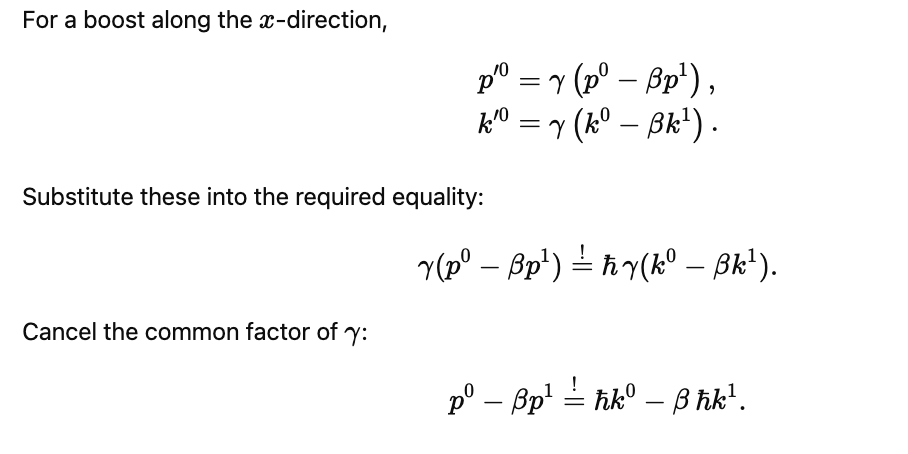
A Lorentz boost mixes the time component with the spatial component along the boost direction. So if you want the relation to remain true in every inertial frame, the spatial parts must match the same way too. The p and k values transform according to the spatial transforms derived here https://mathintuitions.com/2025/01/23/the-lorentz-factor-and-the-invariance-of-relativity/). The Lorentz boosts in time and space, and the invariant, are defined by the following
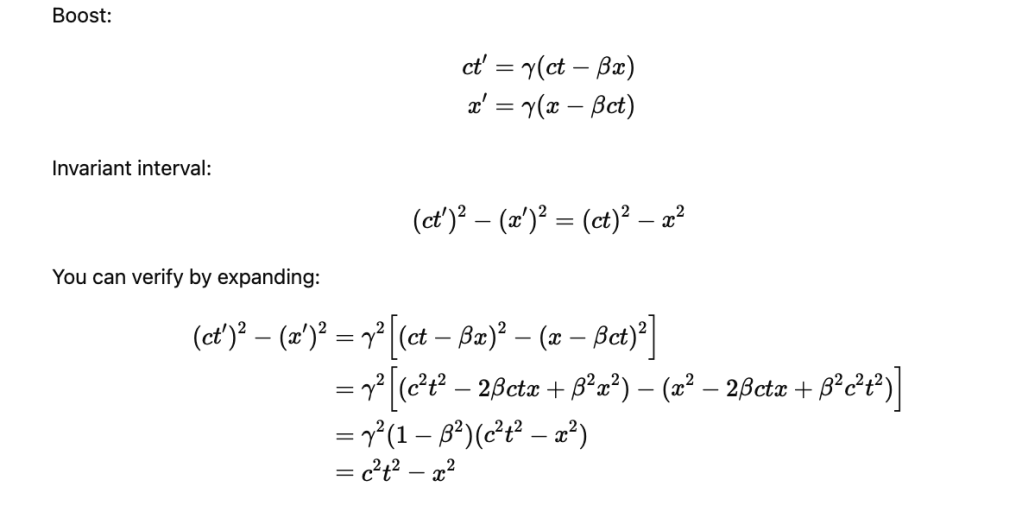
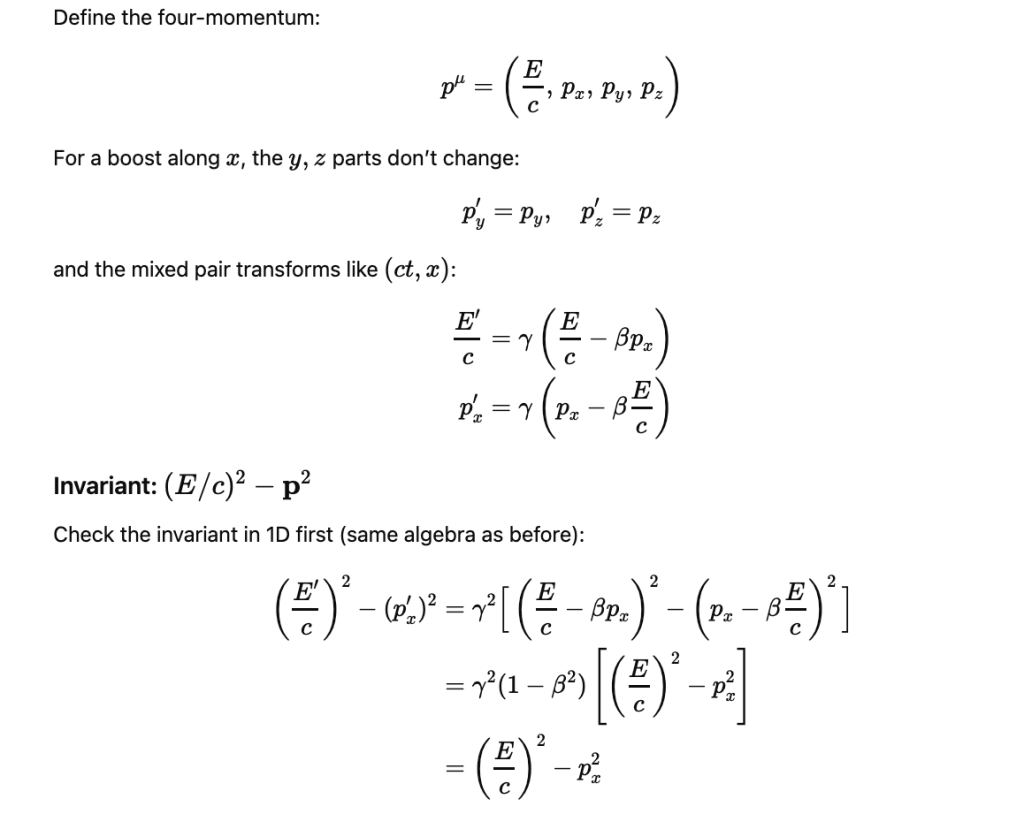
We can see that E/C and p transform the same way as ct and x above in order to arrive at our invariant (E/C)^2 – p^2
:
where and . This is the same result as when we contracted our covariant and contravariant components of p, which by necessity results in a scalar invariant.
Note that our 4 vector k transforms in exactly the same way as E/C and p because of the following:
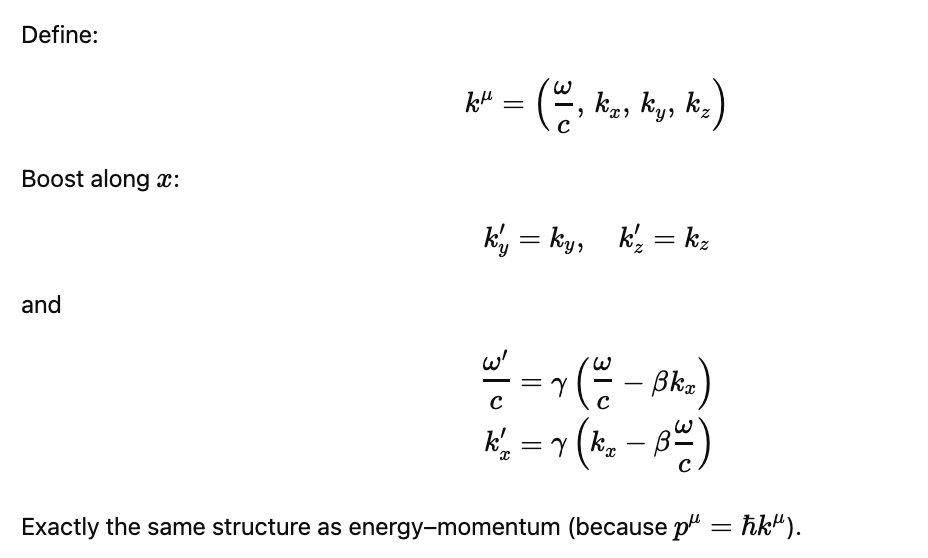
If you were to do the math, the k transform results into an invariant (w/c)^2 -k^2 , which can also be derived by the contraction of the covariant and contravariant components of k, which by necessity results in the scalar invariant above. This scalar means that no matter the frame in the same fashion as as the momentum transform results in our invariant (E/C)^2 -p^2.
Now, you want the same energy–frequency relation to hold in the primed frame. The only way for this to be consistent with Lorentz boosts is the following:
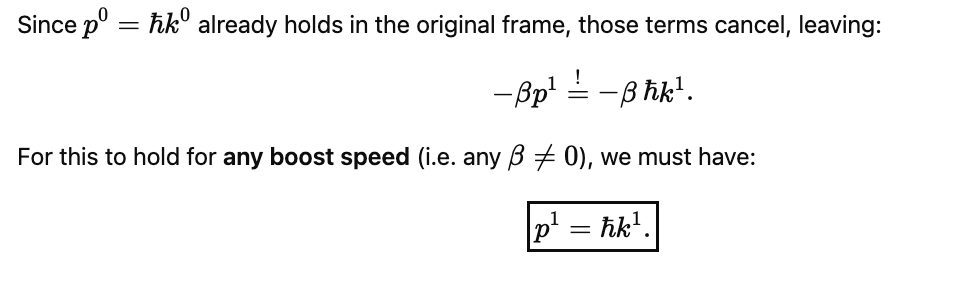
This would then be true for all the p and k components.

 Mathintuitions

