
For a long time I wondered how we can mathematically intuit the fictitious Coriolis Force (title image taken from en.wikipedia.org/wiki/Coriolis_force) . For those unacquainted with this force, the best place to understand it is on a carousel. While riding this carousel, imagine you are on the southern most spot and your friend is on the northern most spot. And, let’s take our imagination for a real spin (sorry, couldn’t avoid the pun): you and your friend do not realize you are actually on a carousel at all! The carousel is spinning counter-clockwise to observers who are not on it and have a bird’s eye view from hundreds of feet above, but to you and your friend, there is no rotation at all. Now, you throw a ball to your friend. He’s a few thousand feet away. Since we’ve already taken great liberties, let’s take one more: the ball has a rocket on it, so that it can actually reach your friend. You throw it perfectly straight, but to you the ball appears to curve further and further to the right so that it completely misses your friend. This is the “fictitious” Coriolis force. It’s fictitious because while the ball seems to be pushed by a mysterious force and accelerate away from the target, the apparent acceleration is only due to a rotating reference frame that isn’t properly accounted for. The following animation from wikipedia is worth a thousand words:

from https://en.wikipedia.org/wiki/Coriolis_force
I searched online for a good mathematical derivation of the Coriolis force that would also be intuitive, but failed to find any, so as any curious amateur mathematician would do, I bought a large expensive textbook called the Physics of the Atmosphere and Climate to access the single eloquent paragraph on the Coriolis Force.
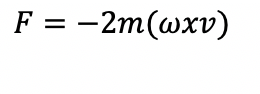
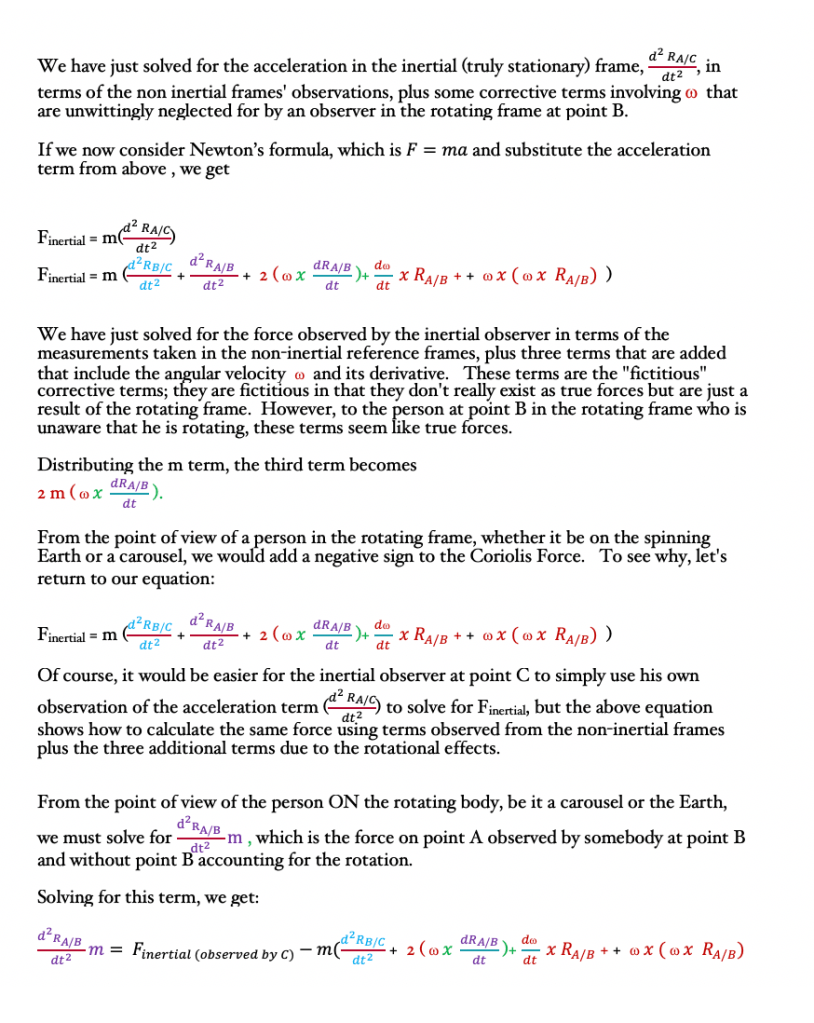
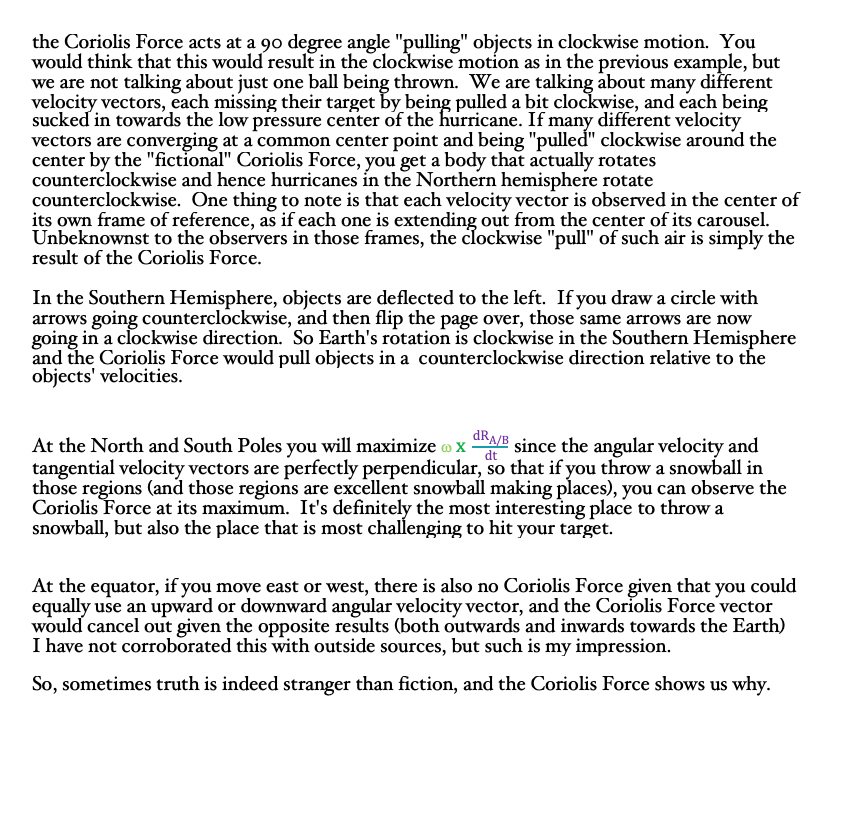
The starting point in my curiosity was in understanding the end result, which is the well-known equation for the fictitious Coriolis Force:
But the bigger question was the following:
Question: How can we understand the mathematical jargon of the Coriolis Force in a deep and intuitive way?
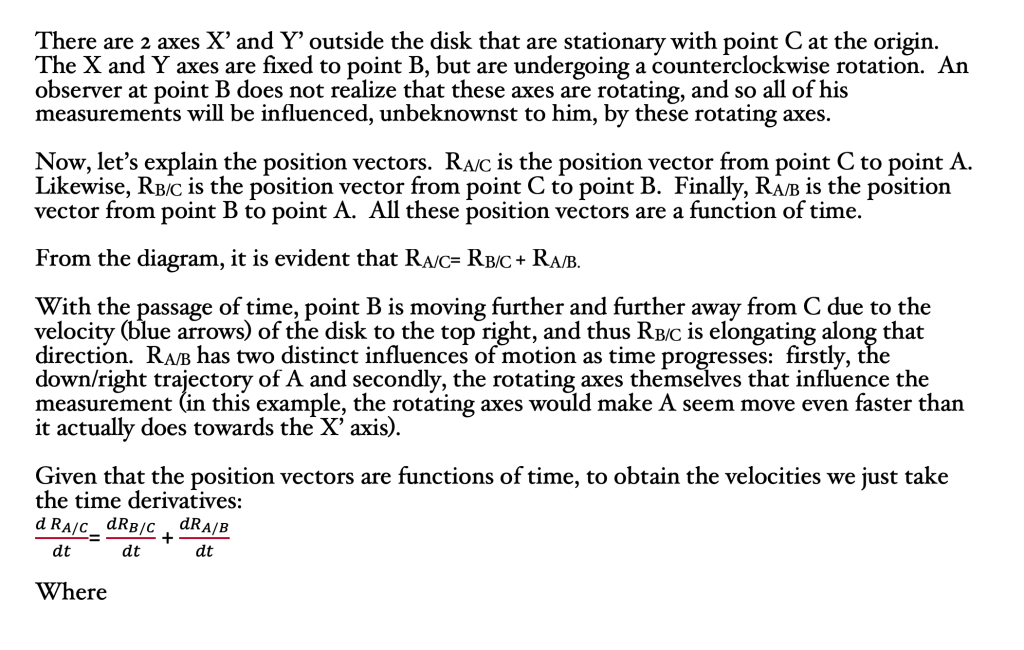
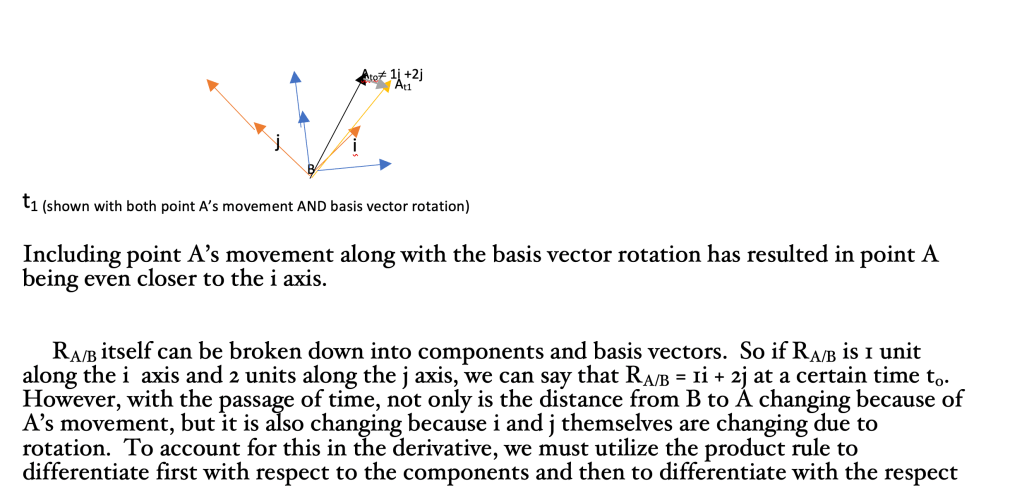
The answer to this question starts with pictures. We must imagine a disk, or carousel, that is spinning counterclockwise with a velocity up and to the right. Point A is moving down and to the right across the disk, point B is stationary on the disk (but rotating counterclockwise with the disk) and point C is outside the disk and completely stationary, or inertial (no velocity, no spinning).








 Mathintuitions
One thought on “Stranger than Fiction: A Derivation of the Coriolis Force to Explain the Path of Hurricanes and Snowballs on Carousels”